
A civic plaza SSID must encrypt public airtime and still force guests through an AUP page. Which statement is most accurate?
Select an answer to reveal the explanation.
Short Explanation
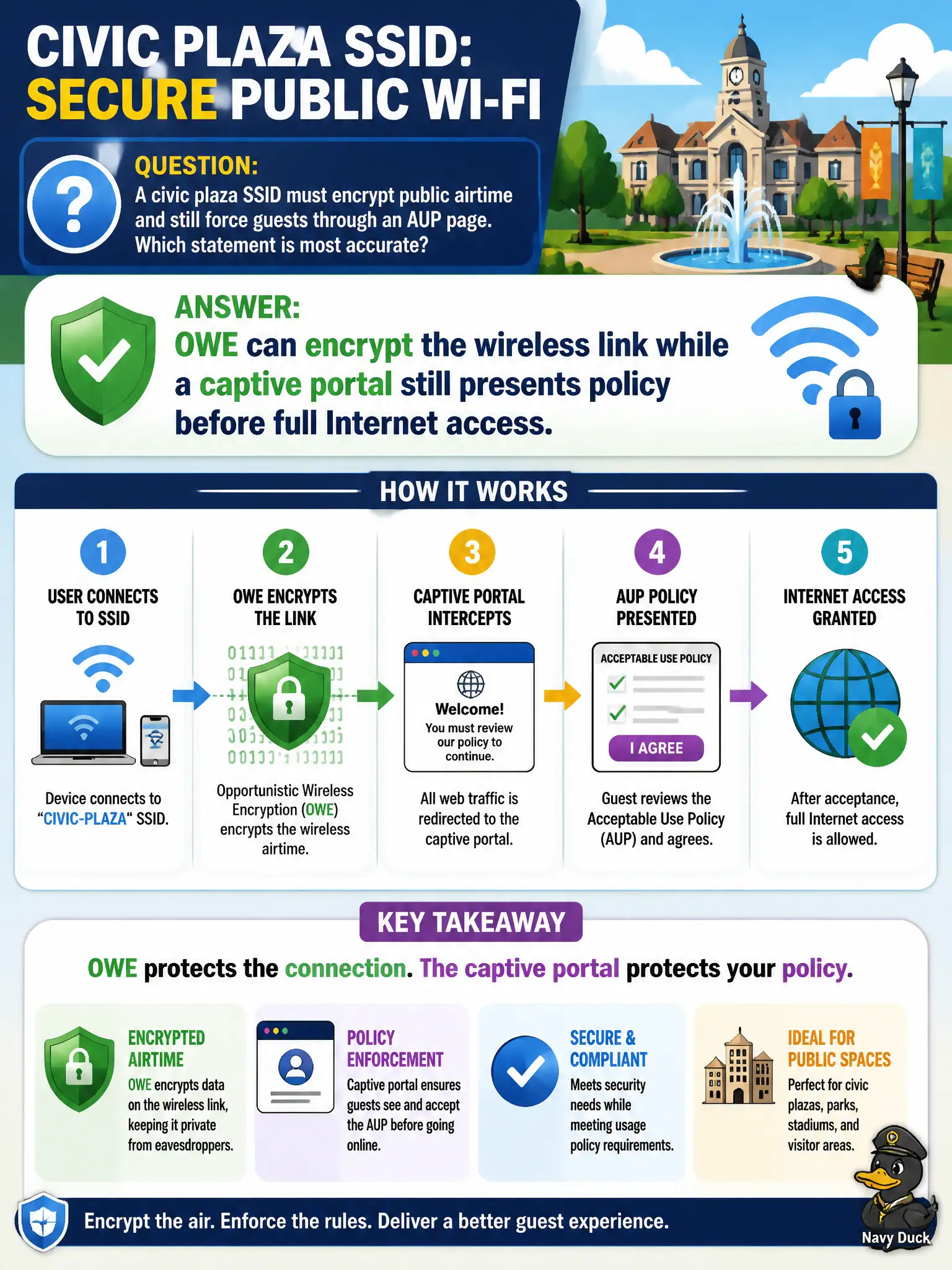
Encryption and the AUP gate solve different jobs: OWE covers the radio path; the portal covers the ‘agree to the rules’ gate. You can have both—privacy curtain plus turnstile—without picking only one.
Full Explanation
For a civic plaza SSID that must encrypt public airtime while enforcing an Acceptable Use Policy (AUP) via a captive portal, Opportunistic Wireless Encryption (OWE) is the most suitable technology. OWE provides encryption of the wireless link without requiring user credentials, thus protecting data confidentiality against passive eavesdropping. Simultaneously, a captive portal can present policy and terms of use before granting full Internet access. This combination balances privacy and access control, allowing guests to benefit from encrypted communication while still acknowledging the AUP. The misconception that OWE and captive portals are mutually exclusive is incorrect; OWE operates at the link layer to encrypt traffic, while captive portals function at the network layer to enforce access policies. WEP is outdated and insecure, and it cannot reliably support captive portals on open SSIDs. The idea that captive portals replace encryption misunderstands their roles; portals control access but do not provide encryption. The limitation is that OWE only protects against passive attacks and does not authenticate users, so it should be combined with network-layer controls like captive portals. To verify, ensure the SSID uses OWE encryption and that users are redirected to a captive portal page before accessing the Internet.