
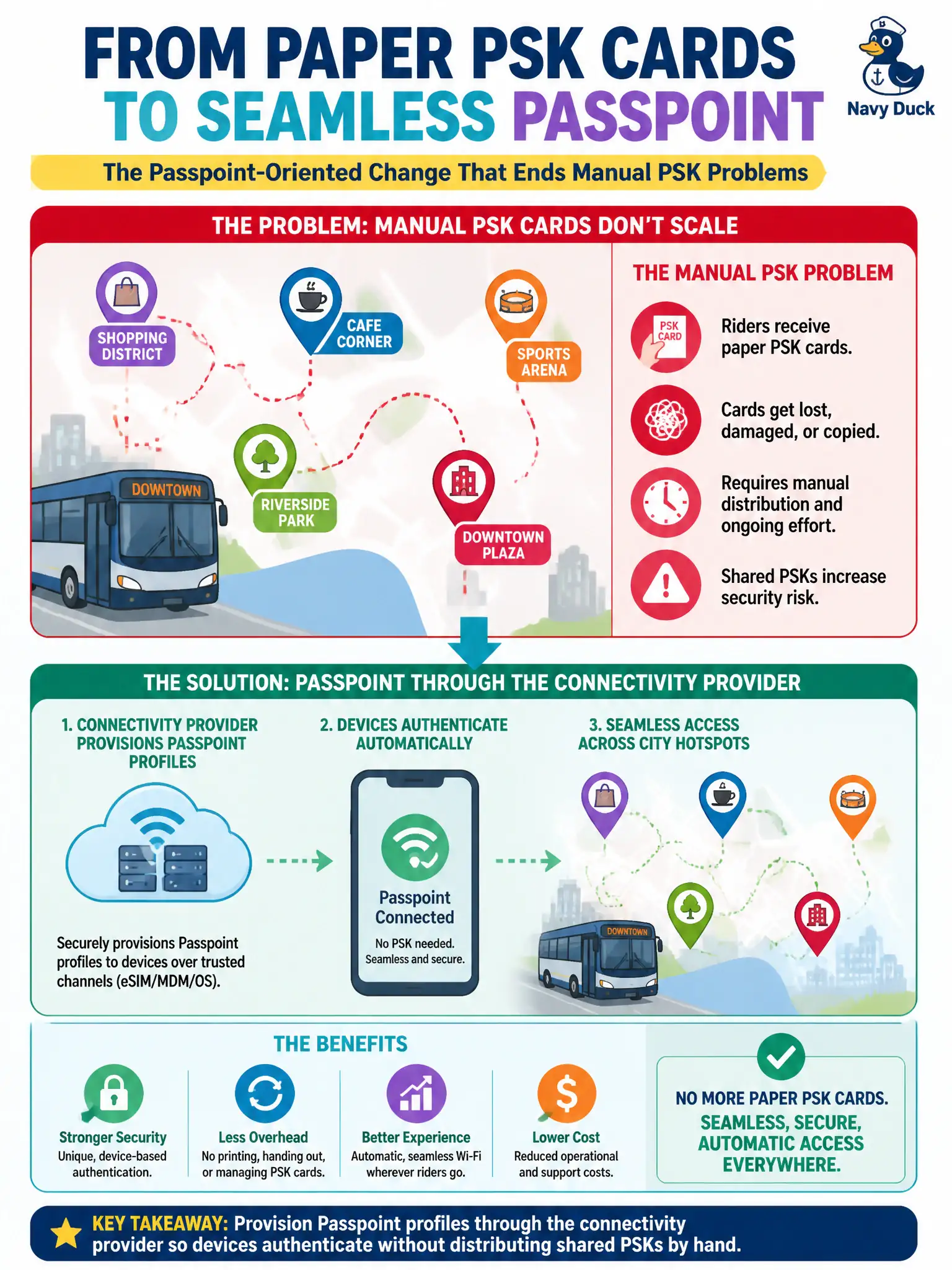
Regional transit riders roam across city hotspots and still receive paper PSK cards. Which Passpoint-oriented change best reduces that manual credential problem?
Select an answer to reveal the explanation.
Short Explanation
Passpoint profiles are like a monthly transit pass loaded on the phone—no more sticky notes with the Wi-Fi password. Longer paper PSKs still mean someone has to hand out and rotate secrets at every hotspot.
Full Explanation
When regional transit riders roam across multiple city hotspots and rely on paper-distributed pre-shared keys (PSKs), managing and distributing credentials manually becomes cumbersome and error-prone. The best Passpoint-oriented solution is to provision Passpoint profiles through the connectivity provider, enabling devices to authenticate automatically without manual PSK distribution. Passpoint (Hotspot 2.0) uses EAP-based authentication and profile provisioning, allowing seamless and secure roaming across participating hotspots. This approach eliminates the need for physical PSK cards, reduces administrative overhead, and improves user experience by enabling automatic network selection and connection. Printing longer PSKs on cards only marginally increases security but does not address the fundamental problem of manual distribution and user inconvenience. Switching every hotspot to open authentication removes authentication entirely, exposing users to security risks and network abuse. Replacing Passpoint with static WEP keys burned into devices is insecure and obsolete, as WEP is vulnerable to attacks and lacks modern security features. The caveat is that Passpoint requires compatible client devices and infrastructure support, but it remains the preferred method for scalable, secure public Wi-Fi credential management. Operationally, confirm that devices receive Passpoint profiles from the provider and connect automatically without manual credential input.