
In a court-house WLAN design workshop, staff confuse PMK, PTK, and GTK roles. Which statement correctly maps the key hierarchy concepts?
Select an answer to reveal the explanation.
Short Explanation
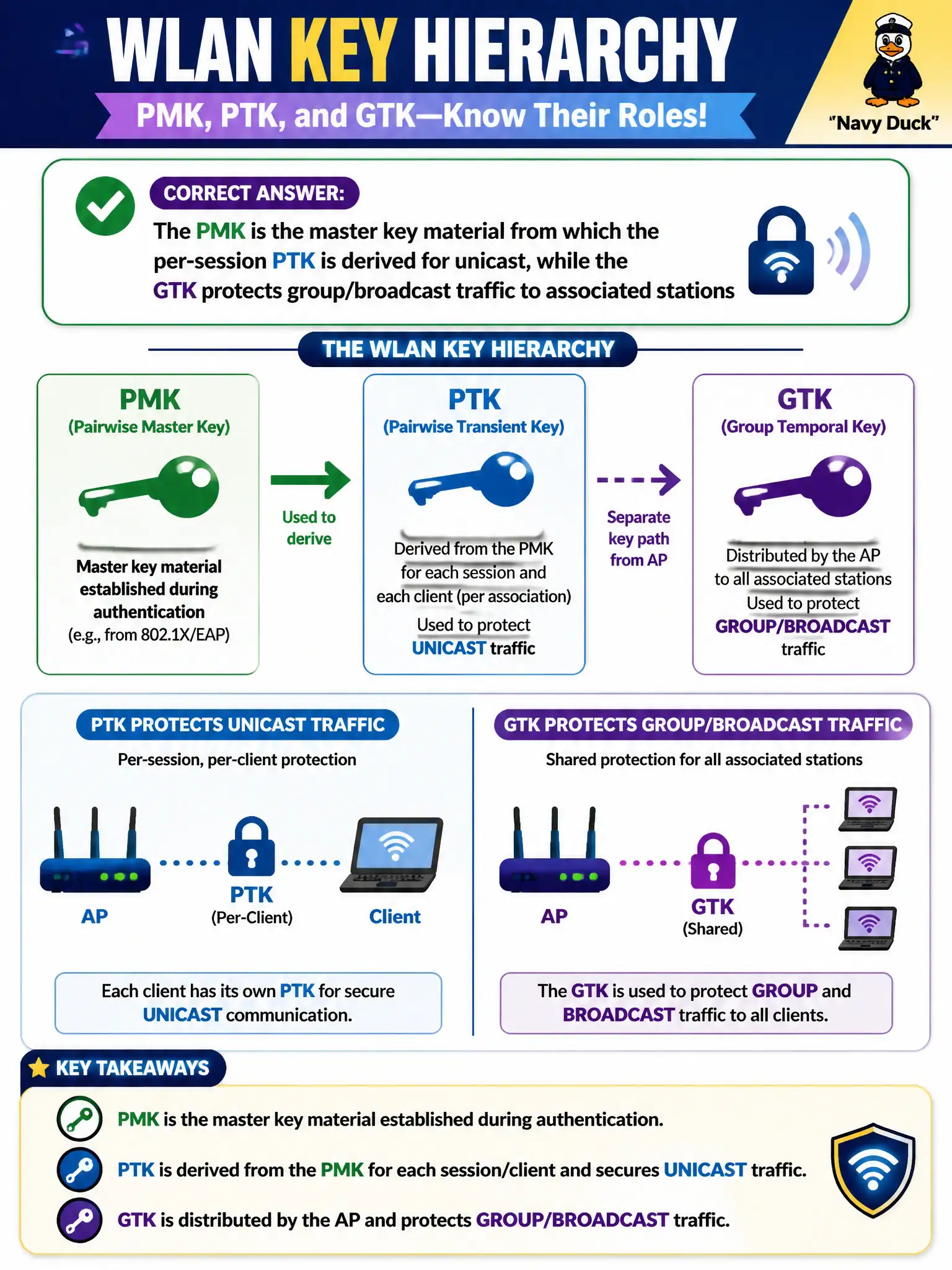
PMK is the master dough; PTK is the personal loaf for your unicast chat with the AP; GTK is the shared basket for group/broadcast bites. Mix those labels and troubleshooting becomes a food fight.
Full Explanation
In a courthouse WLAN workshop, the PMK is master key material from which the per-session PTK is derived for unicast protection, while the GTK protects group and broadcast traffic to associated stations. Keeping that hierarchy straight lets staff reason about rekey events, roam failures, and why one client’s unicast can work while broadcast video or group-addressed management helpers fail. Municipal design notes should use these names precisely rather than treating “the Wi-Fi key” as a single blob. The GTK does not encrypt only EAPOL-Start frames while the PMK encrypts broadcast video end-to-end across the Internet—that mixes link keying with unrelated application transport. The PTK is not a long-lived master shared by every station on the SSID, and the PMK is not freshly derived per broadcast frame; those roles are reversed relative to standard RSN hierarchy teaching. The three names are not identical keys rewritten three times in the beacon for redundancy. Exam caveat: vendor dashboards sometimes show only “encrypted” without naming PMK/PTK/GTK—escalate to protocol captures when hierarchy confusion blocks an outage bridge. Operational check: during a courthouse lab association, identify where the PMK is established (PSK or 802.1X), confirm PTK installation after the 4-way handshake, then force a group rekey and verify GTK update without unnecessarily tearing down every pairwise session.