
Campus Wi-Fi engineers debate two different knobs while migrating city buildings to stronger AKM: WPA3 Transition Mode versus RSN Override. How should a CWSP candidate distinguish them at a conceptual level?
Select an answer to reveal the explanation.
Short Explanation
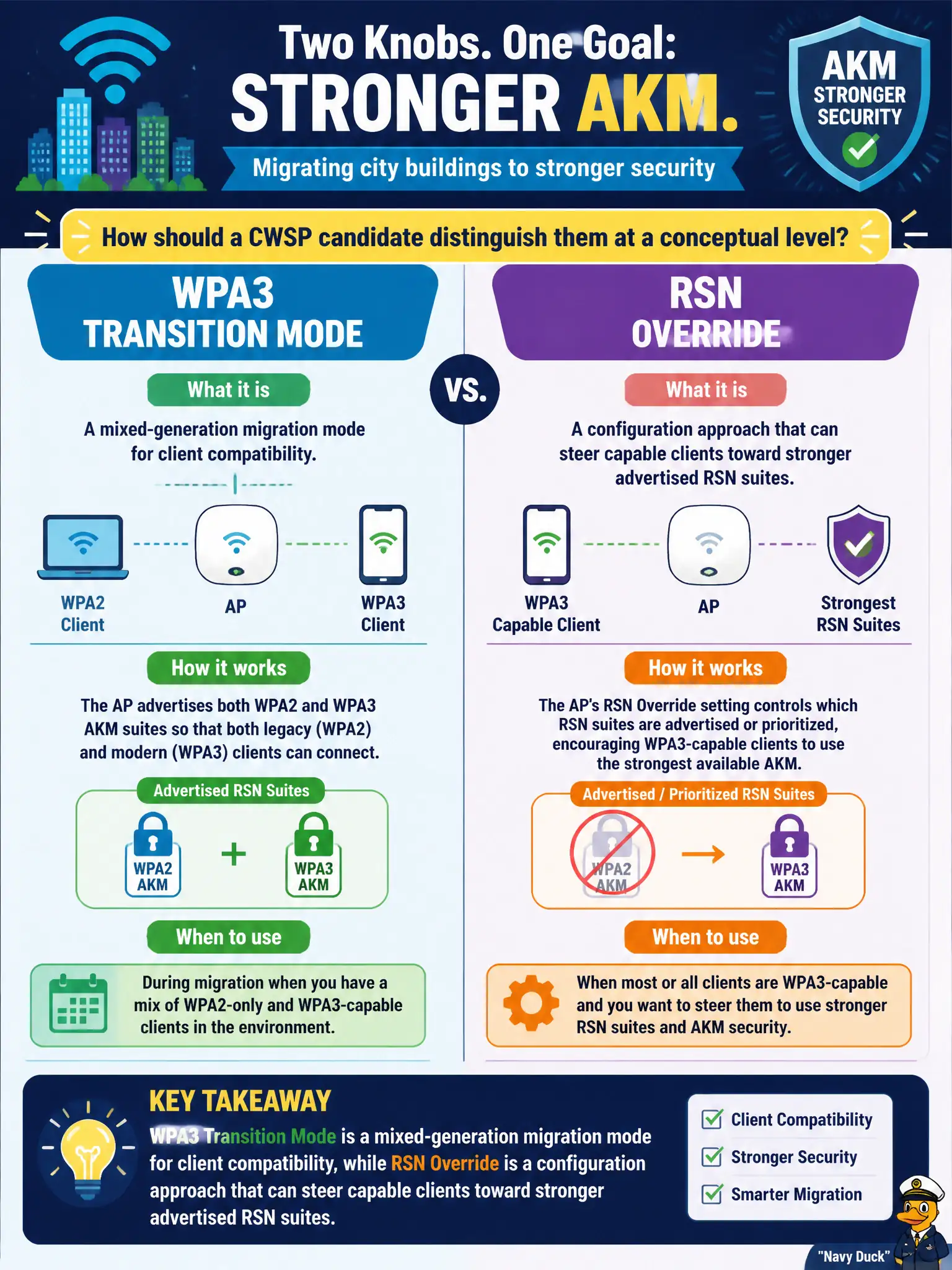
Transition Mode is the temporary “old and new cars in the same garage” setting. RSN Override is more like posting a stronger preferred lock list so capable clients don’t settle for the rusty spare. Related migration talk, different jobs.
Full Explanation
Campus engineers migrating city buildings to stronger AKM must distinguish WPA3 Transition Mode from RSN Override at a conceptual level. WPA3 Transition Mode is a mixed-generation migration mode that preserves client compatibility by allowing older and newer AKM suites during cutover. RSN Override is a configuration approach that can steer capable clients toward stronger advertised RSN suites so they do not unnecessarily settle on weaker negotiated options in a mixed environment. Related migration vocabulary, different jobs. They are not vendor synonyms for disabling all pairwise ciphers on open SSIDs. RSN Override is not limited to wired 802.1X switchports with no effect on WLAN beacons; the concept matters for wireless RSN advertisement and client selection. WPA3 Transition Mode is not exclusively an FT over-the-DS roaming timer unrelated to AKM suites. Exam caveat: vendor names and knobs vary—evaluate the actual beacon result (which suites appear, which clients choose) rather than assuming a marketing label guarantees stronger outcomes. Operational check: in a lab BSS, compare client negotiated AKM/cipher with Transition Mode alone versus with RSN Override steering enabled, using both legacy and modern municipal test clients, and document which combination matches policy.