
Fire-station tablets use 802.11r while paramedics move through the apparatus bay. At a conceptual AKM/roaming level, how do FT over-the-air and FT over-the-DS differ?
Select an answer to reveal the explanation.
Short Explanation
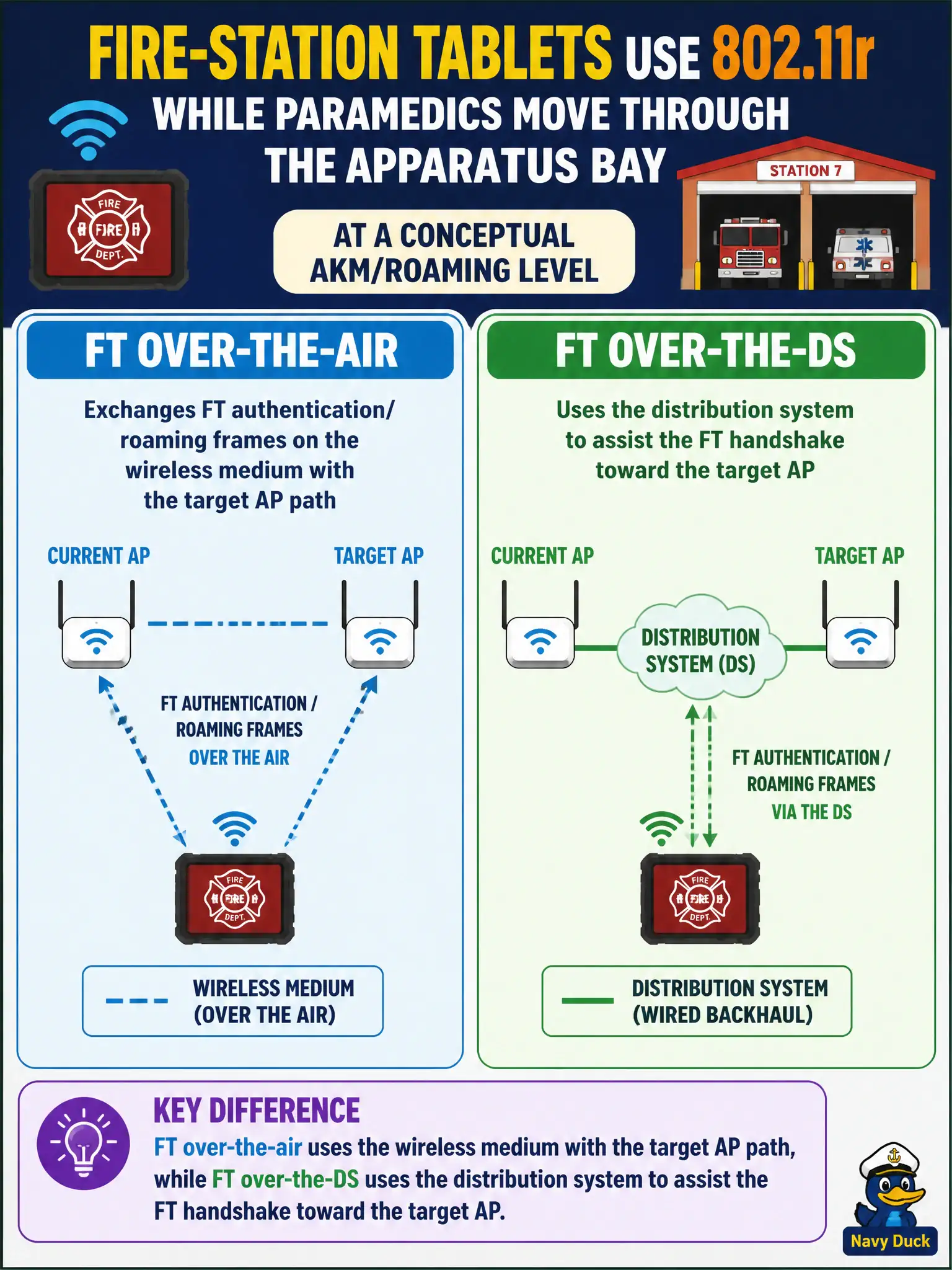
Over-the-air FT talks to the next AP across the RF sidewalk. Over-the-DS FT uses the wired back-alley (distribution system) to help the handshake along. Same FT family, different paths for the paperwork.
Full Explanation
Fire-station tablets using 802.11r while paramedics move through the apparatus bay illustrate two FT paths: over-the-air versus over-the-DS. FT over-the-air exchanges FT authentication and roaming frames on the wireless medium toward the target AP path. FT over-the-DS uses the distribution system to assist the FT handshake toward the target AP. Same fast-transition family and key hierarchy goals, different paths for completing the secure roam paperwork when seconds matter in the bay. Over-the-air FT does not send only captive-portal cookies, and over-the-DS FT does not send only DHCP renewals. Neither mode disables encryption during roam and restores it after voice admission control as a normal design. Over-the-DS FT is not identical to OKC and devoid of an FT key hierarchy; OKC and FT are related mobility concepts that must not be casually synonymized away on an exam. Exam caveat: client drivers and AP modes must agree on which FT method is enabled, or roams fall back to slower full authentication and produce intermittent voice or CAD drops. Operational check: enable one FT method at a time on a bay test SSID, roam a representative tablet between APs, and capture whether FT frames traverse the air path or are assisted via the DS while session continuity meets the fire-department mobility requirement.