
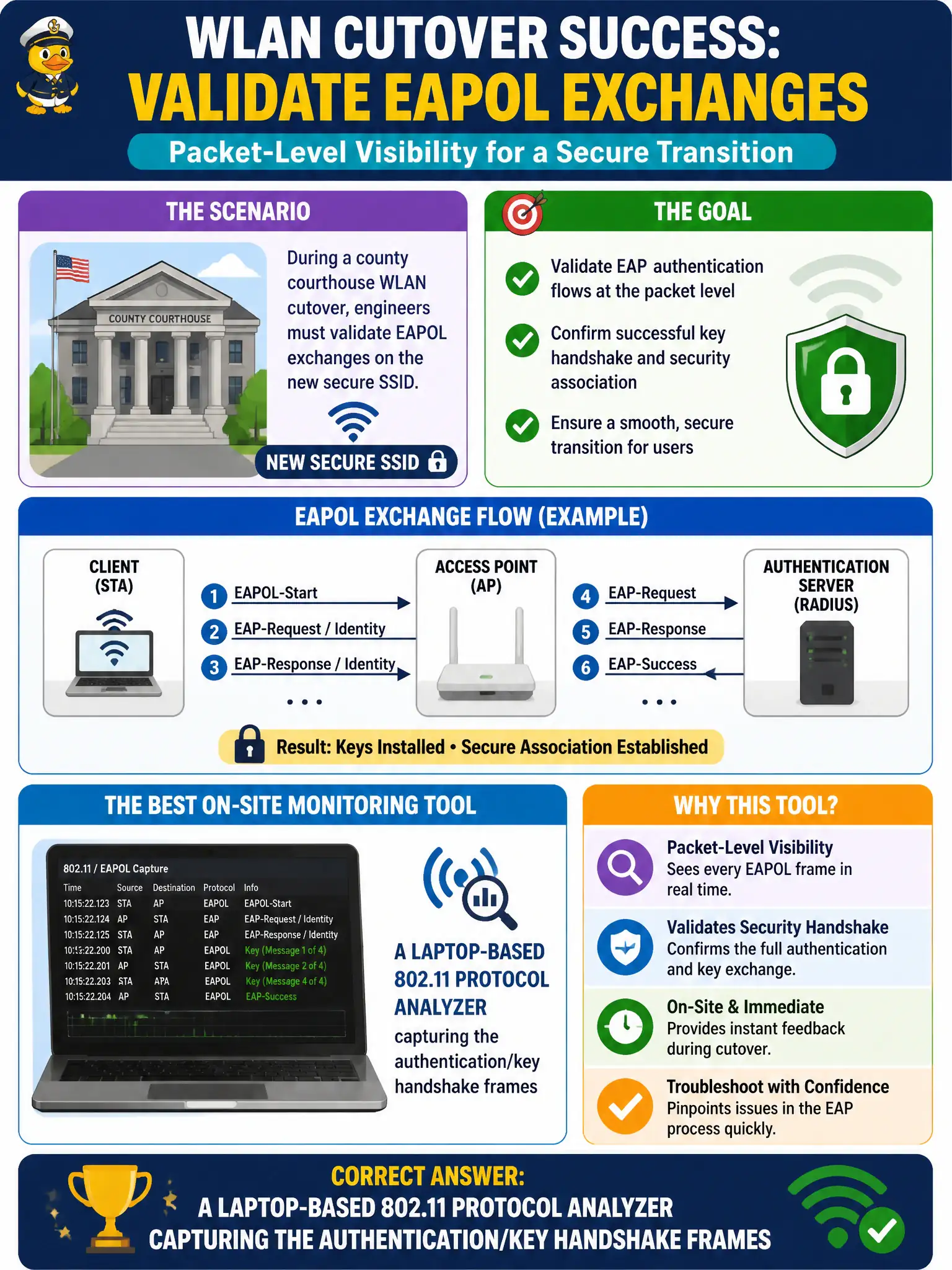
During a county courthouse WLAN cutover, engineers must validate EAPOL exchanges on the new secure SSID. Which on-site monitoring tool best fits that packet-level check?
Select an answer to reveal the explanation.
Short Explanation
EAPOL is a conversation of frames—you need a protocol analyzer that speaks 802.11, usually on a laptop kit at cutover. Spectrum tools see energy, not EAP handshakes; power and HVAC logs are unrelated. Bring the right sniffer for the job.
Full Explanation
Validating EAPOL exchanges during a county courthouse WLAN cutover to a new secure SSID requires a laptop-based 802.11 protocol analyzer that can capture authentication and key-handshake frames. Engineers need to observe EAPOL-Key messages and related management frames to confirm AKM and cipher negotiation completed as designed for judges’, clerks’, and staff devices. Packet-level evidence is the appropriate on-site tool for security cutover sign-off when the question is whether the handshake worked, not merely whether a ping later succeeded. A UPS runtime meter on the IDF power strip speaks only to electrical endurance. A spectrum analyzer alone without frame decode capability shows RF energy, not EAPOL success or failure codes. An HVAC thermostat log export is irrelevant to 802.11 authentication validation and wastes cutover time. Exam caveat: analyzer adapters, driver support, and channel/width settings must match the BSS channel plan, or the capture will miss the handshake entirely and produce false confidence. Operational check: during the cutover pilot, capture a successful staff authentication on the new SSID, archive the EAPOL sequence with the change record, and retain a failing-client capture template for comparison when the help desk escalates association problems.