
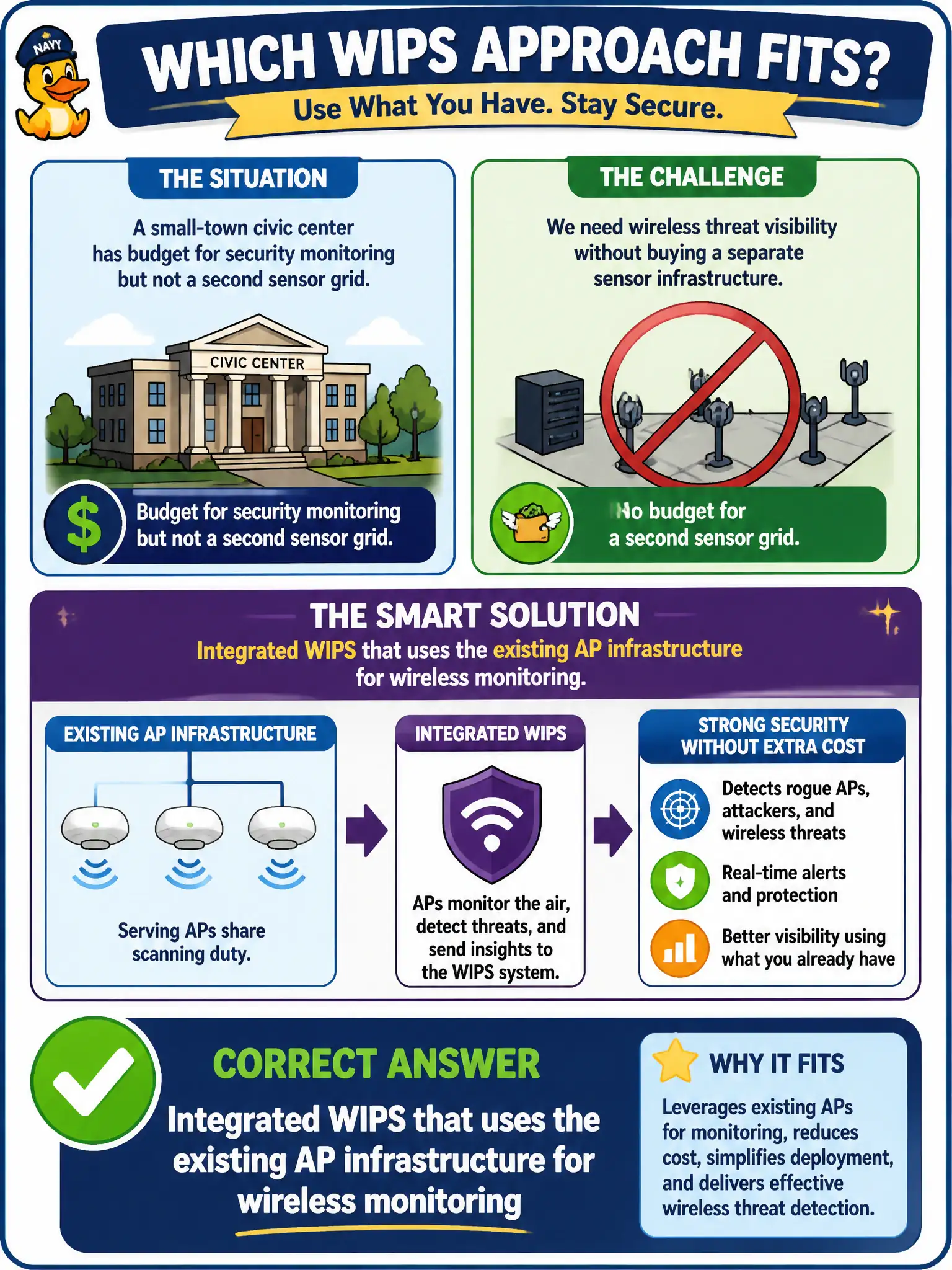
A small-town civic center has budget for security monitoring but not a second sensor grid. Serving APs can share scanning duty. Which WIPS approach fits?
Select an answer to reveal the explanation.
Short Explanation
When the budget will not buy a second forest of sensors, integrated WIPS lets the serving APs moonlights as monitors. It is the practical civic-center choice—imperfect versus overlay, but real monitoring beats a lucky SSID name. Match the architecture to the purse without skipping security entirely.
Full Explanation
A small-town civic center with budget for security monitoring but not a second full sensor grid is a practical fit for integrated WIPS that uses existing AP infrastructure for wireless monitoring. Serving APs and their controller analytics share scanning duty so the municipality still gains rogue and threat visibility without funding overlay hardware in every closet. The design accepts some off-channel tradeoffs in exchange for real monitoring rather than relying on hope or branding. Insisting on overlay-only sensors in every closet regardless of the stated budget constraint may delay any monitoring deployment at all. Trusting an SSID name such as “CivicSecure” as attacker deterrence is not a control. Replacing WIPS with daily manual reboot of all APs is unrelated to continuous wireless threat detection and creates unnecessary service disruption for patrons. Exam caveat: integrated scanning can reduce client airtime if off-channel dwell is aggressive—tune scan duty cycles against civic-center voice, streaming, and ticket-kiosk performance needs. Operational check: enable integrated WIPS features on the civic-center AP group, inject a controlled test rogue during a maintenance window, and verify detection and alerting while measuring whether critical client metrics stay acceptable for evening events.