
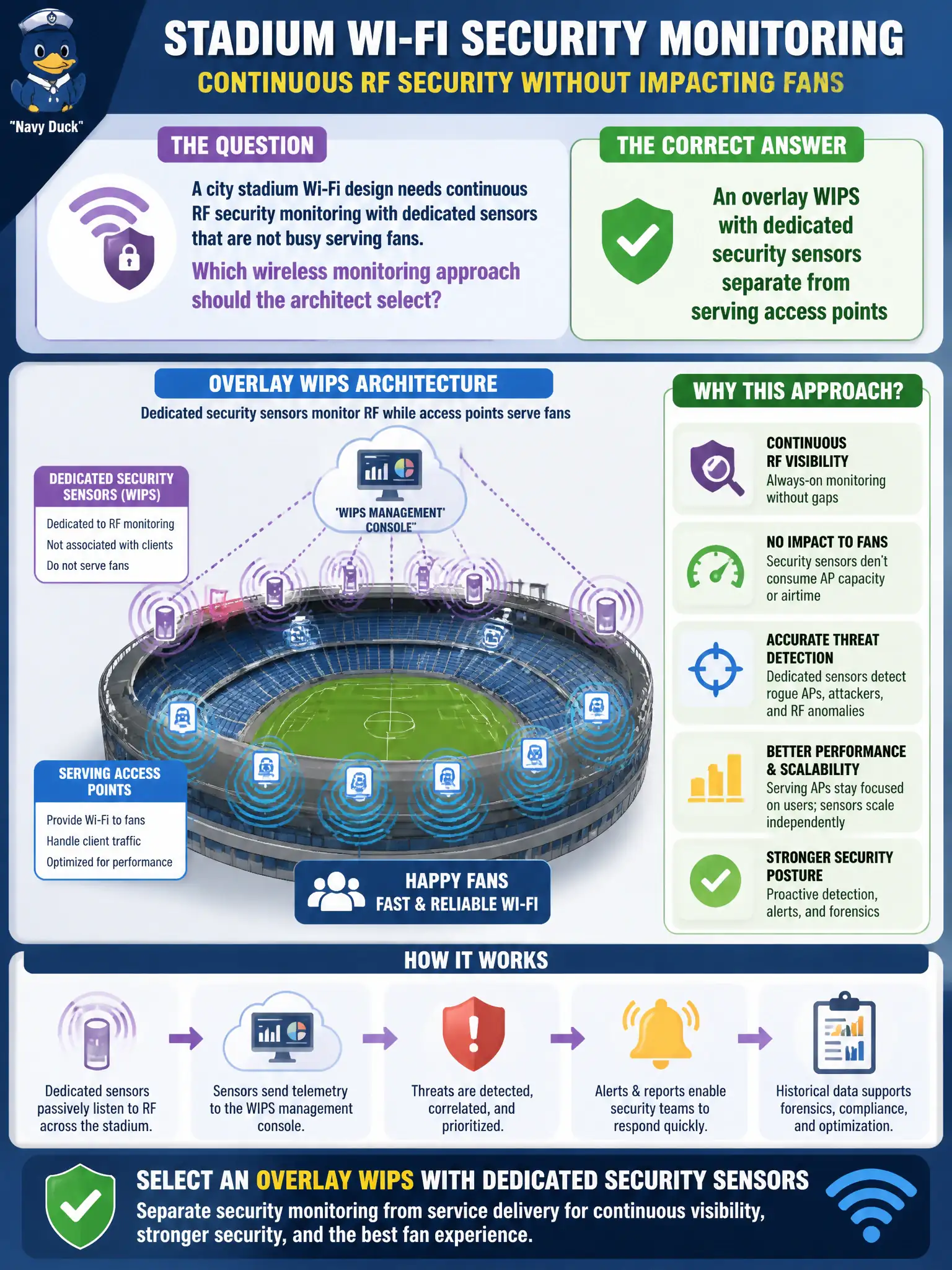
A city stadium Wi-Fi design needs continuous RF security monitoring with dedicated sensors that are not busy serving fans. Which wireless monitoring approach should the architect select?
Select an answer to reveal the explanation.
Short Explanation
Serving APs are busy pouring Wi-Fi to the crowd; overlay sensors are the dedicated security cameras watching the RF. Stadium-grade monitoring that cannot miss off-channel threats picks overlay WIPS. Uptime SNMP and tweet sentiment are not rogue detection.
Full Explanation
A city stadium Wi-Fi design that needs continuous RF security monitoring with sensors not busy serving fans should select an overlay WIPS with dedicated security sensors separate from serving access points. Overlay sensors can dwell off-channel and watch for rogues, evil twins, ad-hoc bridges, and other wireless threats while serving radios stay focused on client performance in a high-density spectator environment. That separation is a classic CWSP monitoring architecture choice when airtime and security scanning would otherwise compete. SNMP polling of switch uptime only proves wired device liveness and cannot decode RF threat behavior in the stands. Relying only on fan complaints in social media is not a Wireless Intrusion Prevention System and provides neither timely detection nor forensic RF context. Disabling all scanning to maximize client airtime abandons rogue visibility precisely when a crowded venue most attracts spoofing and interference. Exam caveat: overlay adds cost plus mounting, power, and RF planning for sensors—those constraints must be in the stadium design package, not deferred until after opening day. Operational check: during a load test or event rehearsal, confirm dedicated sensors continue multi-channel scanning and alert on a deliberate test rogue SSID while serving AP client capacity and latency remain within the published SLA.