
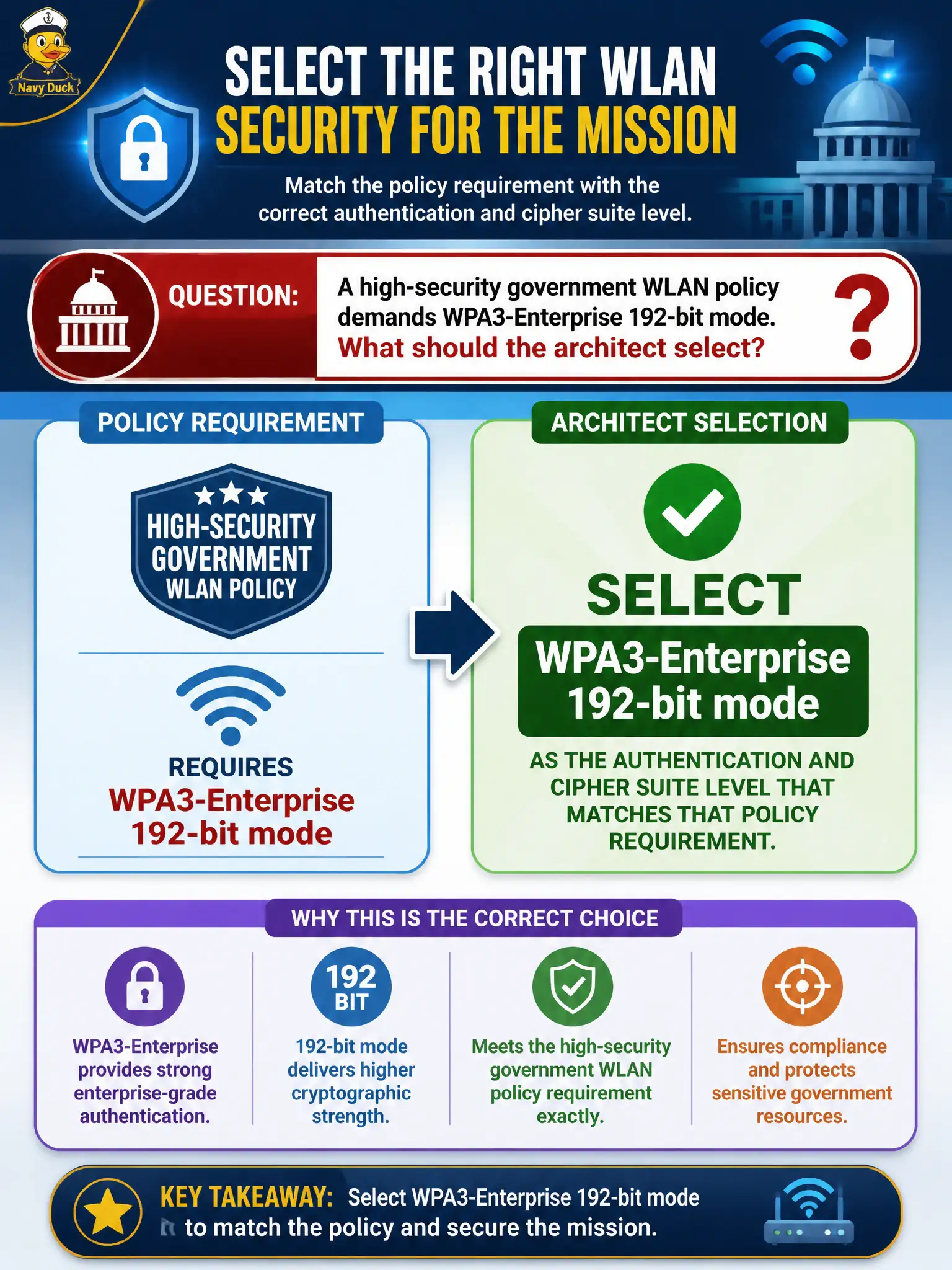
A high-security government WLAN policy demands WPA3-Enterprise 192-bit mode. What should the architect select?
Select an answer to reveal the explanation.
Short Explanation
When the policy says WPA3-Enterprise 192-bit, that is the knob—not a long personal PSK or an open OWE guest trick. Match the suite the mandate named. WEP is the opposite direction.
Full Explanation
A high-security government WLAN policy that demands WPA3-Enterprise 192-bit mode requires selecting that authentication and cipher suite level—not substitutes. WPA2-Personal with a long PSK is not an equivalent 192-bit enterprise substitute. Open Enhanced/OWE does not meet 192-bit enterprise mandates. WEP-104 fails both modernity and policy. Exam caveat: 192-bit mode is a specific WPA3-Enterprise suite alignment; do not equate any strong-looking Personal passphrase or OWE open enhancement with that policy control. Operational check: verify APs, controllers, and clients advertise and negotiate the required 192-bit suites, stage a pilot SSID, and only then mandate citywide. Capture capability matrices in the government WLAN architecture package before the policy enforcement date. In municipal WLAN operations, record the rationale in the change ticket so future on-call staff know which control was chosen and which failure modes the rejected options would create for city services. Re-validate after the next maintenance window that the same control still holds under the infrastructure versions and client fleets used by the civic environment. Treat this decision as part of the CWSP security lifecycle: identify the requirement, select the control, verify in a pilot, monitor for drift, and audit evidence on a recurring municipal cadence rather than assuming a one-time configuration change remains correct indefinitely.