
A civic WLAN design requires port-based network access control for Wi-Fi clients. Which framework provides that model?
Select an answer to reveal the explanation.
Short Explanation
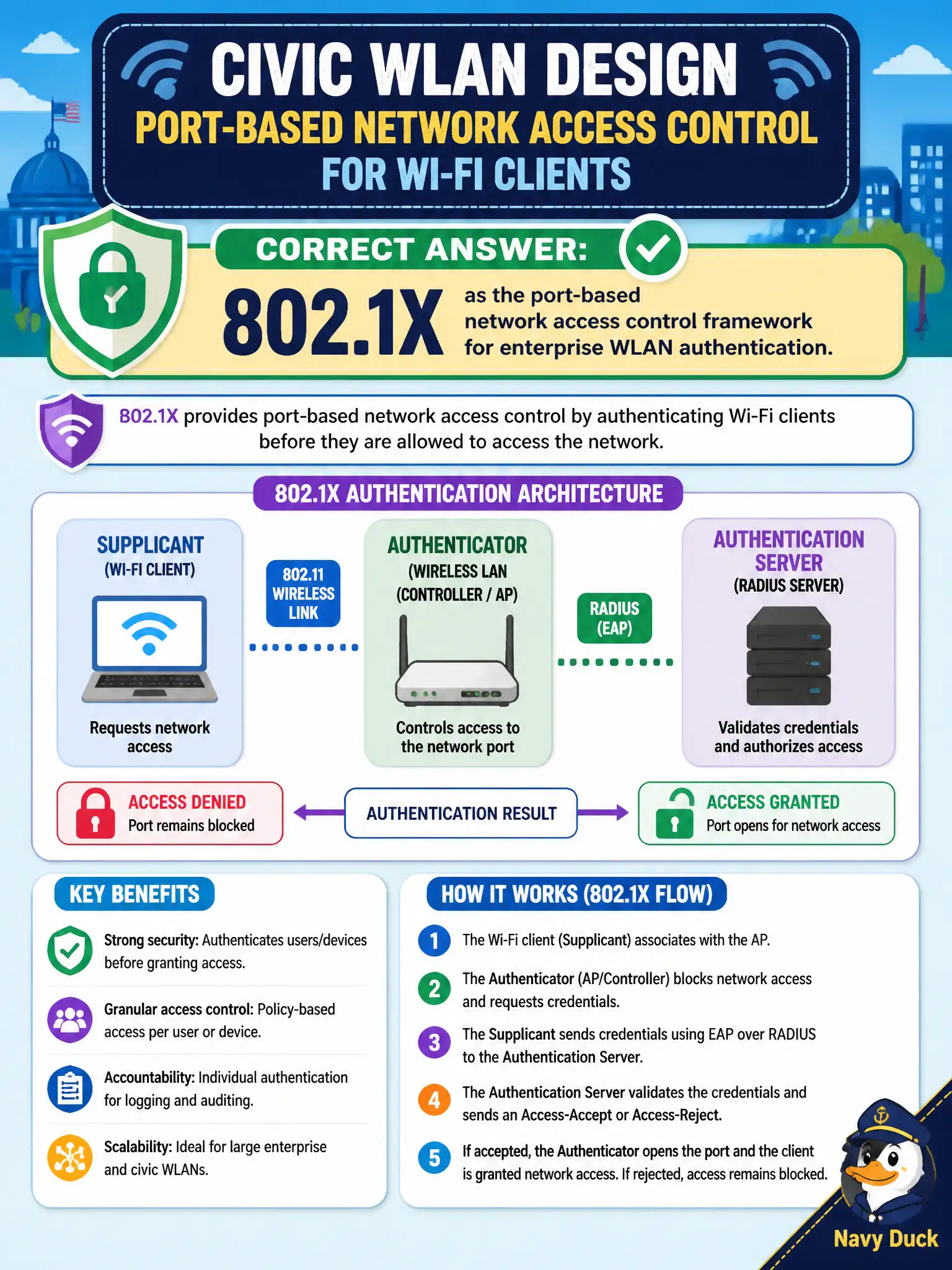
Port-based access control on Wi-Fi is the 802.1X story—supplicant, authenticator, authentication server—not a WEP calendar or a Bluetooth PIN remix. If the design calls for that gate, name 802.1X. Everything else is a side quest.
Full Explanation
Port-based network access control for Wi-Fi clients is provided by 802.1X as the framework for enterprise WLAN authentication, working with EAP methods and AAA to gate access at the association/authentication boundary. Static WEP key rotation without an authentication exchange is deprecated crypto, not port-based NAC. Uncontrolled open association with DNS sinkholes alone is not 802.1X. Bluetooth pairing PINs reused as 802.11 pairwise keys are unrelated to the 802.1X model. Exam caveat: 802.1X is the framework; EAP is the method family; RADIUS is the common AAA transport—keep those layers distinct on CWSP design items. Operational check: confirm civic SSIDs intended for staff use 802.1X, validate RADIUS reachability, and test that failed authentication yields no network access. Record framework/method/AAA selections in the municipal enterprise WLAN design record for auditors and future engineers. In municipal WLAN operations, record the rationale in the change ticket so future on-call staff know which control was chosen and which failure modes the rejected options would create for city services. Re-validate after the next maintenance window that the same control still holds under the infrastructure versions and client fleets used by the civic environment.