
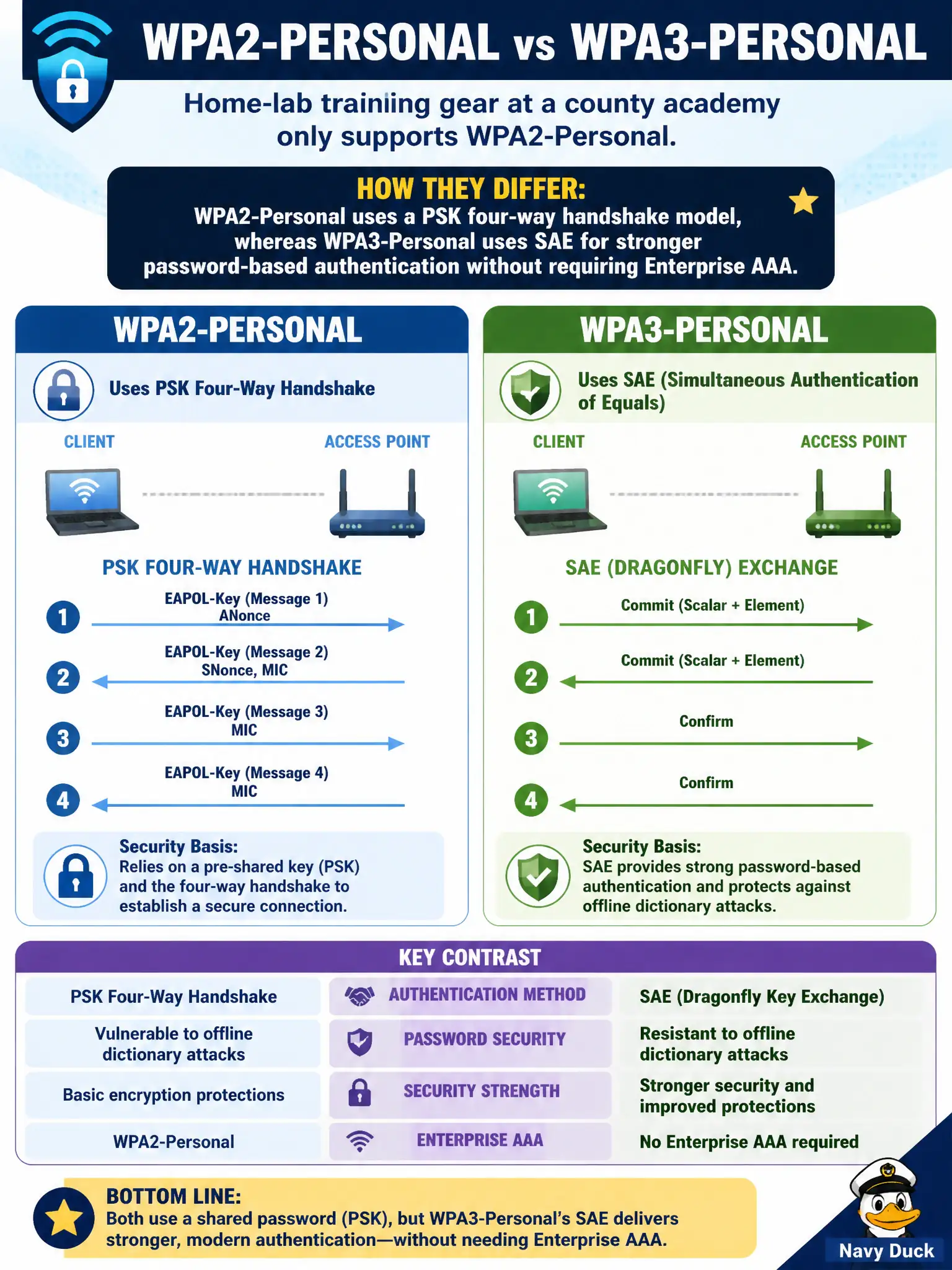
Home-lab training gear at a county academy only supports WPA2-Personal. How should instructors contrast it with WPA3-Personal?
Select an answer to reveal the explanation.
Short Explanation
WPA2-Personal is the familiar shared-password handshake; WPA3-Personal swaps in SAE so guessing games and some offline cracks get harder—still no RADIUS required. Teaching that contrast keeps academy labs honest about what the old gear can and cannot do. They are not the same sticker with different paint.
Full Explanation
Instructors contrasting home-lab WPA2-Personal gear with WPA3-Personal should teach that WPA2-Personal uses a PSK four-way handshake model vulnerable to offline dictionary attacks against captured handshakes, whereas WPA3-Personal uses SAE for stronger password-based authentication without requiring Enterprise AAA. They are not identical; SAE is a material AKM change. WPA3-Personal does not require RADIUS. WPA2-Personal does not default to GCMP-256 192-bit enterprise suites. Exam caveat: Personal versus Enterprise is orthogonal to WPA2 versus WPA3 generations—SAE is Personal-mode WPA3, while 192-bit mode is an Enterprise high-assurance suite. Operational check: demonstrate a lab capture of a WPA2-PSK handshake versus an SAE exchange on academy gear, show why offline cracking narratives differ, and quiz staff before they deploy county field SSIDs. Keep the lesson in the municipal wireless training curriculum for new network hires. In municipal WLAN operations, record the rationale in the change ticket so future on-call staff know which control was chosen and which failure modes the rejected options would create for city services. Re-validate after the next maintenance window that the same control still holds under the infrastructure versions and client fleets used by the civic environment.