
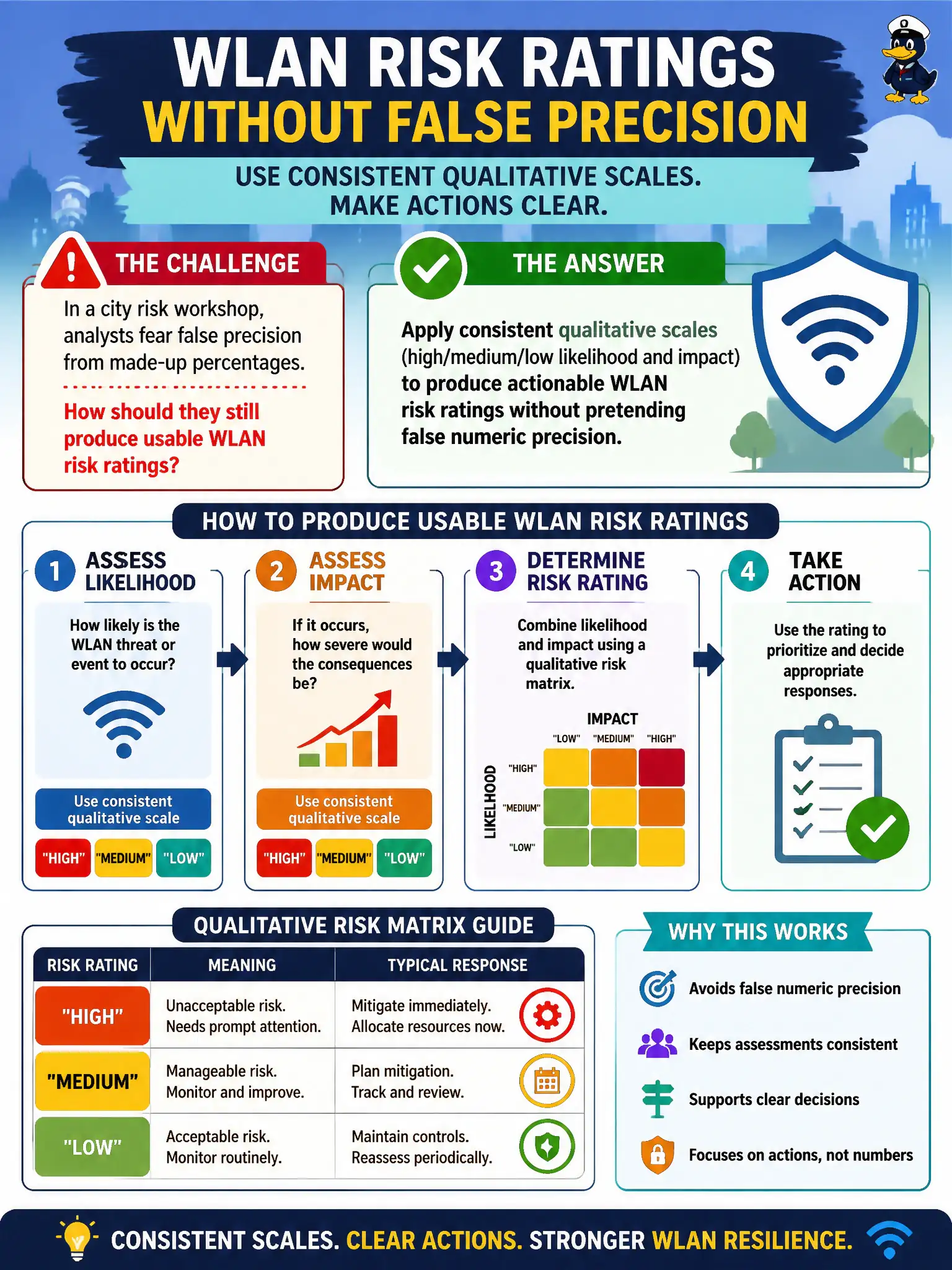
In a city risk workshop, analysts fear false precision from made-up percentages. How should they still produce usable WLAN risk ratings?
Select an answer to reveal the explanation.
Short Explanation
You do not need fake decimal odds to decide what to fix first—high/medium/low done consistently still moves the queue. Waiting for perfect actuarial purity parks the WLAN in limbo. Usable beats pretend precision.
Full Explanation
City risk workshops that fear false precision should still produce usable WLAN risk ratings by applying consistent qualitative scales such as high/medium/low likelihood and impact, without inventing six-decimal probabilities. Abandoning all ratings until perfect actuarial models arrive freezes decisions. Inventing false numeric precision is worse than honest qualitative scales. Rating only risks with published insurance premiums ignores most operational WLAN threats municipalities actually face. Exam caveat: qualitative risk ratings are acceptable and expected when quantitative data is thin—consistency matters more than spurious precision. Operational check: adopt a written H/M/L matrix for WLAN findings, calibrate examples with the workshop, score the backlog, and publish the method beside the ratings. Revisit calibration yearly so municipal analysts do not drift into incompatible scoring habits across departments. In municipal WLAN operations, record the rationale in the change ticket so future on-call staff know which control was chosen and which failure modes the rejected options would create for city services. Re-validate after the next maintenance window that the same control still holds under the infrastructure versions and client fleets used by the civic environment.