
Why should asset classification treat guest APs differently from payment-terminal APs in a civic arena?
Select an answer to reveal the explanation.
Short Explanation
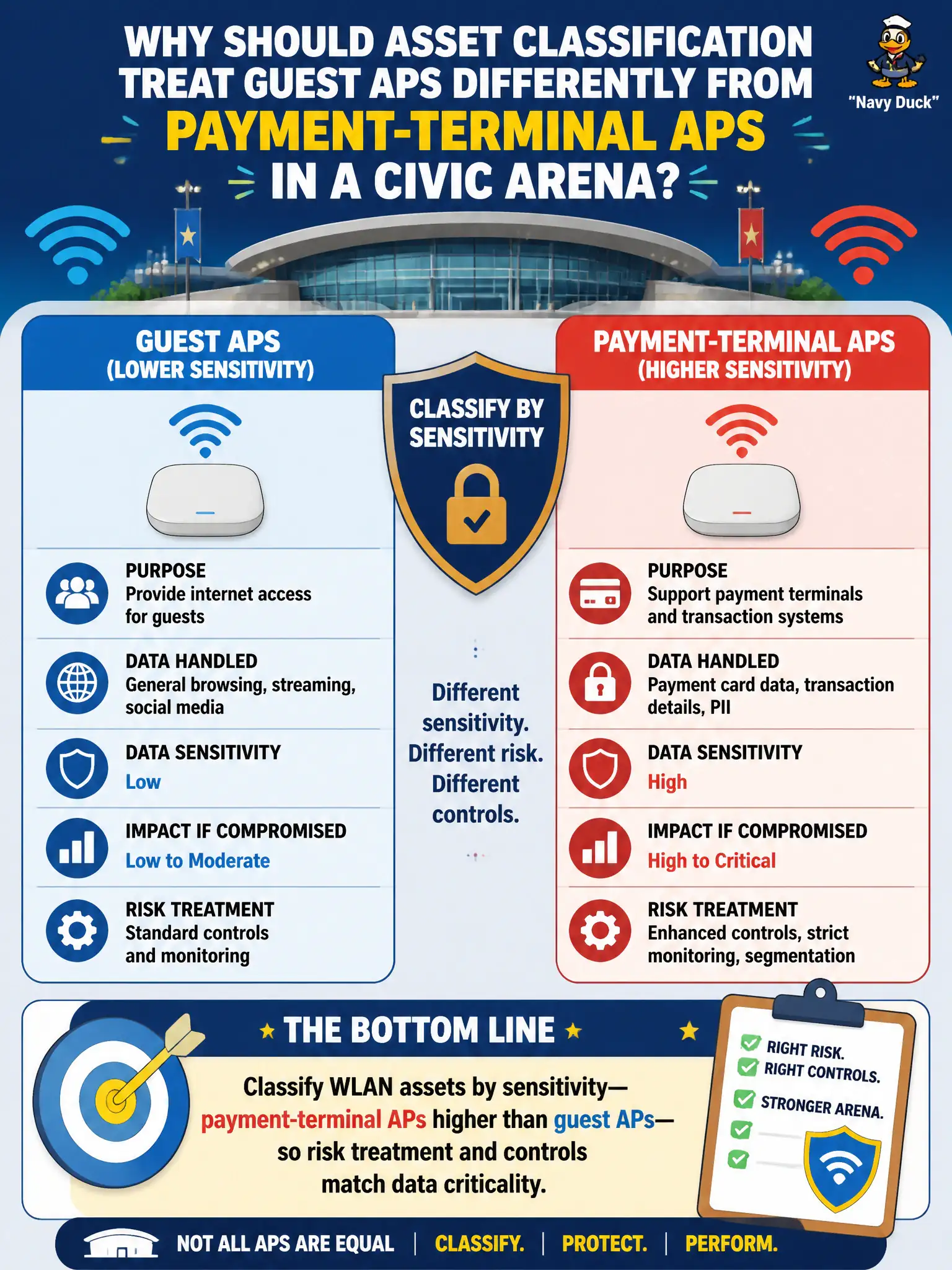
Payment-terminal APs guard the cash register; guest APs guard the free coffee Wi-Fi. Tag them differently so hardening and monitoring match what they carry. One flat “all APs are equal” label wastes controls or under-protects card traffic.
Full Explanation
Asset classification should treat payment-terminal APs as higher sensitivity than guest APs in a civic arena so risk treatment and controls match data criticality. Forcing one sensitivity label for all APs collapses differentiated controls. Guest APs should not outrank payment APs merely because visitors complain louder. Classification applies to wireless infrastructure assets, not only chairs and projectors. Exam caveat: classification drives control selection—PCI-relevant WLAN assets deserve stricter encryption, segmentation, and monitoring than open guest amenities. Operational check: tag arena APs by SSID/purpose and data sensitivity, apply stricter baselines to payment-terminal coverage cells, and verify guest APs cannot reach cardholder VLANs. Review classification annually with municipal finance and security before peak event season. In municipal WLAN operations, record the rationale in the change ticket so future on-call staff know which control was chosen and which failure modes the rejected options would create for city services. Re-validate after the next maintenance window that the same control still holds under the infrastructure versions and client fleets used by the civic environment.