
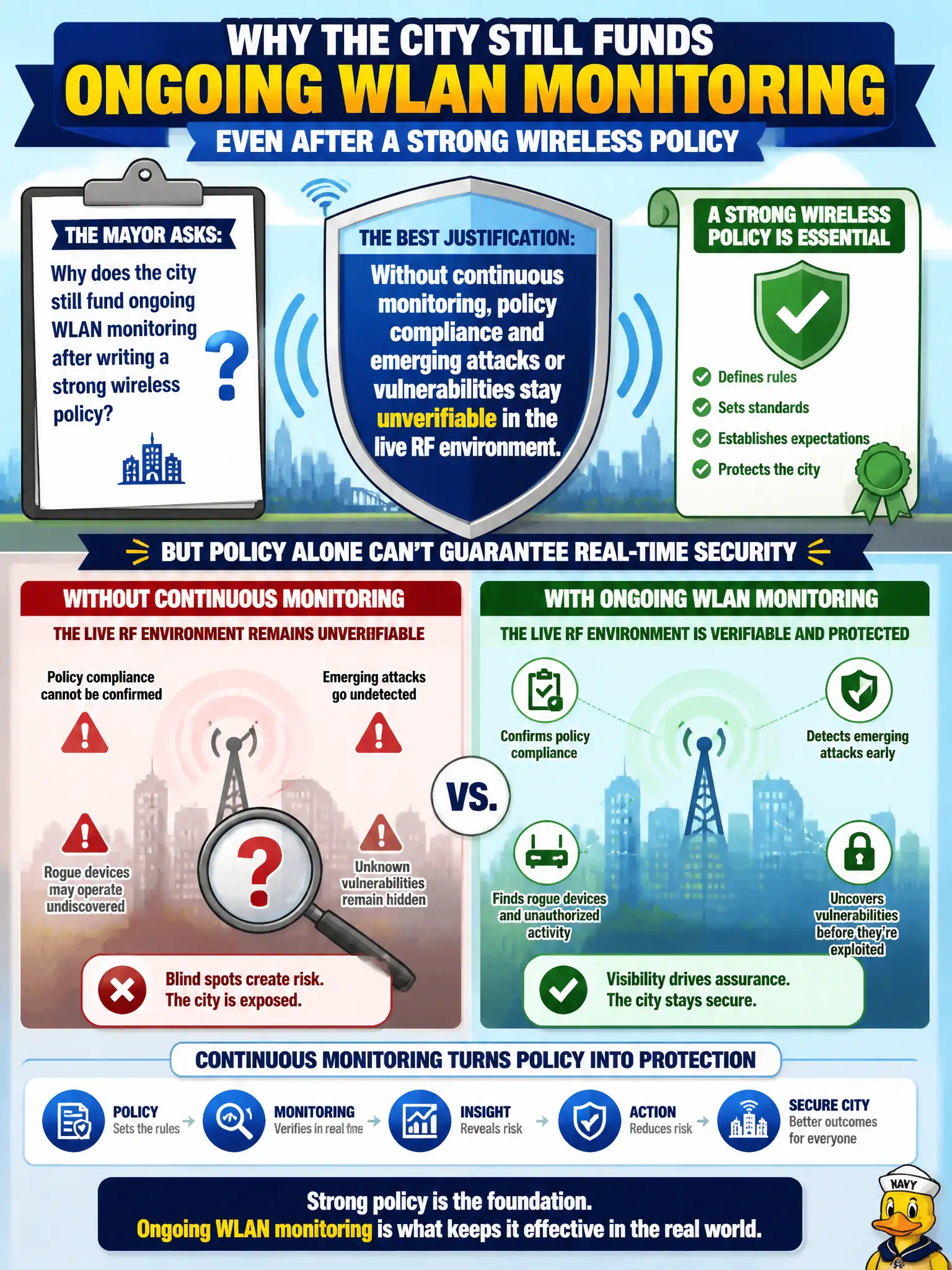
A mayor asks why the city still funds ongoing WLAN monitoring after writing a strong wireless policy. What is the best justification?
Select an answer to reveal the explanation.
Short Explanation
A written policy without eyes on the air is a speed-limit sign with no patrol car. Monitoring is how you prove the WLAN still matches the policy and catch attacks or new holes as they show up. Paper alone does not defend City Hall’s SSID.
Full Explanation
A mayor asking why the city still funds ongoing WLAN monitoring after writing a strong wireless policy needs a clear answer: without continuous monitoring, policy compliance and emerging attacks or vulnerabilities stay unverifiable in the live RF environment. Policy on paper does not make attacks impossible, and wired SIEM does not see every RF frame. Monitoring is not merely a marketing dashboard for bond ratings; it is how security lifecycle management proves that civic WLAN controls still operate. Stopping monitoring after signature of policy creates a false sense of completion. Exam caveat: CWSP lifecycle and monitoring objectives treat policy, design, and monitoring as complementary—policy without verification is incomplete security management. Operational check: present a monthly WIPS/SIEM summary of rogue SSIDs, misconfigured APs, and policy violations; map each to policy clauses; and show remediation closures. Keep that report in the municipal security metrics pack so budget conversations tie funding to verifiable RF outcomes rather than slogan-level policy language. In municipal WLAN operations, record the rationale in the change ticket so future on-call staff know which control was chosen and which failure modes the rejected options would create for city services. Re-validate after the next maintenance window that the same control still holds under the infrastructure versions and client fleets used by the civic environment.