
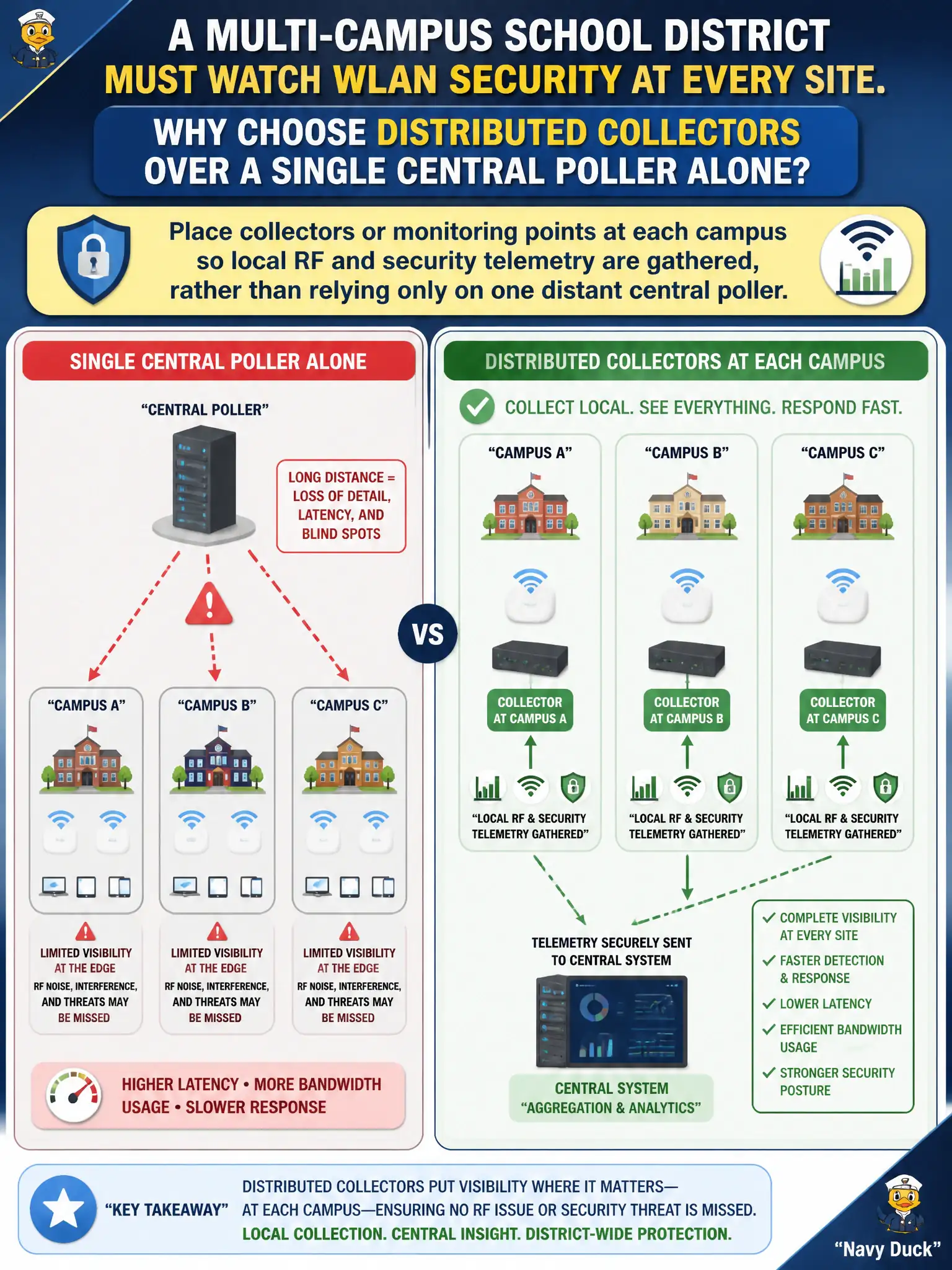
A multi-campus school district must watch WLAN security at every site. Why choose distributed collectors over a single central poller alone?
Select an answer to reveal the explanation.
Short Explanation
One poller across town trying to hear every campus is like one smoke detector covering five school buildings. Put collectors closer to each site so RF and security events are actually gathered, then roll them up centrally if you want. Distance and scale beat wishful central-only listening.
Full Explanation
A multi-campus school district needs local RF and security telemetry at each site; placing collectors or monitoring points at each campus gathers that data rather than relying only on one distant central poller that cannot see every remote RF frame with zero latency. Distributed collectors are not illegal under PCI by nature; payment scope may constrain design but does not ban distributed monitoring. A single central poller does not magically capture every remote RF frame instantly. Turning WIPS off at branch campuses to save licenses is the opposite of distributed monitoring. Exam caveat: centralized versus distributed monitoring is about where collection happens—district designs often combine local collectors with central SIEM correlation rather than choosing only one extreme. Operational check: deploy or enable a collector/sensor role per campus, verify each campus forwards security events to the district SIEM, and spot-check that a test rogue at a remote school appears with the correct site tag. Update the municipal/district monitoring diagram so NOC staff know which collector owns which campus. In municipal WLAN operations, record the rationale in the change ticket so future on-call staff know which control was chosen and which failure modes the rejected options would create for city services. Re-validate after the next maintenance window that the same control still holds under the infrastructure versions and client fleets used by the civic environment.