
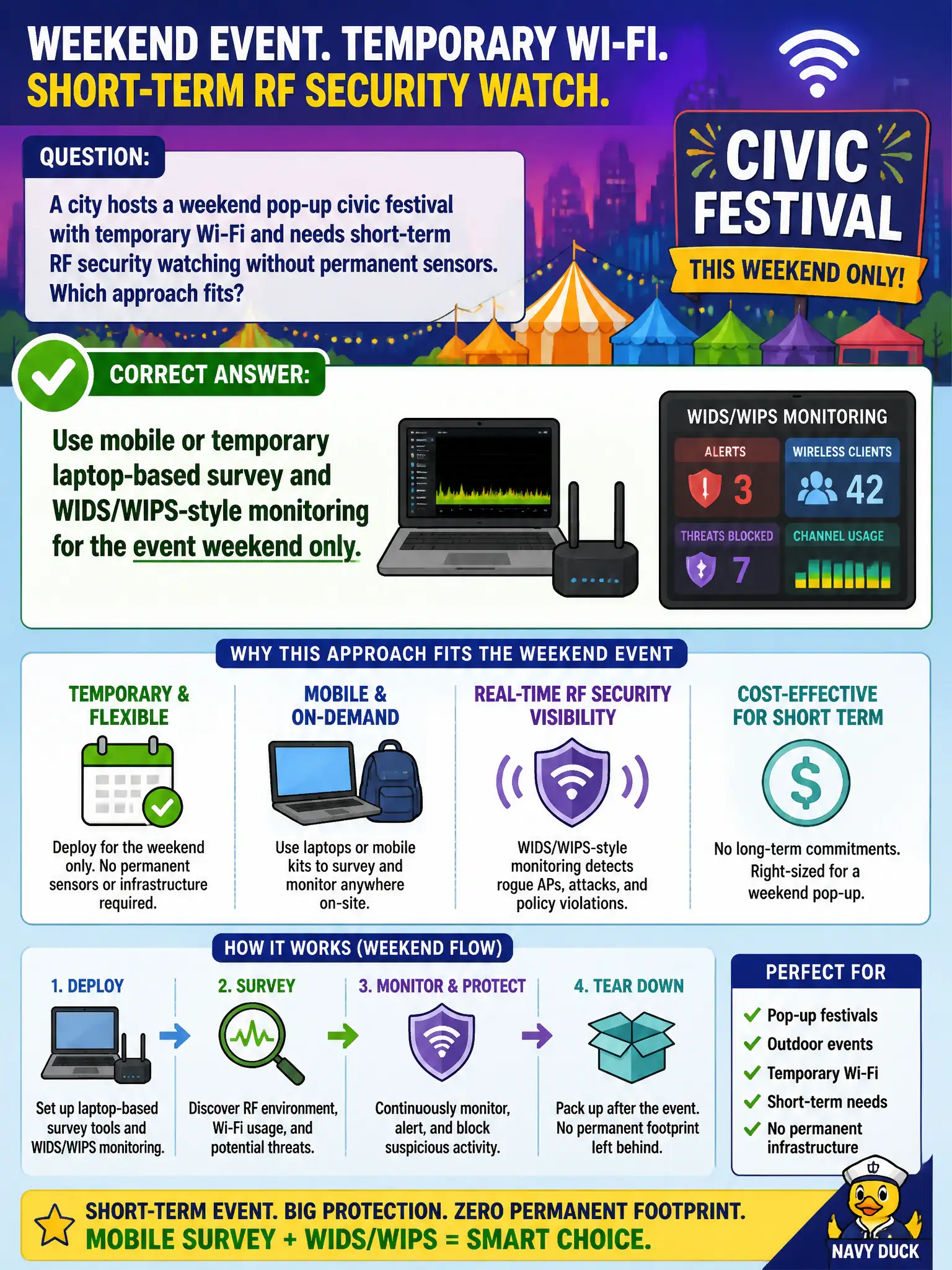
A city hosts a weekend pop-up civic festival with temporary Wi-Fi and needs short-term RF security watching without permanent sensors. Which approach fits?
Select an answer to reveal the explanation.
Short Explanation
A weekend festival WLAN is a pop-up street fair—you do not pour concrete for permanent sensor poles overnight. A laptop or mobile survey kit lets you watch the RF for that short window and pack up Monday. Permanent tent SIEM gear, silent logging, or WEP are the wrong tools for a temporary risk.
Full Explanation
A weekend pop-up civic festival with temporary Wi-Fi needs short-term RF security watching without permanent sensors, which fits mobile or temporary laptop-based survey and WIDS/WIPS-style monitoring for the event window only. Mandating a permanent fiber SIEM appliance under every festival tent before opening day is disproportionate for a temporary venue. Disabling all logging for the weekend to save storage removes the evidence trail when incidents occur. Requiring WEP so monitoring tools are unnecessary combines deprecated crypto with a false claim that weak encryption eliminates monitoring needs. Exam caveat: mobile/temporary monitoring is a recognized WIDS/WIPS deployment style alongside integrated and overlay—match the model to event duration and risk, not to permanent campus defaults alone. Operational check: check out calibrated survey laptops, define channels and SSIDs in scope for the festival, staff a watch rotation, and export alerts to the city’s incident channel. Tear down temporary monitoring gear after the event and archive the weekend log package with the civic special-event after-action report. In municipal WLAN operations, record the rationale in the change ticket so future on-call staff know which control was chosen and which failure modes the rejected options would create for city services. Re-validate after the next maintenance window that the same control still holds under the infrastructure versions and client fleets used by the civic environment.