
A municipal IT director asks how integrated WIPS differs from overlay for city hall Wi-Fi. What is the accurate tradeoff?
Select an answer to reveal the explanation.
Short Explanation
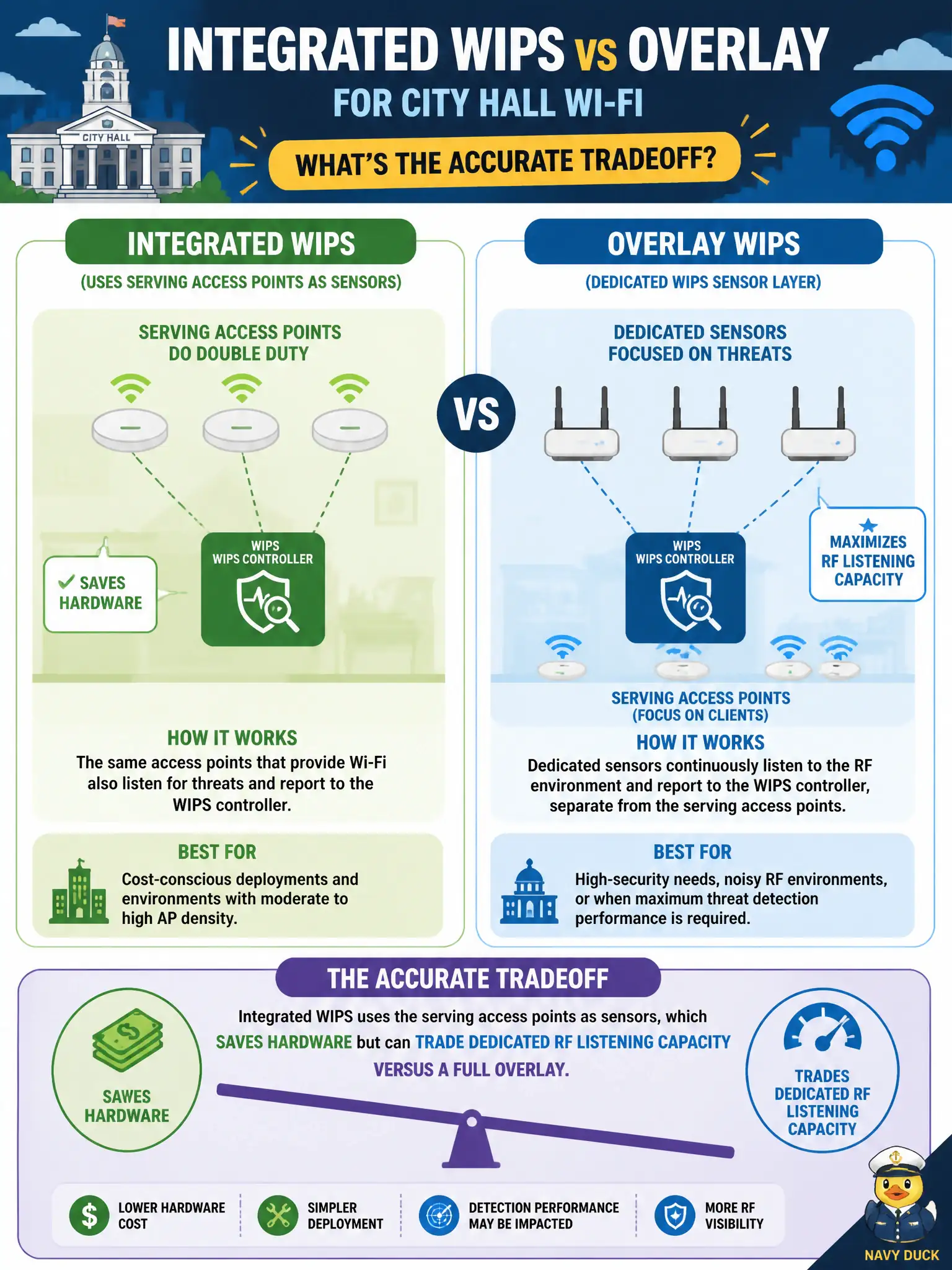
Integrated WIPS is the multitasking officer who also runs the front desk—cheaper headcount, but split attention. Overlay keeps a dedicated watcher on the RF. Knowing that tradeoff stops leaders from expecting overlay-grade listening from APs that are already busy serving clients.
Full Explanation
Integrated WIPS uses the serving access points as sensors, which saves dedicated sensor hardware but can trade away some dedicated RF listening capacity compared with a full overlay deployment—the accurate tradeoff a municipal IT director should hear for city hall Wi-Fi. Integrated designs do not require a separate sensor AP on every channel with no serving role ever allowed; that describes a dedicated/overlay mindset. Overlay WIPS is not limited to detecting Ethernet cable cuts; it observes 802.11 frames from dedicated sensors. Integrated WIPS does not always block every client association by default without policy; containment is policy-driven. Exam caveat: exam items often test the definitional tradeoff—cost/hardware savings versus dedicated monitoring capacity—rather than declaring one model universally superior for every civic site. Operational check: inventory whether city hall relies on integrated sensing only, measure channel dwell/load during peak hours, and decide if overlay sensors are needed for high-risk wings. Document the chosen model and residual monitoring gaps in the municipal wireless security architecture. In municipal WLAN operations, record the rationale in the change ticket so future on-call staff know which control was chosen and which failure modes the rejected options would create for city services. Re-validate after the next maintenance window that the same control still holds under the infrastructure versions and client fleets used by the civic environment.