
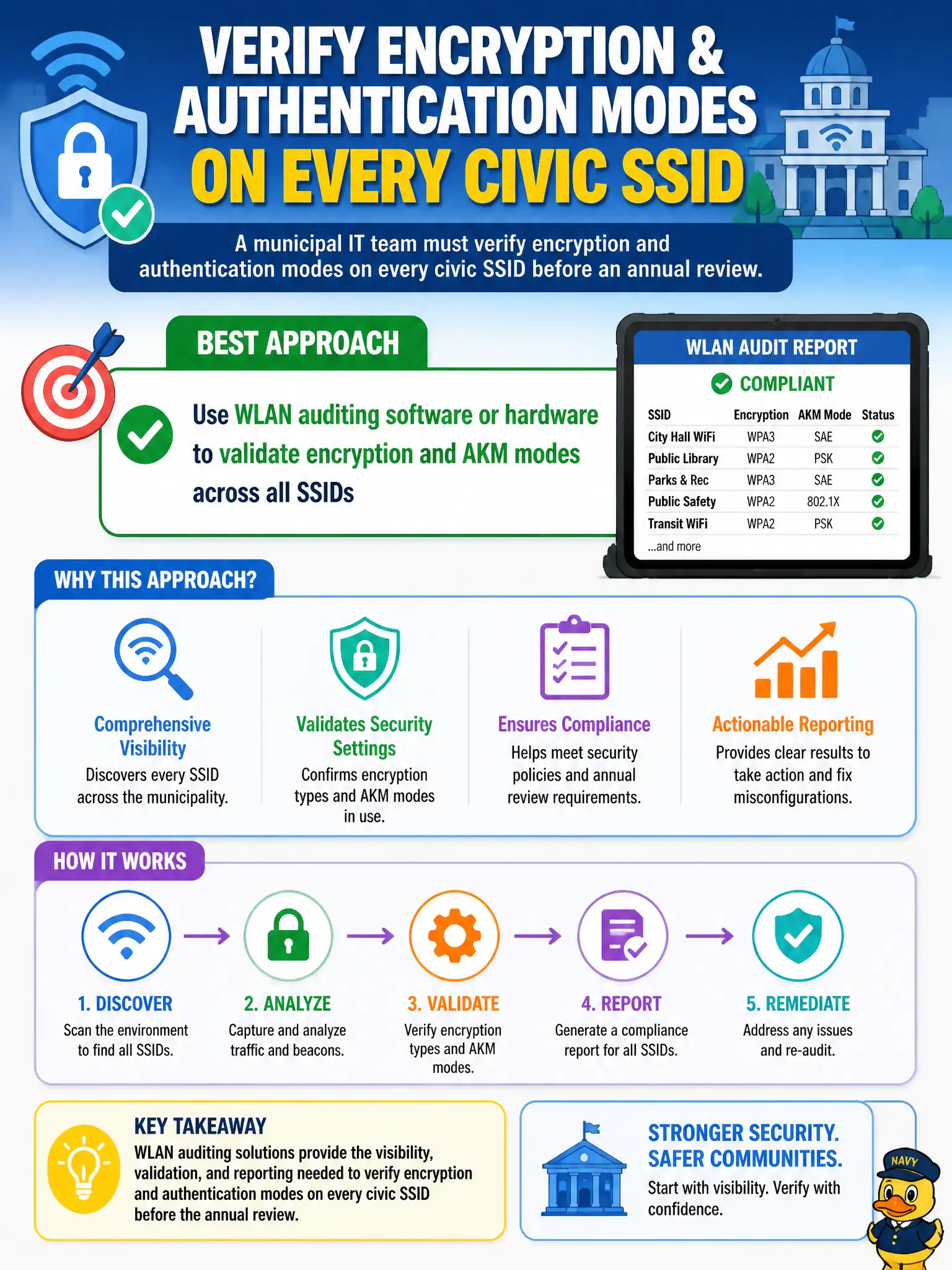
A municipal IT team must verify encryption and authentication modes on every civic SSID before an annual review. Which approach best fits that goal?
Select an answer to reveal the explanation.
Short Explanation
Trust-but-verify on city Wi-Fi means pointing real WLAN audit tools at the air and reading what each SSID actually negotiates—not believing last year’s diagram. Measure encryption and auth modes end to end.
Full Explanation
Verifying encryption and authentication modes on every civic SSID before an annual review is best done with WLAN auditing software or hardware that observes what the air and infrastructure actually advertise and negotiate. Verbal vendor confirmation without surveying the RF misses drift, rogue profiles, and forgotten transition SSIDs. Assuming every SSID matches a three-year-old Visio diagram ignores configuration entropy common in municipal environments. Disabling all SSIDs overnight measures nothing about security posture and creates a service outage. Exam caveat: annual reviews need empirical AKM/cipher validation, not documentation archaeology alone; diagrams are inputs, not substitutes for WLAN audit tooling. Operational check: run an authorized SSID survey across representative city sites, export encryption and AKM columns, diff against the approved standard, and open remediation tickets for any WEP/TKIP/open/misprofiled networks. Attach the survey file to the annual municipal wireless compliance package. In municipal WLAN operations, record the rationale in the change ticket so future on-call staff know which control was chosen and which failure modes the rejected options would create for city services. Re-validate after the next maintenance window that the same control still holds under the infrastructure versions and client fleets used by the civic environment.