
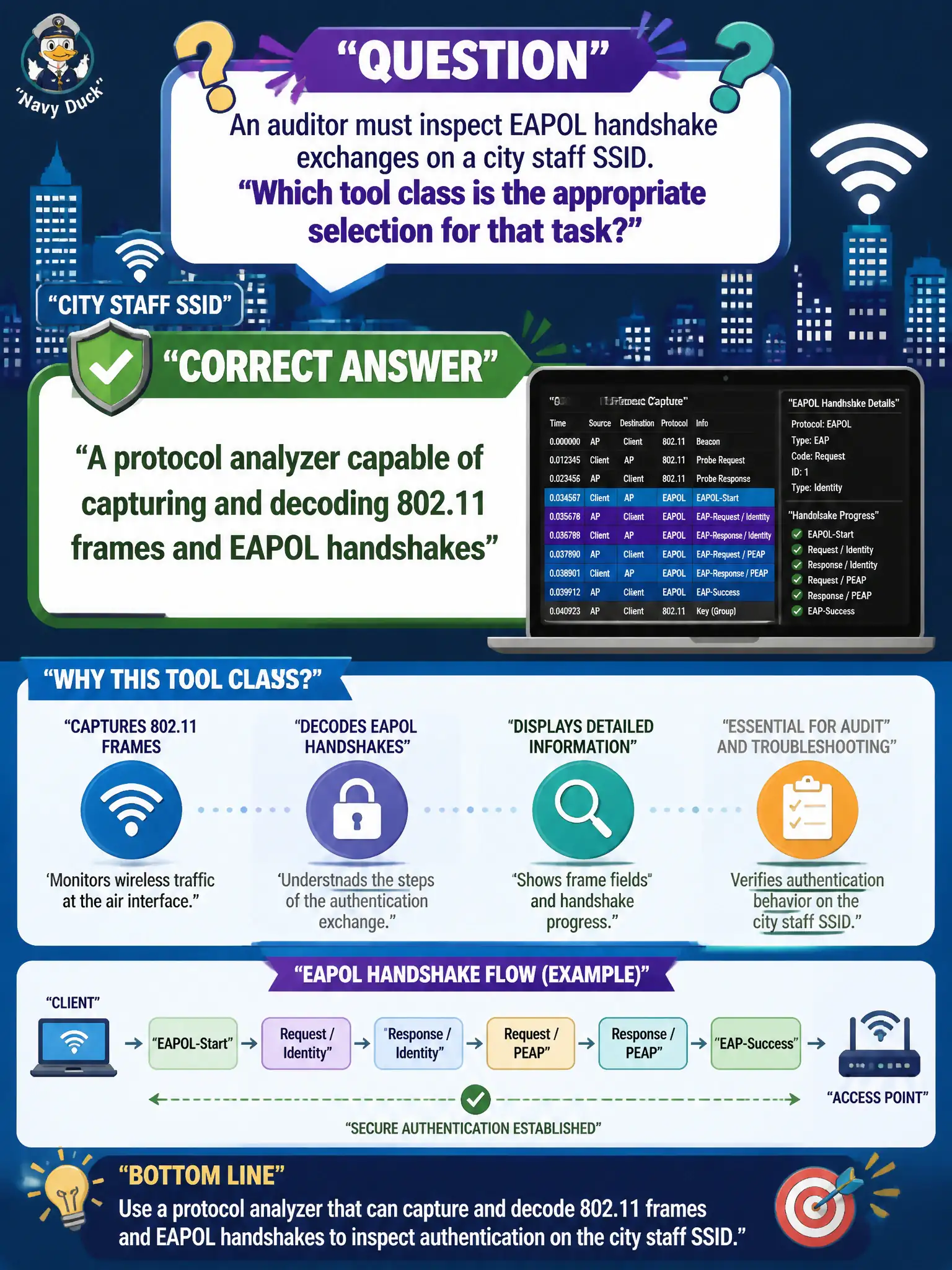
An auditor must inspect EAPOL handshake exchanges on a city staff SSID. Which tool class is the appropriate selection for that task?
Select an answer to reveal the explanation.
Short Explanation
Want to see the EAPOL handshake dance? Grab a protocol analyzer—that is the packet microscope. A spectrum waterfall shows RF energy, not whether the 4-way handshake looks healthy.
Full Explanation
Inspecting EAPOL handshake exchanges on a city staff SSID requires a protocol analyzer capable of capturing and decoding 802.11 frames, including EAPOL key exchanges used in WPA2/WPA3 Enterprise and Personal associations. Spectrum analyzers that only paint RF waterfalls show energy, not EAPOL semantics. Cable toners validate copper plant, not wireless handshakes. Badge printers produce visitor vouchers and contribute nothing to frame decode. Exam caveat: match tool class to the inspection goal—protocol analyzers for frame/EAPOL detail, spectrum tools for RF interference, WIPS for ongoing detection—do not treat colorful RF plots as proof of handshake correctness. Operational check: place an authorized capture adapter in monitor mode near a staff AP, filter for EAPOL, confirm four-way or enterprise EAPOL sequences decode, and archive a sanitized capture with the municipal assessment notes. Ensure the capture window was covered by the rules of engagement so clinic or city privacy expectations are met. In municipal WLAN operations, record the rationale in the change ticket so future on-call staff know which control was chosen and which failure modes the rejected options would create for city services. Re-validate after the next maintenance window that the same control still holds under the infrastructure versions and client fleets used by the civic environment.