
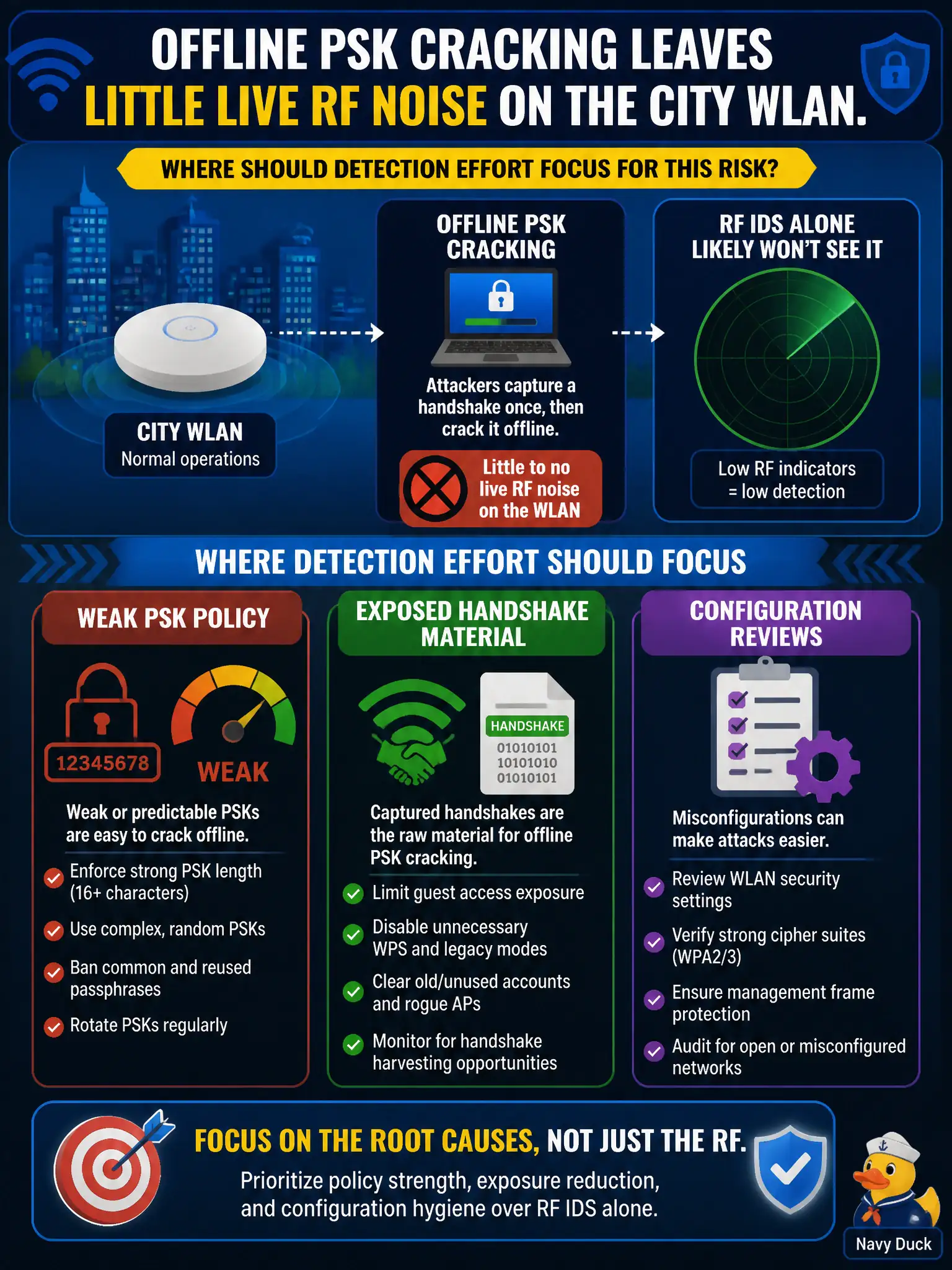
Security reviewers note that offline PSK cracking leaves little live RF noise on the city WLAN. Where should detection effort focus for this risk?
Select an answer to reveal the explanation.
Short Explanation
Offline cracking is quiet—like picking a lock at home after photographing it. You catch the risk by hunting weak passwords and leaked handshake exposure, not by waiting for a loud RF alarm. Policy and config review are the metal detectors here.
Full Explanation
Security reviewers who note that offline PSK cracking leaves little live RF noise on the city WLAN should focus detection effort on weak PSK policy, exposed handshake material, and configuration reviews rather than RF IDS alone. Silent offline guessing after a handshake is captured will not reliably light up spectrum sensors; prevention and hygiene are the primary controls. Focusing only on increasing beacon intervals to 1000 TUs citywide does not address passphrase strength or handshake exposure. Relying exclusively on ultrasonic audio sensors in wiring closets is irrelevant to PSK cracking. Disabling all SIEM parsers for RADIUS because cracking is silent removes useful auth telemetry without solving Personal-mode risk. Civic Personal SSIDs need strong passphrase policy, limited distribution, rotation after events that could expose handshakes, and migration to Enterprise authentication. Exam caveat: RF IDS remains valuable for deauth that enables capture, but offline cracking itself is largely a policy and architecture detection problem. Operational check: audit Personal SSID passphrase length/complexity, review where handshakes could be captured (public parks APs), rotate keys on a schedule, monitor for deauth precursors, and prioritize moving staff SSIDs to 802.1X.