
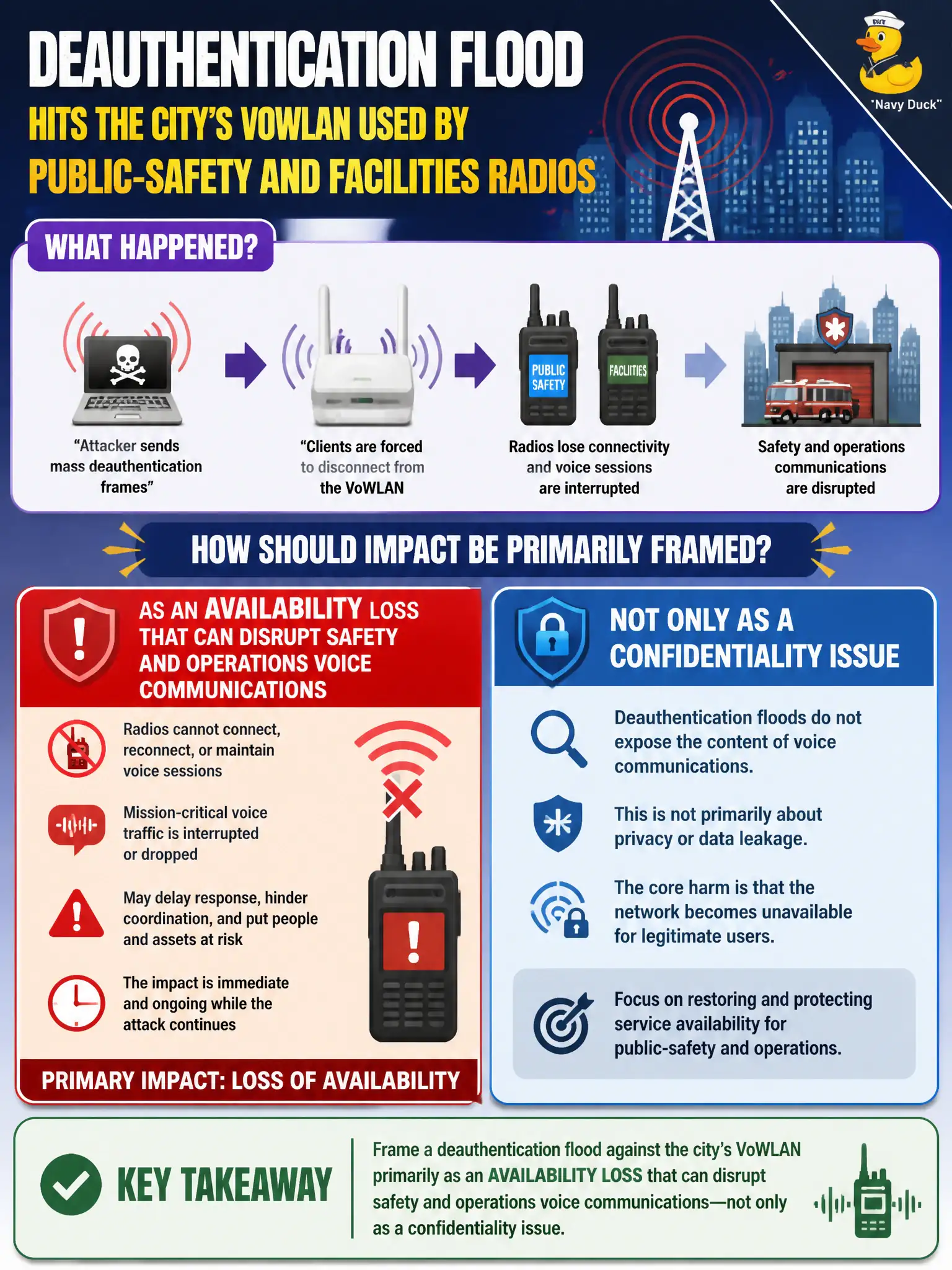
A deauthentication flood hits the city's VoWLAN used by public-safety and facilities radios. How should impact primarily be framed?
Select an answer to reveal the explanation.
Short Explanation
Deauth storms knock phones off the air. For city VoWLAN, think dropped calls and broken ops audio—availability—before you fixate on secret-stealing headlines.
Full Explanation
A deauthentication flood against the city's VoWLAN used by public-safety and facilities radios should primarily be framed as an availability loss that can disrupt safety and operations voice communications, not only as a confidentiality issue. Deauth and similar DoS techniques force disassociation and degrade voice continuity; for public-safety adjacent users, that availability hit is the dominant business impact. Framing it only as a confidentiality breach because deauth always reveals full packet payloads is incorrect—deauth frames disrupt association and do not by themselves decrypt application payloads. Calling it a beneficial RF clean-up that improves voice quality reverses the harm. Calling it irrelevant because voice over WLAN never depends on association stability ignores fundamental 802.11 behavior. Municipal voice WLAN impact statements should lead with continuity of operations and safety communications. Exam caveat: some deauth scenarios are precursors to evil-twin or handshake capture, but the primary framing for a flood against VoWLAN remains availability. Operational check: confirm WIPS or sensor alerts for deauth floods at affected sites, enable protected management frames where client and AP support allow, validate VoWLAN roaming and capacity after mitigation, and include availability metrics in the incident report for facilities and public-safety stakeholders.