
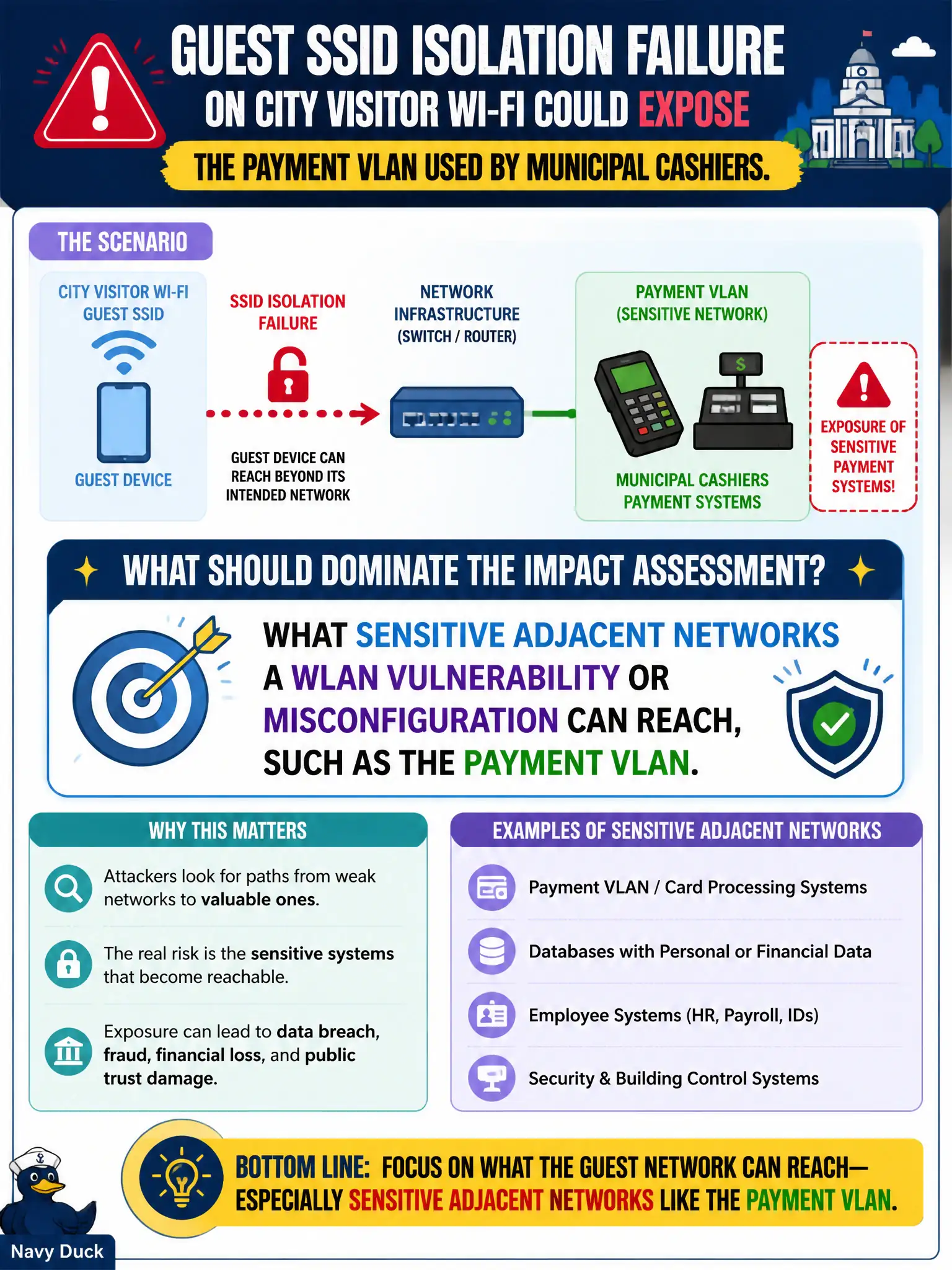
A guest SSID isolation failure on city visitor Wi-Fi could expose the payment VLAN used by municipal cashiers. What should dominate the impact assessment?
Select an answer to reveal the explanation.
Short Explanation
Impact is about what the guest hop can touch next. If isolation fails and visitors can nose into the payment VLAN, that adjacency—not the pretty portal—is the scary part for city risk.
Full Explanation
When a guest SSID isolation failure on city visitor Wi-Fi could expose the payment VLAN used by municipal cashiers, impact assessment should be dominated by what sensitive adjacent networks a WLAN vulnerability or misconfiguration can reach. Lateral exposure to payment systems elevates confidentiality and integrity impact far beyond guest browsing inconvenience. Focusing only on the guest SSID's marketing name and splash-page colors addresses branding, not blast radius. Whether visitors liked the captive-portal artwork is irrelevant to impact. AP LED brightness during business hours does not measure network adjacency risk. Civic guest networks often sit near staff or payment segments in shared switching; isolation failures are high-impact precisely because of those adjacencies. Exam caveat: impact analysis for WLAN issues must follow trust-boundary reachability, especially toward cardholder or sensitive staff VLANs. Operational check: validate guest-to-payment isolation with controlled connectivity tests, review PVLAN/ACL/firewall rules, monitor for guest scanning toward payment subnets, and treat any isolation failure as a high-priority incident affecting payment security evidence.