
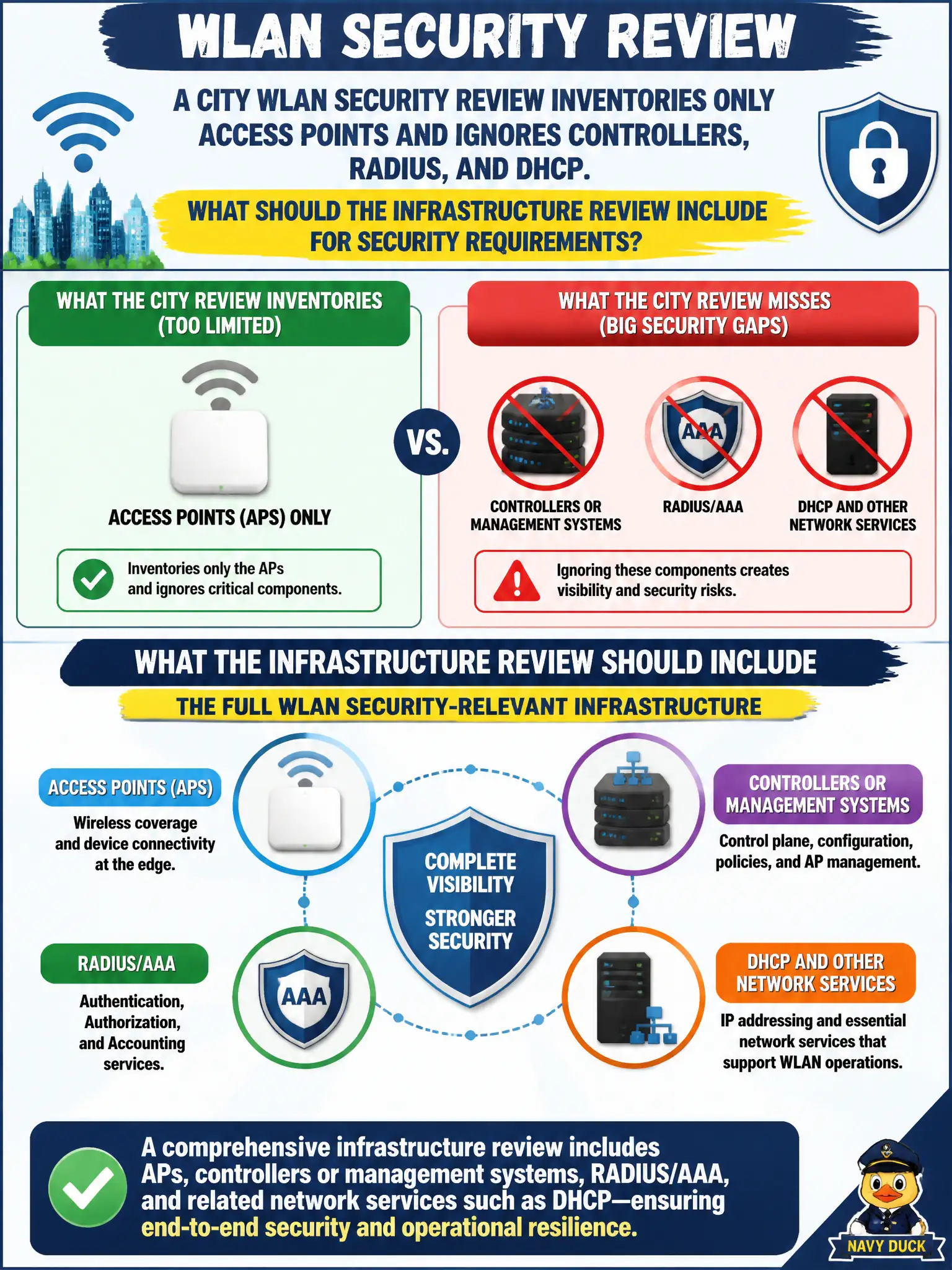
A city WLAN security review inventories only access points and ignores controllers, RADIUS, and DHCP. What should the infrastructure review include for security requirements?
Select an answer to reveal the explanation.
Short Explanation
APs are the tip of the iceberg. Controllers, RADIUS, and DHCP steer who gets on and how—if you only inventory the radios, you're reviewing the doorbell and ignoring the locks.
Full Explanation
A city WLAN security review that inventories only access points misses the broader security-relevant infrastructure. Controllers or cloud management systems, RADIUS/AAA servers, and related network services such as DHCP influence authentication success, authorization results, address assignment, and the telemetry available for monitoring and incident response. CWSP expects that infrastructure review to cover devices and services that affect security posture, not radios alone. Limiting the review to ceiling mounts and cable color codes addresses installation hygiene but not who can authenticate or how management planes are hardened. Inventorying only public website certificates unrelated to WLAN AAA describes an orthogonal TLS asset and does not characterize the wireless authentication path. Focusing solely on guest splash-page HTML templates mistakes presentation content for the control plane that enforces association, encryption, and logging. Incomplete inventories lead to policies that harden APs while leaving shared RADIUS admin credentials or unmanaged cloud controller roles untouched. Exam caveat: cloud-managed WLAN still presents a management plane and AAA dependencies that must appear in the infrastructure review even when radios are distributed across sites. Operational check: build an inventory covering AP models and firmware, controllers or cloud organizations, RADIUS servers and NAS clients, DHCP scopes serving WLAN, and management jump hosts; mark each for patching, privileged access, and log forwarding requirements tied to the WLAN security policy.