
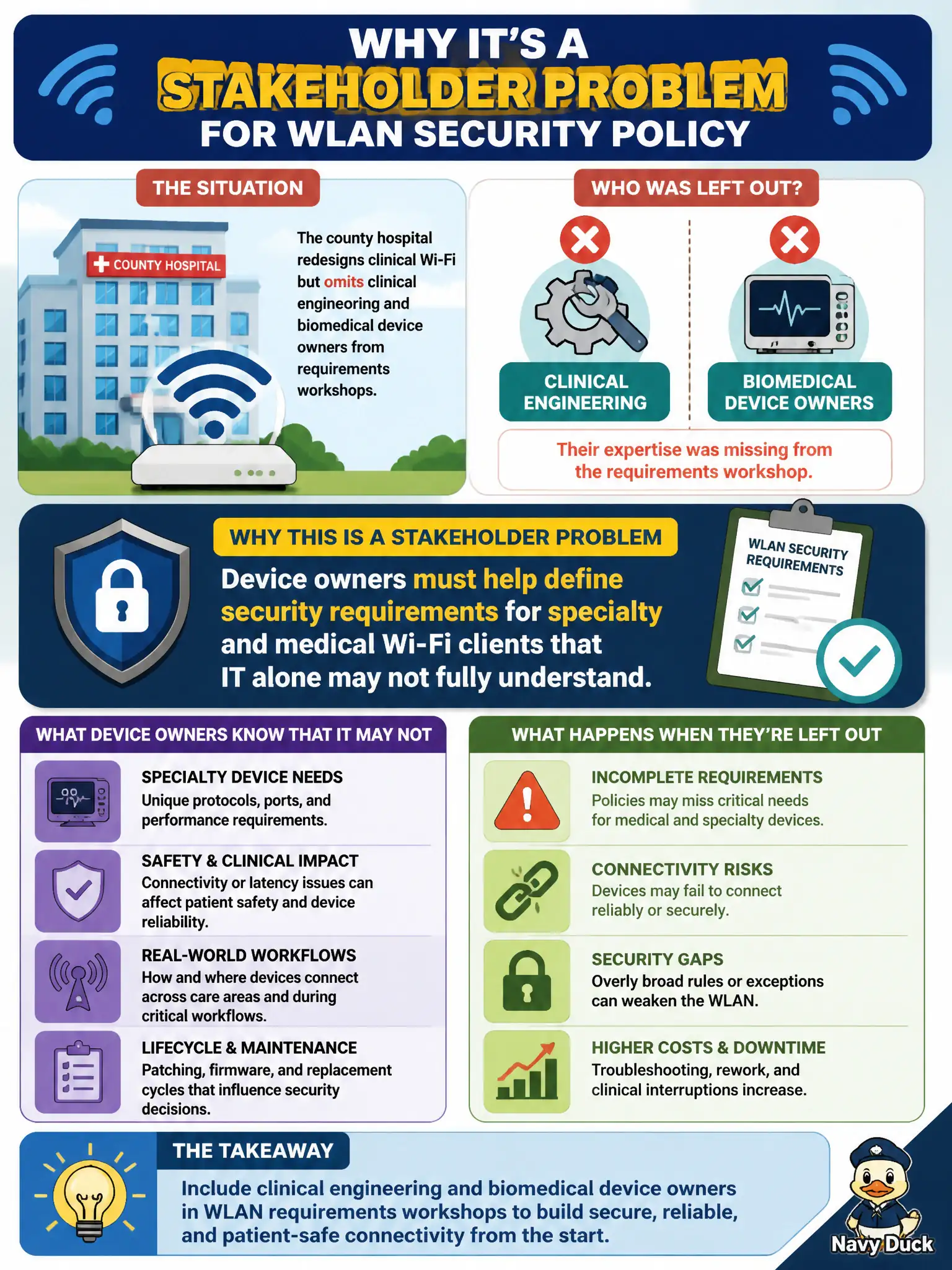
A county hospital redesigns clinical Wi-Fi but omits clinical engineering and biomedical device owners from requirements workshops. Why is that a stakeholder problem for WLAN security policy?
Select an answer to reveal the explanation.
Short Explanation
Biomedical gear on Wi-Fi isn't "just another laptop." The folks who own those devices know the quirks and risks—leave them out and you'll write pretty policy that bricks a pump or ignores a real threat.
Full Explanation
Omitting clinical engineering and biomedical device owners from a county hospital WLAN redesign is a stakeholder failure because specialty and medical Wi-Fi clients introduce constraints, clinical risk, and failure modes that general IT may not fully understand. Device owners help define which EAP methods and cipher suites devices can negotiate, how much latency or roaming disruption clinical workflows tolerate, and what compensating controls are acceptable when a pump or monitor cannot meet the enterprise baseline. Those teams are not limited to cafeteria guest Wi-Fi branding; their input is about clinical safety and device behavior on production SSIDs. The assertion that medical devices never use WLAN is false in contemporary hospitals and would incorrectly shrink the requirements set. Claiming only the CIO may attend any WLAN meeting under HIPAA misstates both HIPAA collaboration norms and CWSP stakeholder practice—multiple operational roles must inform secure design. Leaving device owners out often yields policies that brick specialty clients or ignore real threats on clinical SSIDs. Exam caveat: specialty clients frequently force documented exceptions, segmentation, or phased upgrades; capturing those constraints is part of requirements work, not an optional courtesy invite. Operational check: inventory medical and specialty WLAN clients with named owners, capture EAP/cipher limitations and clinical criticality ratings, require clinical engineering sign-off on security requirements, and retest representative devices in a lab SSID before cutting over clinical production wireless.