
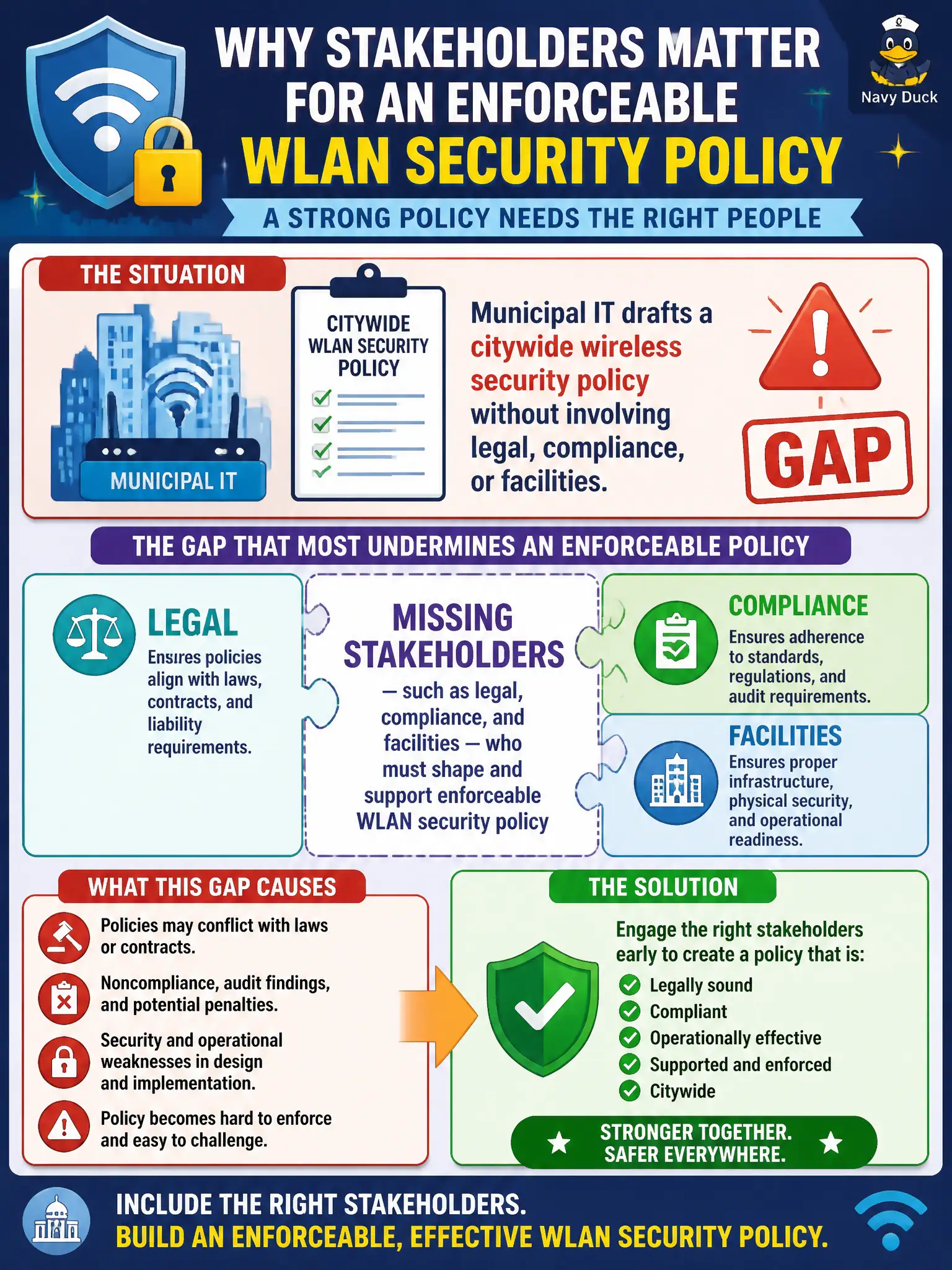
Municipal IT drafts a citywide wireless security policy without involving legal, compliance, or facilities. Which gap most undermines an enforceable WLAN security policy?
Select an answer to reveal the explanation.
Short Explanation
IT writing wireless policy in a vacuum is like writing building codes without the fire marshal. Legal, compliance, and facilities have to be in the room or the policy won't stick when something breaks.
Full Explanation
Drafting a citywide wireless security policy without involving legal, compliance, or facilities most undermines enforceability because those stakeholders shape regulatory interpretation, liability language, physical placement constraints, and day-to-day support for the policy. CWSP Domain 1 expects identification of appropriate stakeholders when developing WLAN security requirements and policy; IT alone rarely owns every obligation that makes a wireless policy stick in a municipal environment. A missing preferred AP vendor logo on the cover page is cosmetic branding and does not confer authority, completeness, or cross-department buy-in. Omitting CWNA-level free-space path-loss formulas from an appendix may disappoint RF engineers, but path-loss math belongs in design documentation rather than substituting for governance stakeholders. Listing every possible 802.11 PHY data rate is engineering trivia that neither legal nor facilities need in order to approve enforceable outcomes such as authentication strength, guest isolation, and acceptable use. Without legal and compliance, regulatory citations and retention rules drift; without facilities, mounting, cabling, and shared-space constraints surface only after failed installs. Exam caveat: the exact stakeholder roster varies by city size, yet legal/compliance and facilities (or physical security) recur as WLAN policy stakeholders in public-sector settings. Operational check: maintain a stakeholder or RACI register for WLAN policy, circulate drafts for legal and facilities review, capture written approvals, and record how physical and regulatory constraints were addressed alongside technical controls before publishing the policy as binding.