
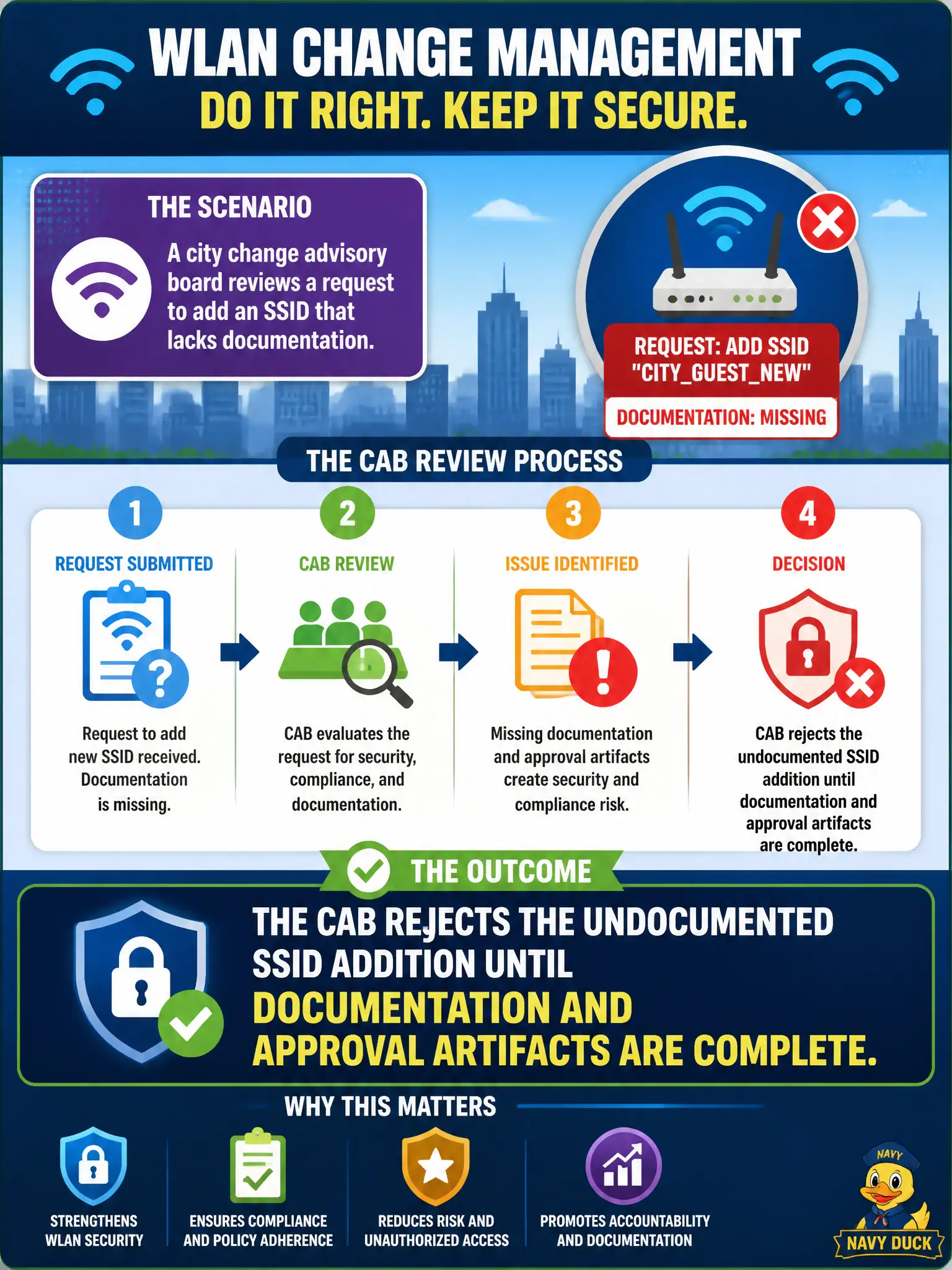
A city change advisory board reviews a request to add an SSID that lacks documentation. What outcome reinforces proper WLAN security change management?
Select an answer to reveal the explanation.
Short Explanation
No paperwork, no SSID—that is the CAB doing its job. Approval gates stop shadow Wi-Fi from becoming production. Rubber-stamping undocumented adds is how rogue networks get a hall pass.
Full Explanation
In municipal WLAN security change management, the Change Advisory Board (CAB) plays a critical role in ensuring that any modifications, such as adding a new SSID, are properly vetted and documented before implementation. The correct outcome is for the CAB to reject the addition of an undocumented SSID until all necessary documentation and approval artifacts are complete. This ensures that changes are traceable, risks are assessed, and compliance with security policies is maintained. Adding an SSID without documentation can introduce unauthorized access points, misconfigured security settings, or network segmentation issues, potentially exposing the municipal network to attacks or unauthorized use. Approving SSIDs instantly to avoid slowing network teams disregards the importance of risk assessment and proper controls, increasing the chance of security breaches. Banning all future SSIDs permanently is an overreaction that stifles necessary network growth and flexibility, ignoring the fact that well-documented and approved SSIDs can be securely managed. Ignoring WLAN changes and focusing only on unrelated items like printer firmware requests demonstrates a lack of governance and fails to address WLAN-specific risks. A key caveat is that documentation should include security configurations, purpose, and ownership to ensure accountability. Operationally, before adding any SSID, verify that the CAB has reviewed and approved the change with complete documentation, ensuring the WLAN remains secure and manageable within the municipal environment.