
Monitoring shows a municipal guest VLAN approaching firewall session limits during festival weeks. What load-observation response best protects secure service delivery?
Select an answer to reveal the explanation.
Short Explanation
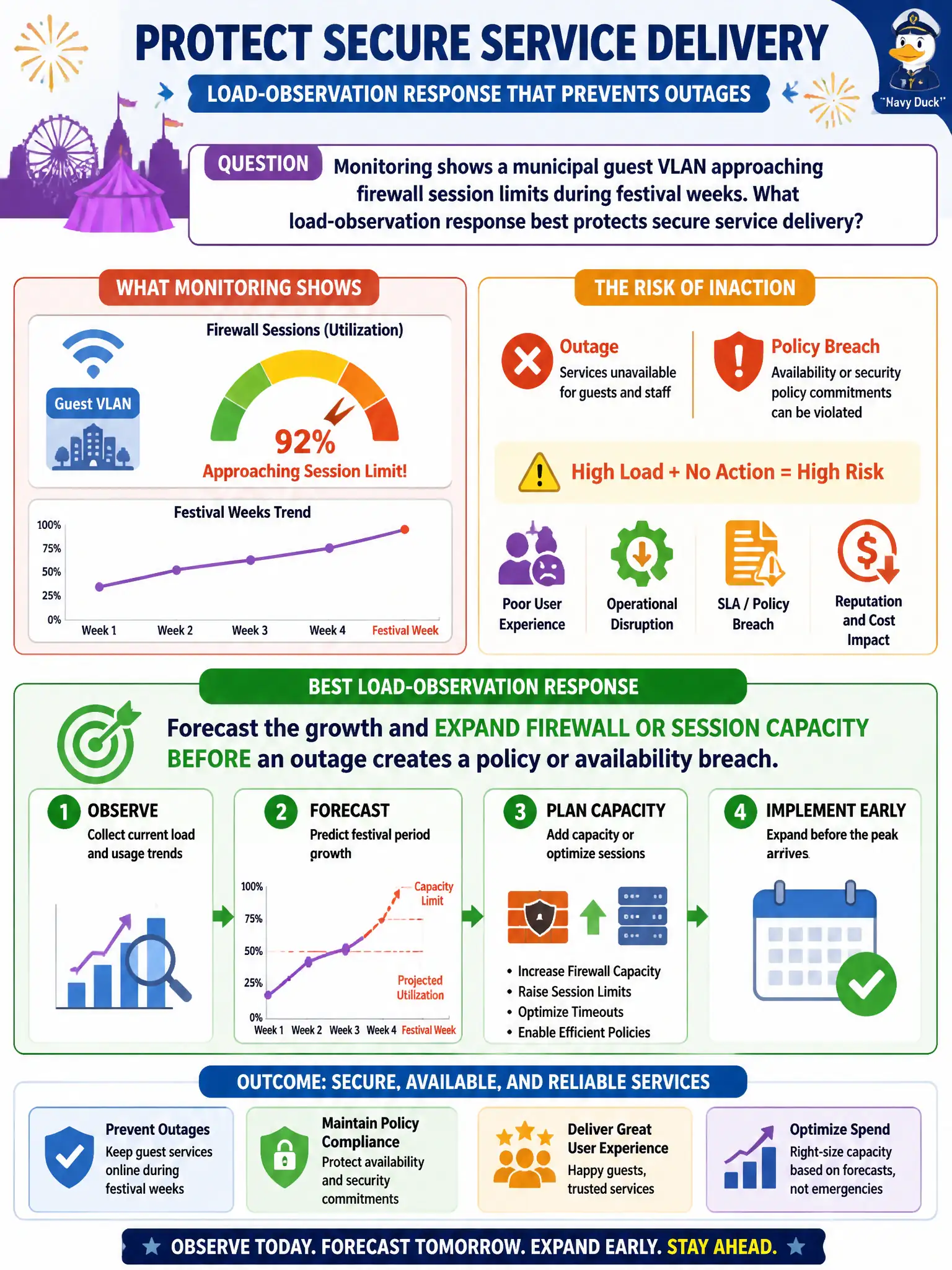
If guest sessions are racing toward the firewall’s ceiling, widen the road before the parade. Forecasting from monitoring prevents the outage that also breaks policy promises. Waiting for the crash is not capacity planning.
Full Explanation
In municipal wireless networks, especially those supporting guest VLANs during high-demand events such as festivals, proactive management of firewall session limits is critical to maintaining both service availability and security. When monitoring indicates that a guest VLAN is approaching the firewall's session capacity, the most effective and responsible response is to forecast the anticipated growth and expand the firewall or session capacity before reaching a critical failure point. This proactive approach ensures that the firewall can continue to enforce security policies without interruption, preventing dropped connections or unauthorized access that might occur if session limits are exceeded. Ignoring the trend until the firewall fails abruptly is a reactive and risky strategy; it can lead to sudden service outages, degraded user experience, and potential security breaches due to unmonitored or uncontrolled traffic flows. Disabling guest firewalling entirely to avoid session limits fundamentally undermines network security by removing essential traffic filtering and access controls, thereby exposing the municipal network to threats such as malware propagation, unauthorized access, and data leakage. Similarly, reducing the frequency of monitoring to obscure the approaching limit is counterproductive; it delays detection and response, increasing the likelihood of a critical failure and complicating troubleshooting efforts. It is important to note that firewall capacity planning in a municipal context must be dynamic and account for predictable, event-driven traffic spikes, such as those occurring during festivals or public gatherings. Network teams should leverage usage trend analysis, capacity simulations, and scheduled upgrades or rule optimizations to ensure that the firewall infrastructure scales appropriately. This ensures secure, uninterrupted guest access, maintains compliance with municipal security policies, and supports the civic commitment to reliable public services. Operationally, teams can verify effectiveness by correlating session count trends with event schedules, confirming that capacity expansions precede peak loads, and validating that no session drops or policy violations occur during festival periods.