
During a quarterly WLAN security audit at city offices, which technique best discovers whether staff still share Personal PSK on whiteboards?
Select an answer to reveal the explanation.
Short Explanation
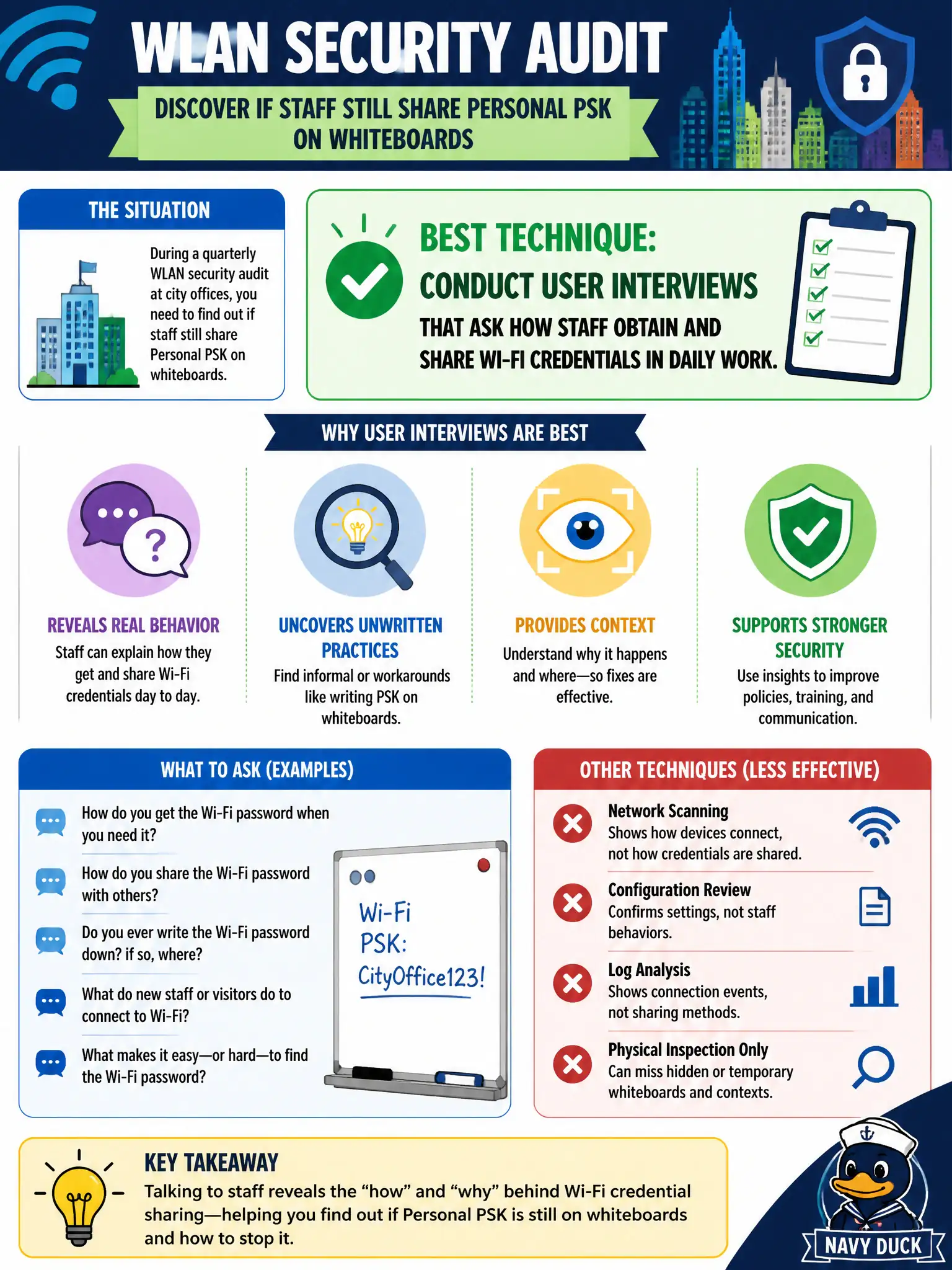
Sometimes the best audit tool is a conversation. Ask people how they really share the Wi-Fi password—you will hear about whiteboards faster than any RF sweep. Policies on a shelf do not prove habits on the wall.
Full Explanation
Conducting user interviews that explore how staff obtain and share Wi-Fi credentials is a critical technique during a municipal WLAN security audit to uncover whether Personal Pre-Shared Keys (PSKs) are still being shared on whiteboards or through other informal means. This direct engagement with users provides insights into the actual behaviors and informal practices that technical tools alone cannot detect. For example, while a spectrum analyzer sweep can identify RF activity and potential unauthorized devices, it cannot reveal if passwords are visibly posted on whiteboards or verbally shared among employees, which represent significant security vulnerabilities. Assuming that written policies alone prevent such risky practices is insufficient because policy compliance is often imperfect; staff may inadvertently or intentionally circumvent rules, especially if convenient shortcuts like whiteboard postings exist. Similarly, limiting the audit to counting access points in the asset database only verifies inventory accuracy and does not address credential management or user behavior, which are crucial for preventing unauthorized access. The key caveat is that comprehensive WLAN security audits in civic environments must integrate both technical assessments and human-factor evaluations to fully understand and mitigate risks. Operationally, auditors should supplement technical scans with structured interviews or anonymous surveys to identify and remediate insecure credential-sharing habits, ensuring that policies are effectively enforced and that staff are educated on secure practices.