
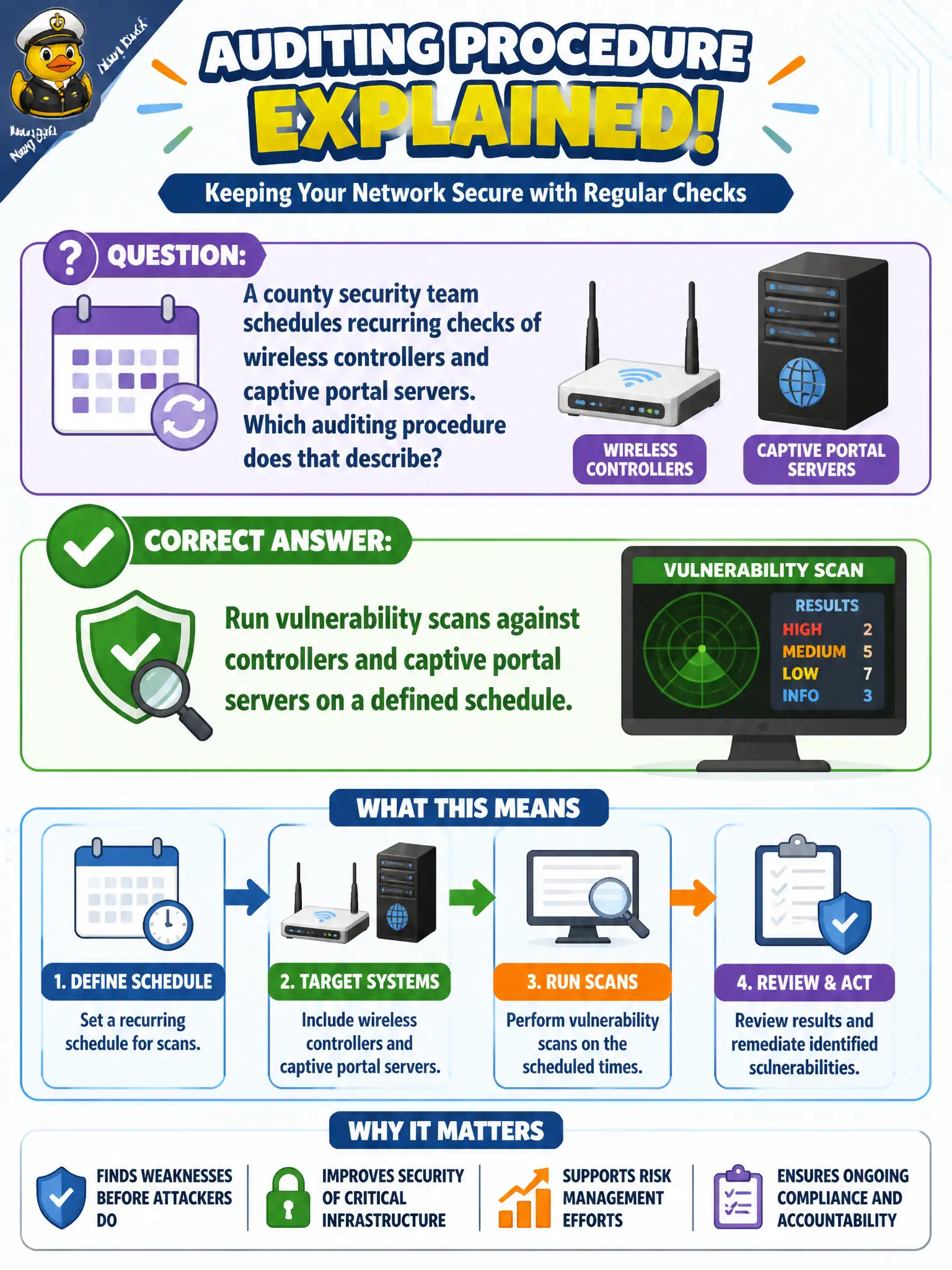
A county security team schedules recurring checks of wireless controllers and captive portal servers. Which auditing procedure does that describe?
Select an answer to reveal the explanation.
Short Explanation
Controllers and captive portals are computers with attack surface—scan them on a schedule. Vulnerability scanning is audit hygiene, not a one-time graduation party. Public-facing portals especially deserve regular eyes.
Full Explanation
Scheduling recurring vulnerability scans against wireless controllers and captive portal servers represents a fundamental auditing procedure in municipal WLAN security management. Wireless controllers and captive portal servers are critical infrastructure components that manage authentication, access control, and network traffic flow for public and government wireless networks. Regular vulnerability scans systematically probe these devices for known security weaknesses, outdated software versions, misconfigurations, and potential exploits. By conducting these scans on a defined schedule, the county security team ensures that emerging vulnerabilities are detected promptly, enabling timely remediation before attackers can leverage them. This proactive approach aligns with best practices in risk management and continuous security monitoring, which are essential for maintaining the integrity and availability of public wireless services. In contrast, relying solely on interviews with facilities staff about physical aspects such as furniture placement near access points overlooks the technical security posture of wireless infrastructure. While physical security is important, it does not substitute for technical vulnerability assessments that uncover software and configuration flaws. Similarly, performing only a single penetration test without follow-up scans is insufficient because wireless threats evolve rapidly, and new vulnerabilities continuously emerge. A one-time test provides a snapshot but fails to maintain ongoing assurance. Additionally, disabling scans of captive portal servers due to their exposure to the public Internet is a critical misstep; these servers are often targeted by attackers seeking to bypass authentication or inject malicious content. Securing them through regular vulnerability assessments is vital to prevent compromise and protect users. This auditing procedure should be integrated into a comprehensive security program with clear policies, documented schedules, and tracking of remediation efforts. To operationally verify effectiveness, the team must confirm that scheduled scans are executed as planned, findings are documented, and identified issues are addressed within defined timeframes, thereby ensuring continuous protection of municipal wireless infrastructure.