
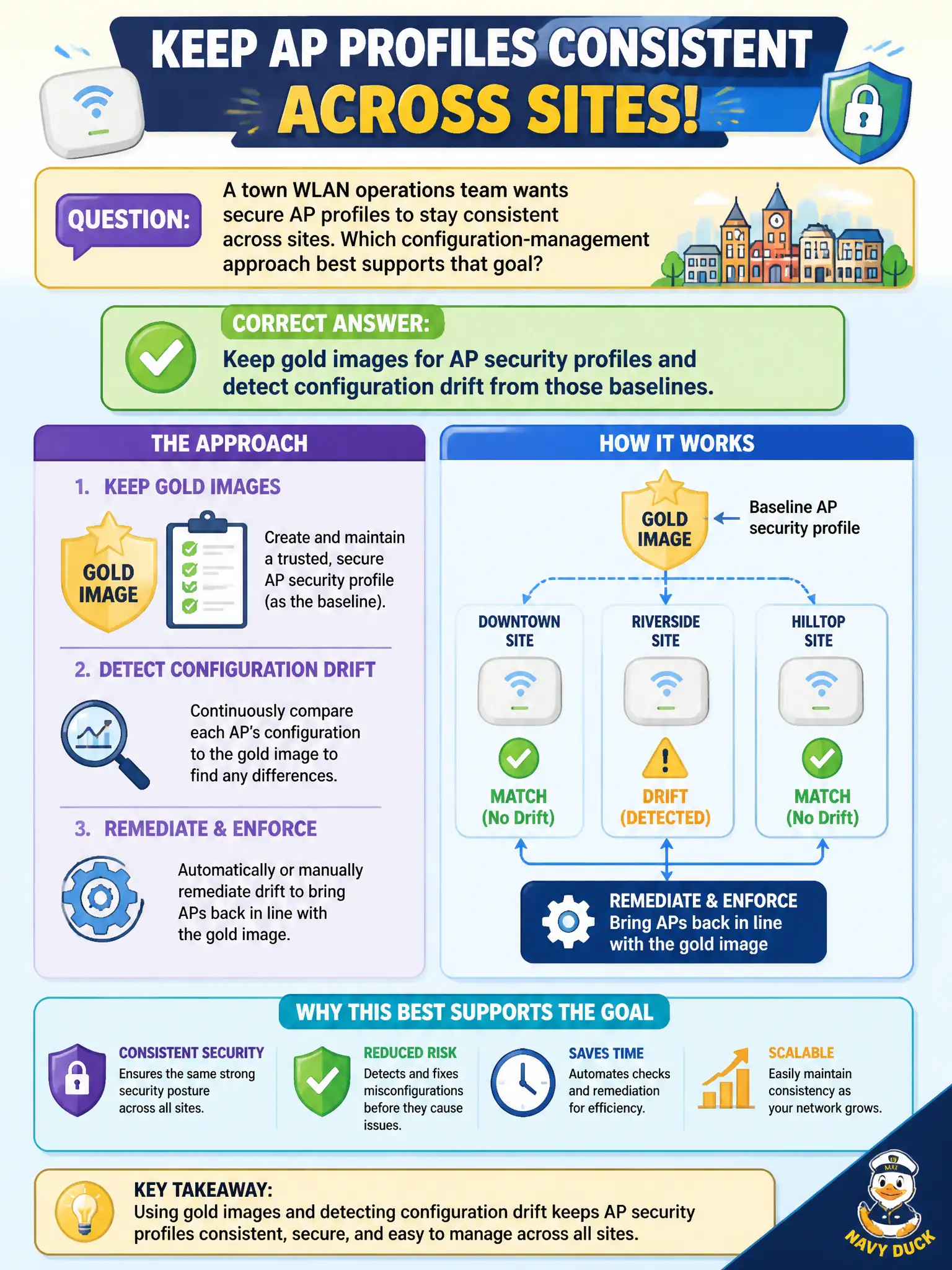
A town WLAN operations team wants secure AP profiles to stay consistent across sites. Which configuration-management approach best supports that goal?
Select an answer to reveal the explanation.
Short Explanation
Gold images are the recipe cards for secure AP profiles. Keep them, cook from them, and notice when someone adds mystery ingredients. Drift detection is how you catch the quiet weakening of Wi-Fi security.
Full Explanation
Maintaining gold images for access point (AP) security profiles and actively detecting configuration drift from those baselines is the most effective approach for ensuring consistent and secure WLAN configurations across multiple municipal sites. Gold images represent carefully vetted and approved configuration templates that define the security parameters, such as encryption methods, authentication protocols, and access control lists, which comply with the town's security policies. By establishing these baselines, the operations team can systematically compare live AP configurations against the gold standard to identify unauthorized or accidental deviations that could introduce vulnerabilities or operational inconsistencies. This proactive monitoring helps prevent security gaps that might arise from manual misconfigurations or unauthorized changes. Conversely, allowing each site administrator to create unique security settings without a shared baseline leads to configuration fragmentation. This fragmentation complicates centralized management, increases the likelihood of inconsistent security postures, and makes auditing and incident response more difficult. Simply storing gold images once without performing ongoing comparisons to live configurations is ineffective because configuration drift can occur silently over time, leaving the network vulnerable to undetected changes. Similarly, disabling centralized profiles so that APs revert to factory defaults after reboot removes customized security controls, exposing the network to default vulnerabilities, non-compliance with municipal security standards, and operational instability. Factory defaults often lack necessary encryption and authentication settings, making the network susceptible to unauthorized access. The best practice is to implement automated tools that regularly audit AP configurations against gold images and alert administrators immediately upon detecting drift. This ensures timely remediation and maintains a consistent, secure WLAN environment across all municipal sites. To operationalize this, the town should deploy configuration management systems capable of scheduled scans and real-time alerts, ensuring that all APs adhere to the approved security profiles continuously.