
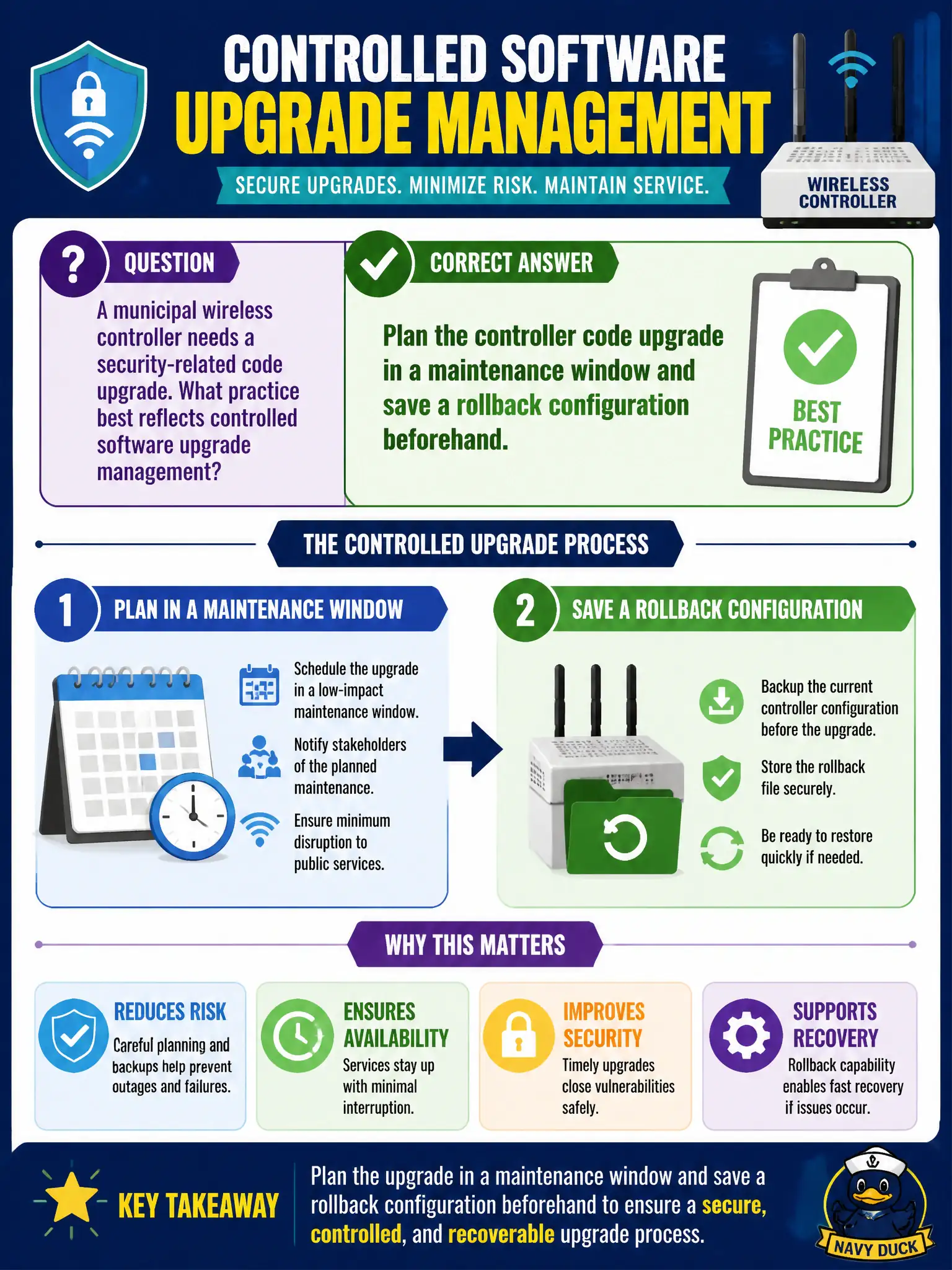
A municipal wireless controller needs a security-related code upgrade. What practice best reflects controlled software upgrade management?
Select an answer to reveal the explanation.
Short Explanation
Treat controller code like changing the engine—pick a quiet window and keep the old parts handy. Save rollback config before you upgrade. Midday heroics without a back-out plan are how civic Wi-Fi becomes the headline.
Full Explanation
Planning a wireless controller code upgrade within a maintenance window and saving a rollback configuration beforehand exemplifies controlled software upgrade management. This method minimizes service disruption during low-usage periods and provides a safety net to revert to a known good state if the new code introduces issues, preserving network stability and security. Pushing production controller code at peak times, such as during a council meeting, risks interrupting critical municipal operations and lacks preparedness for failure recovery without a rollback copy. Upgrading only a random access point while ignoring the controller's code neglects the fact that controllers coordinate security policies and traffic management; thus, their software integrity is crucial. Deleting prior configurations immediately during an upgrade to free disk space is dangerous because configuration files are essential for restoring settings if the upgrade fails, potentially leading to prolonged outages. The scope of this practice applies primarily to critical infrastructure components where uptime and security are paramount. Operationally, ensure that upgrade plans include scheduled windows, backup configurations, and tested rollback procedures before deployment.