
A county library WLAN shows rising client counts. Leadership wants capacity forecasts, but policy requires client isolation on the public SSID. How should monitoring data be used?
Select an answer to reveal the explanation.
Short Explanation
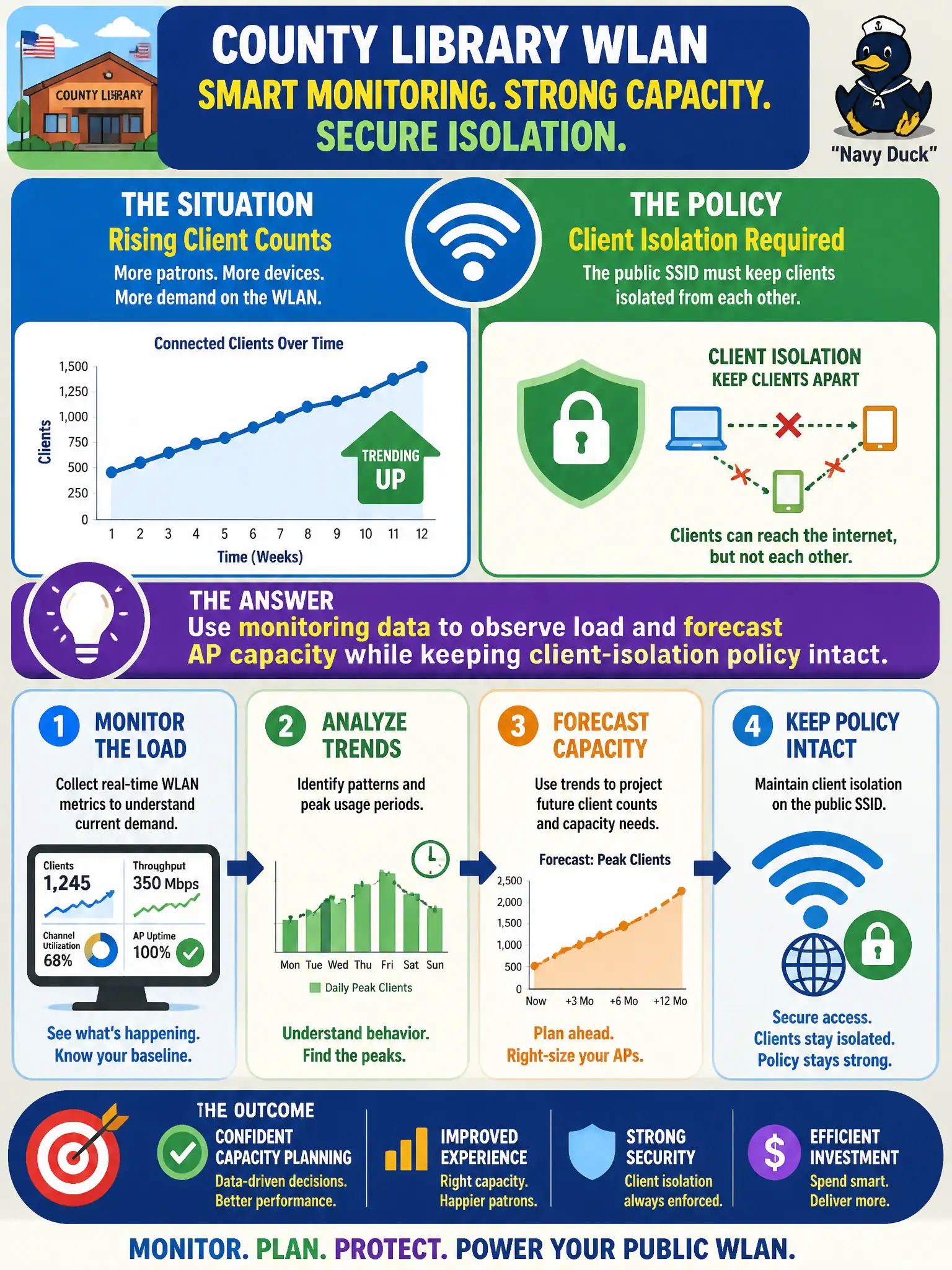
Watch the meters, plan more APs, and leave isolation on—the policy is not optional ballast. Capacity forecasting and security policy can walk together. Turning off isolation to “fix” load is solving the wrong problem.
Full Explanation
In a county library WLAN where client counts are rising, monitoring data should be leveraged to observe network load and forecast access point (AP) capacity while maintaining client isolation on the public SSID as per policy. Client isolation prevents direct device-to-device communication, enhancing security and privacy in public environments. Using monitoring tools to analyze utilization patterns and client density enables proactive capacity planning without compromising isolation policies. Disabling client isolation to increase airtime density misunderstands that isolation is a security control, not a performance limiter, and removing it exposes clients to potential attacks. Ignoring load metrics and adding APs only after outages is reactive and risks service degradation. Forecasting capacity based on physical seating instead of WLAN utilization data is imprecise, as device density and usage patterns vary independently of furniture count. The key caveat is that capacity planning must balance performance needs with security policies. An operational check involves reviewing WLAN monitoring reports to confirm that client isolation remains enabled and that AP addition plans are based on observed utilization trends rather than physical layout alone.