
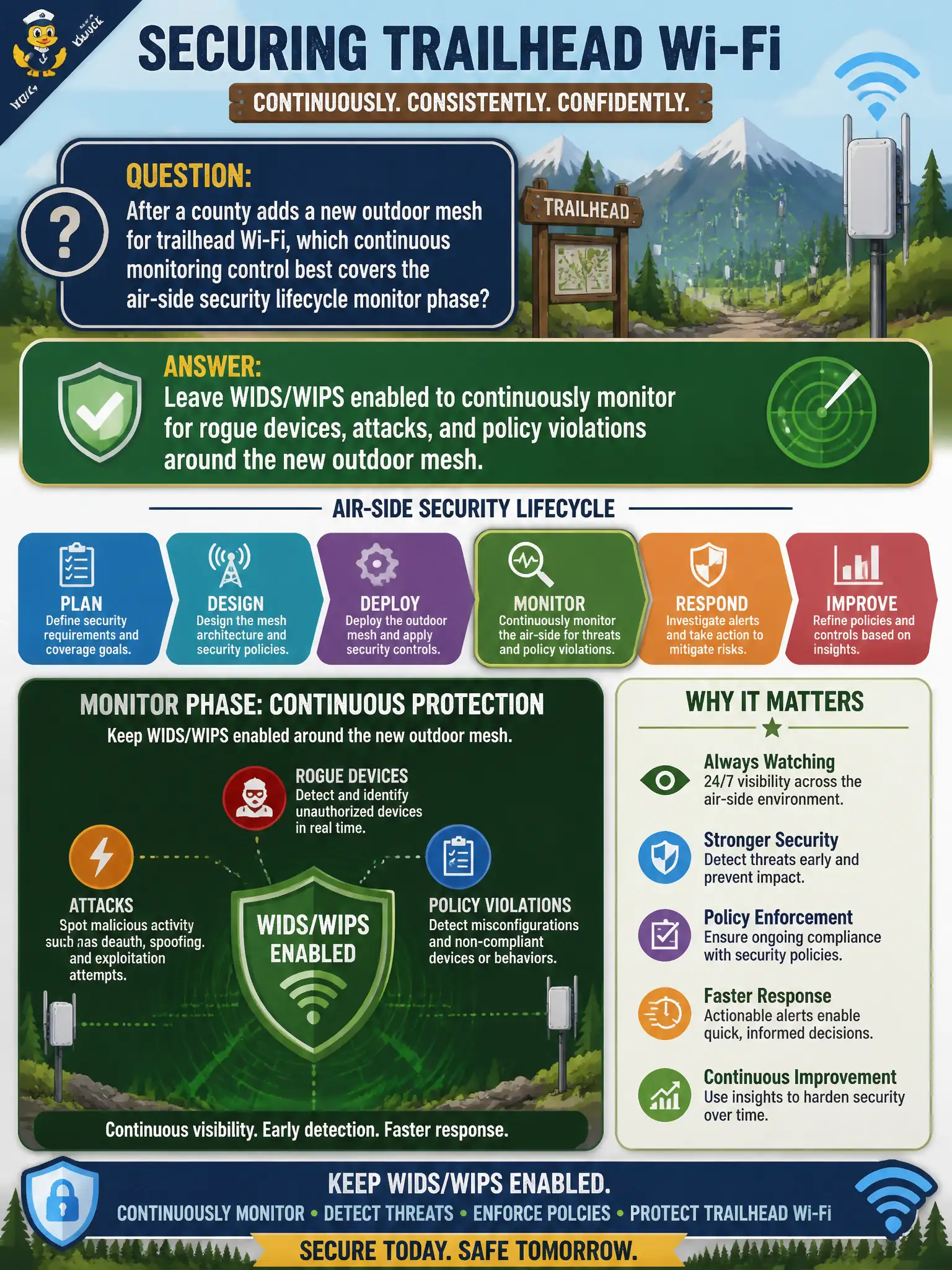
After a county adds a new outdoor mesh for trailhead Wi-Fi, which continuous monitoring control best covers the air-side security lifecycle monitor phase?
Select an answer to reveal the explanation.
Short Explanation
Outdoor mesh is still Wi-Fi in the wild—keep the WIPS eyes open. Continuous monitoring catches rogues and attacks that a cutover screenshot never will. Trusting the mesh blindly outdoors is wishful thinking.
Full Explanation
After deploying a new outdoor mesh network for trailhead Wi-Fi, maintaining continuous air-side security monitoring is critical to detect rogue devices, attacks, and policy violations. Keeping Wireless Intrusion Detection and Prevention Systems (WIDS/WIPS) enabled provides ongoing surveillance of the RF environment, leveraging signature-based and anomaly detection techniques to identify threats in real time. Disabling WIDS/WIPS outdoors under the assumption that mesh links are inherently trusted neglects the risk of external attackers exploiting the mesh's wireless interfaces, potentially compromising the network or users. Replacing continuous monitoring with a one-time screenshot of the mesh dashboard at cutover is insufficient because it captures only a static snapshot without detecting dynamic threats or changes over time. Monitoring only Power over Ethernet (PoE) switch port lights ignores the RF layer entirely and cannot detect wireless-specific threats such as rogue access points or jamming attacks. The operational check involves verifying that WIDS/WIPS sensors are active and properly configured around the mesh coverage area, with alerts integrated into the security operations center for timely incident response.