
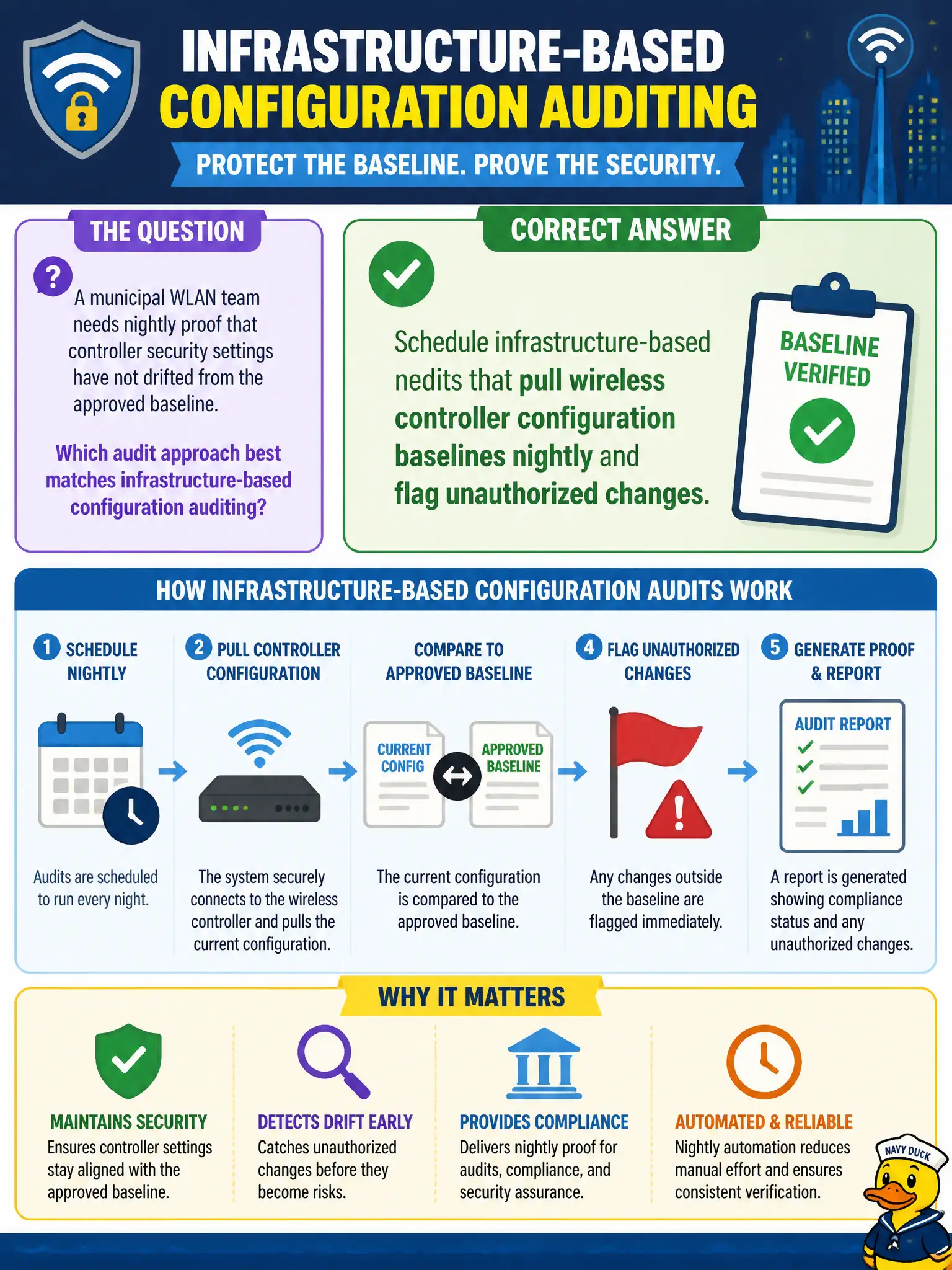
A municipal WLAN team needs nightly proof that controller security settings have not drifted from the approved baseline. Which audit approach best matches infrastructure-based configuration auditing?
Select an answer to reveal the explanation.
Short Explanation
Infrastructure audits are the nightly roll call for your controller configs. Pull the baselines, compare to gold, and catch drift before Monday’s surprise. Waiting for users to yell is not an audit strategy.
Full Explanation
To ensure that controller security settings remain consistent with the approved baseline in a municipal WLAN environment, scheduling infrastructure-based audits that automatically retrieve wireless controller configuration data nightly and flag unauthorized changes is the most effective method. This approach provides continuous, objective verification of configuration integrity, enabling rapid detection and remediation of drift from security policies. Interviewing help-desk staff each morning lacks technical rigor and is prone to human error or incomplete knowledge, making it an unreliable substitute for automated audits. Relying solely on end-user complaints to detect changes in encryption settings is reactive and inefficient, as users may not notice or report subtle security degradations promptly. Disabling configuration backups prevents the comparison of current settings against a known good baseline, eliminating the ability to detect unauthorized or accidental changes. It is important to maintain secure and automated configuration management processes to support compliance and incident response. Operationally, the WLAN team should implement scripts or tools that extract controller configurations, compare them against a stored baseline, and generate alerts for any deviations.