
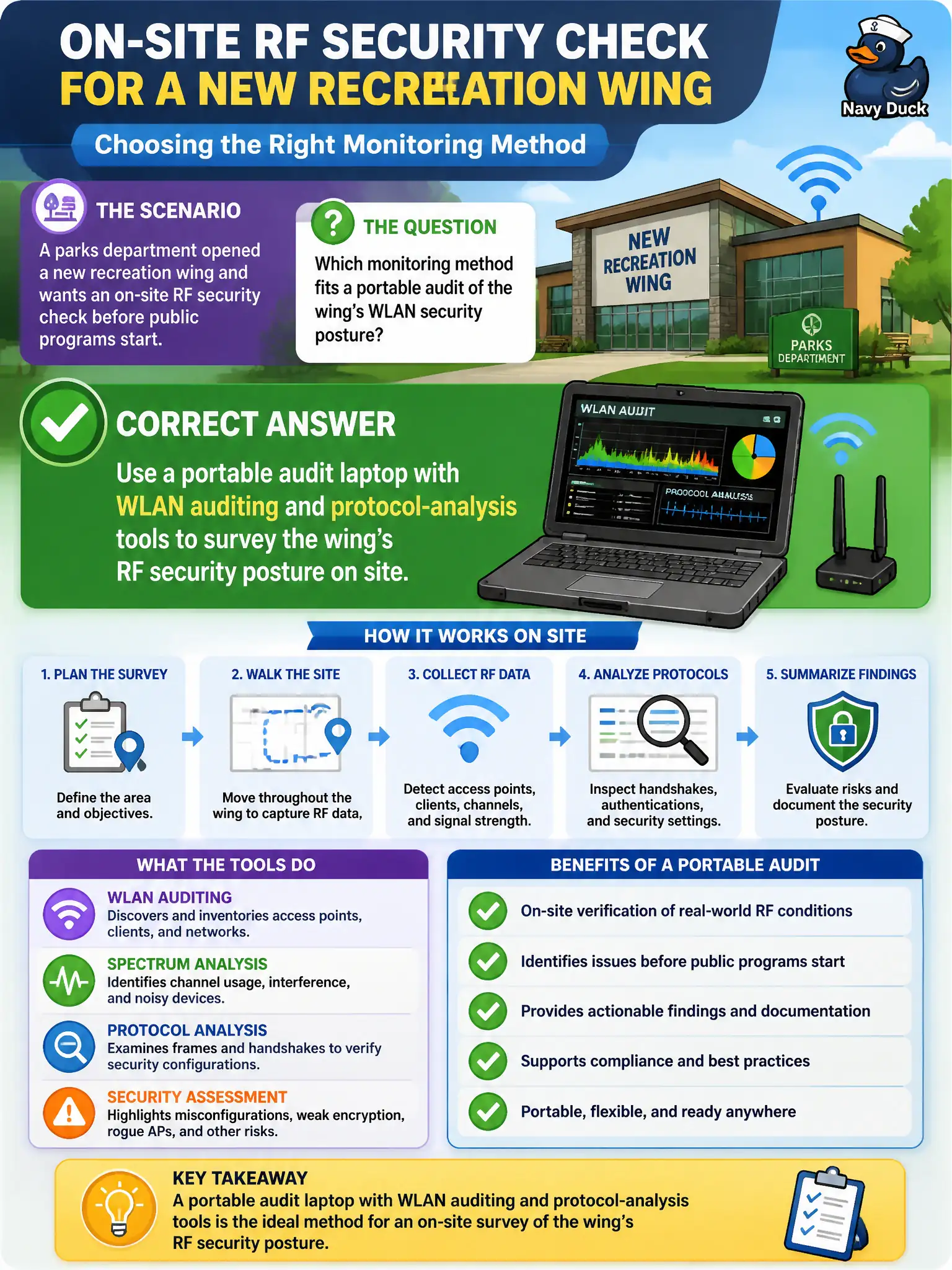
A parks department opened a new recreation wing and wants an on-site RF security check before public programs start. Which monitoring method fits a portable audit of the wing’s WLAN security posture?
Select an answer to reveal the explanation.
Short Explanation
Think of a portable audit like a security walk-through with a spectrum flashlight. You take the laptop into the new wing and look at what the air is actually saying. A wired ping from the closet does not see rogue SSIDs in the gym.
Full Explanation
For an on-site RF security check of a newly opened recreation wing's WLAN before public use, deploying a portable audit laptop equipped with WLAN auditing and protocol-analysis tools is the most appropriate monitoring method. This approach allows direct measurement of the RF environment, detection of unauthorized access points, verification of encryption standards, and assessment of signal coverage and interference in the specific physical space. Relying solely on annual paper policy reviews without any on-site RF measurement fails to capture real-time or location-specific security conditions and cannot detect active threats or configuration issues. Simply pinging the default gateway from a wired closet does not assess wireless security posture or RF vulnerabilities, as it only tests basic network connectivity from a fixed point. Disabling Wireless Intrusion Prevention Systems (WIPS) citywide to reduce RF noise during the opening weekend compromises ongoing protection and is counterproductive to security assurance. The operational check involves using tools like Wireshark or AirMagnet on the audit laptop to scan for unauthorized devices, analyze encryption types, and confirm that the WLAN adheres to security policies within the recreation wing environment.