
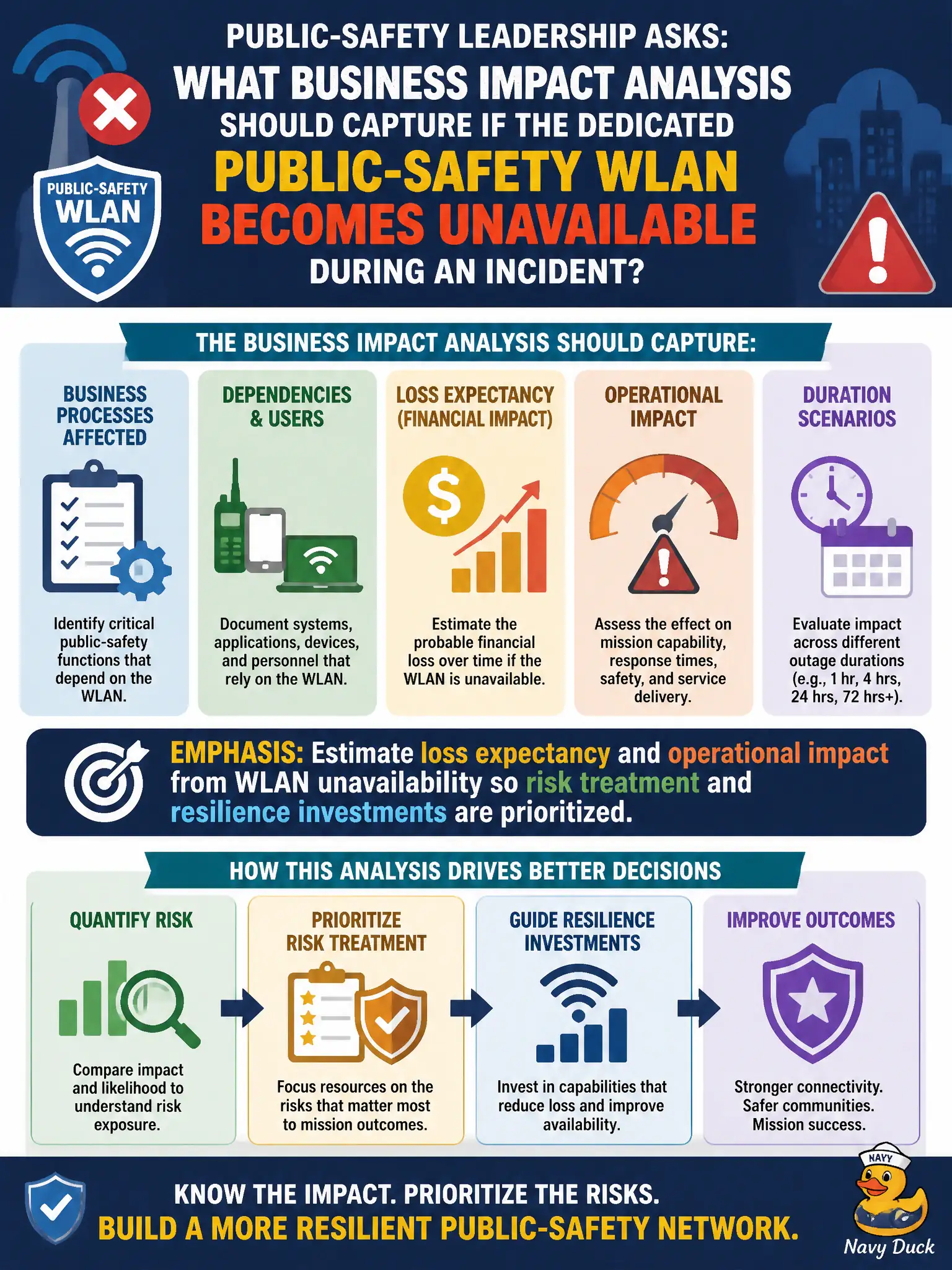
Public-safety leadership asks what business impact analysis should capture if the dedicated public-safety WLAN becomes unavailable during an incident. What should that analysis emphasize?
Select an answer to reveal the explanation.
Short Explanation
When the public-safety WLAN goes dark, somebody should already know what that costs in ops terms. Loss expectancy drives resilience spend. Cafe Wi-Fi daydreams are not a BIA.
Full Explanation
Public-safety leadership asking what business impact analysis should capture if the dedicated public-safety WLAN becomes unavailable during an incident should hear loss expectancy and operational impact estimates that prioritize risk treatment and resilience investments. BIA translates RF outage into mission language—dispatch delays, lost telemetry, mutual-aid friction—for budget and architecture decisions. Civic wireless resilience funding depends on that articulation.
Assuming zero impact because responders can always switch to open cafe Wi-Fi is operationally reckless. Measuring only marketing impressions lost on the guest SSID answers the wrong mission. Deferring analysis until after the next outage produces forensic captures learns only after harm.
Exam caveat: BIA should include dependencies (AAA, backhaul, power) not only AP hardware failure. Operational check: workshop a public-safety WLAN outage scenario, record impact metrics and recovery time objectives, and feed results into redundancy and spare plans. In municipal WLAN programs, capture the decision in the wireless standard and re-check it at change review so the next project inherits the same control bar instead of rediscovering the failure during an outage. In municipal WLAN programs, capture the decision in the wireless standard and re-check it at change review so the next project inherits the same control bar instead of rediscovering the failure during an outage.