
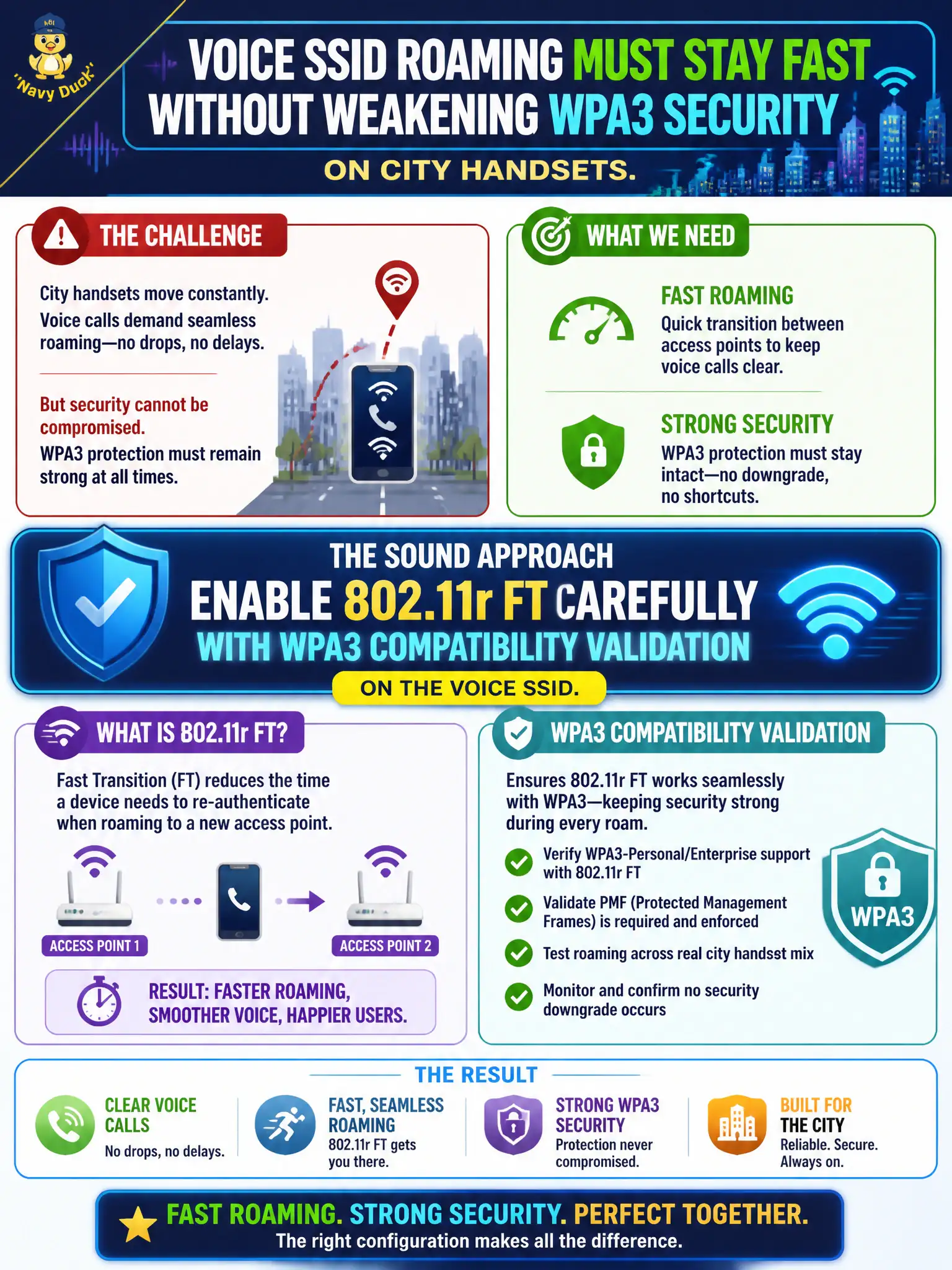
Voice SSID roaming must stay fast without weakening WPA3 security on city handsets. What is the sound approach?
Select an answer to reveal the explanation.
Short Explanation
Voice hates long reauthentication pit stops. 802.11r FT is the express lane—if you check that WPA3 and the handsets actually play nice. Stripping encryption or clinging to WEP just to roam faster is a career-limiting shortcut.
Full Explanation
Voice SSID roaming for city handsets must stay fast without weakening WPA3 security. Enabling 802.11r fast BSS transition carefully with WPA3 compatibility validation on the voice SSID is the sound approach: reduce full EAP cost on roam while preserving modern AKM and cipher requirements. Public-safety and facilities voice users notice roam-induced drops immediately, so FT belongs in the voice profile after interoperability testing.
Disabling all encryption on the voice SSID to guarantee roam speed trades confidentiality for a false performance fix. Forcing full EAP on every roam with no FT/OKC when voice dropouts occur ignores the purpose of fast transition tools. Using WEP plus aggressive band steering as the voice security model combines obsolete crypto with roam disruption.
Exam caveat: 802.11r and WPA3 client quirks are real—validate handset models before citywide enablement rather than flipping FT globally on day one. Operational check: with FT enabled on the voice SSID, walk roam boundaries during test calls, confirm reduced reauth time without drops, and compare against a control call with FT disabled. In municipal WLAN programs, write the control into standards and verify it during change review so the next project inherits the same bar rather than rediscovering the failure mode under outage pressure.