
Municipal IoT sensors cannot perform 802.1X. Which onboarding pattern best limits blast radius versus one global PSK?
Select an answer to reveal the explanation.
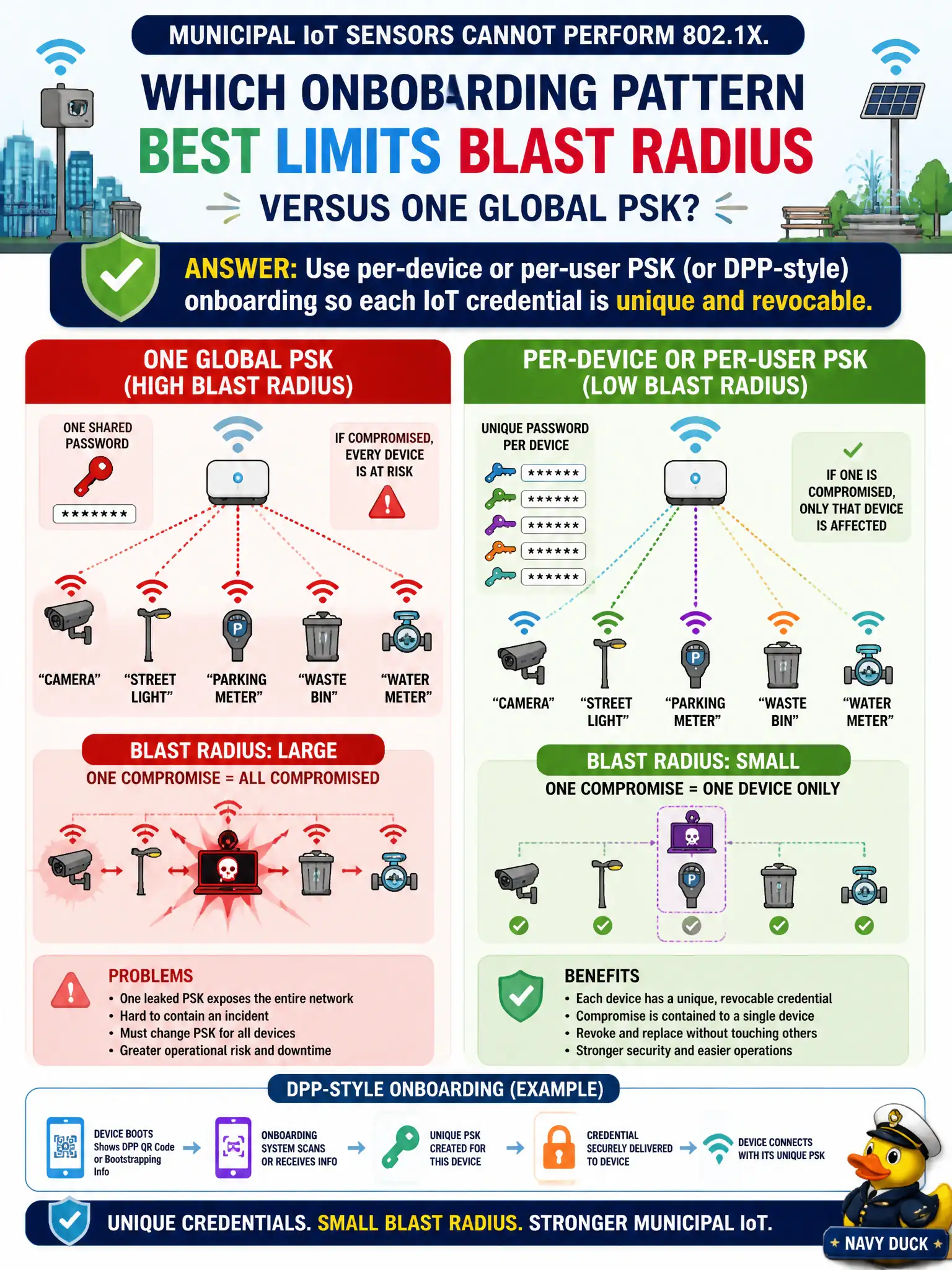
Short Explanation
One giant IoT password is a master key taped to the fridge. Per-device or DPP-style onboarding lets you revoke one sensor without rekeying the city. Waiting a year with the door open is not a strategy.
Full Explanation
Municipal IoT sensors that cannot perform 802.1X still need better credential hygiene than one global PSK. Per-device or per-user PSK (or DPP-style) onboarding so each IoT credential is unique and revocable limits blast radius when a sensor is lost, cloned, or decommissioned. Civic IoT estates for meters, sensors, and building systems grow quickly; shared campus PSKs become forever-secrets that nobody can rotate safely.
Printing one campus-wide PSK on a sticker inside every sensor enclosure guarantees compromise spreads to the whole fleet. Bridging all IoT devices onto the domain admin VLAN without authentication maximizes privilege. Disabling wireless security until next fiscal year’s 802.1X-capable sensors arrive leaves an unprotected window with no compensating control.
Exam caveat: unique PSKs still belong on isolated IoT VLANs with ACLs—credential uniqueness does not replace segmentation. Operational check: onboard two sensors with distinct credentials, revoke one, confirm only the revoked device loses access, and verify IoT VLAN ACLs still block lateral movement to staff subnets. In municipal WLAN programs, write the control into standards and verify it during change review so the next project inherits the same bar rather than rediscovering the failure mode under outage pressure.