
A civic campus places dense BLE tags on an IoT VLAN while WIPS/IDS watches the WLAN. What monitoring awareness is most important?
Select an answer to reveal the explanation.
Short Explanation
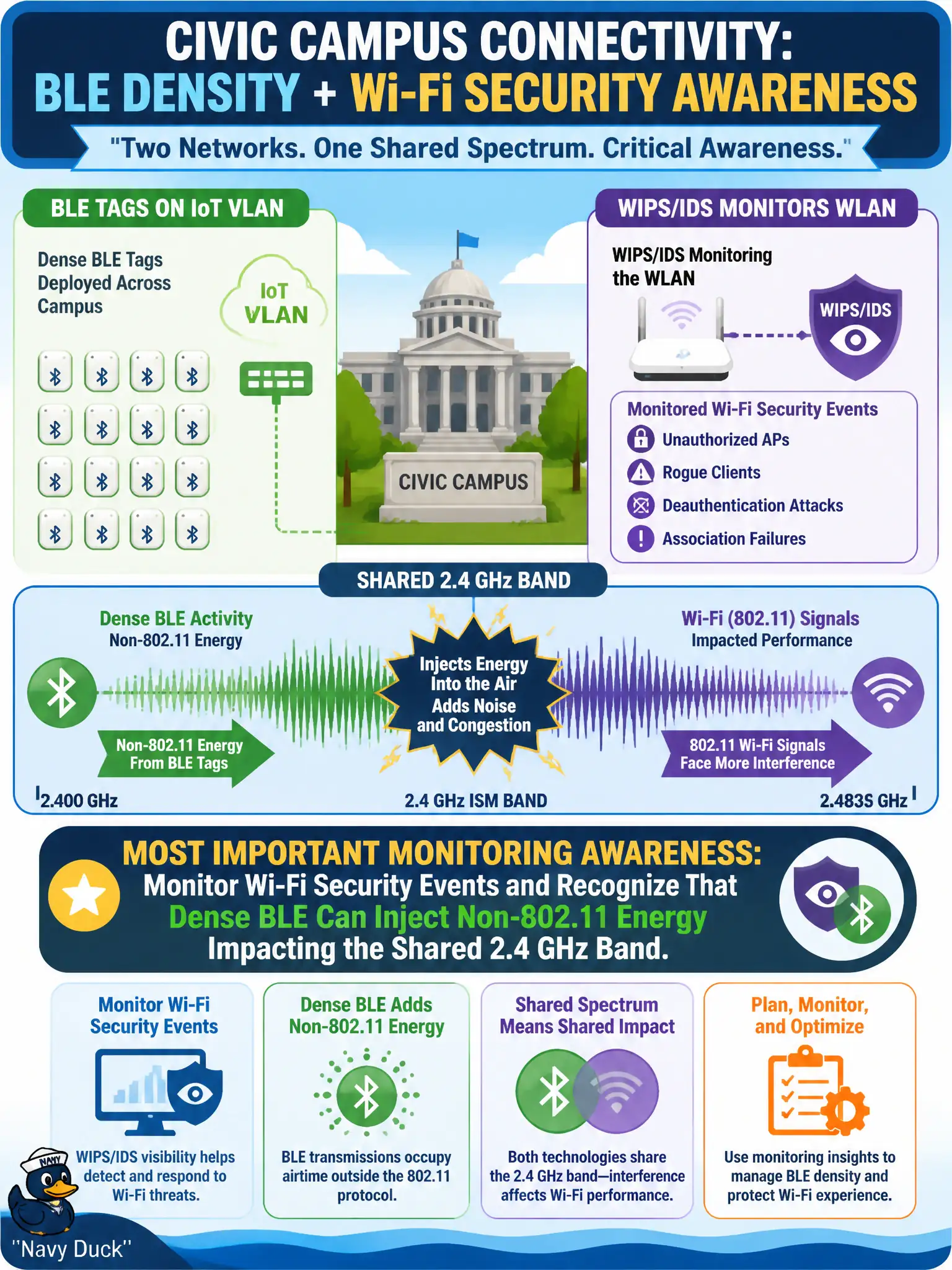
WIPS watches Wi-Fi bad guys; dense BLE still lights up the 2.4 GHz neighborhood like a noisy party next door. Keep security monitoring and remember non-802.11 energy is real. VLANs do not silence radios.
Full Explanation
On a civic campus with dense BLE tags on an IoT VLAN while WIPS/IDS watches the WLAN, monitor Wi-Fi security events and recognize that dense BLE can inject non-802.11 energy impacting the shared 2.4 GHz band. WIPS alone does not always decode every BLE advertisement as 802.11 management frames. Non-802.11 energy can affect Wi-Fi, so spectrum views remain necessary near dense BLE. IoT VLANs do not eliminate RF coexistence issues by definition—they segment IP, not spectrum. Exam caveat: security monitoring and spectrum coexistence are both required near dense BLE. Operational check: correlate WIPS alerts with spectrum duty cycle near tag-dense floors and adjust BLE density or Wi-Fi channels for municipal campus stability. In municipal WLAN and IoT operations, record the chosen control and the rejected alternatives in the change ticket so on-call staff understand which failure modes were avoided for city services. Re-validate after the next maintenance window that the same control still holds under the current platform code, device mix, and civic event calendar used by the wireless team. Keep RF, capacity, security, and QoS evidence attached to the municipal runbook entry for auditors and future CWNE-level reviews.