
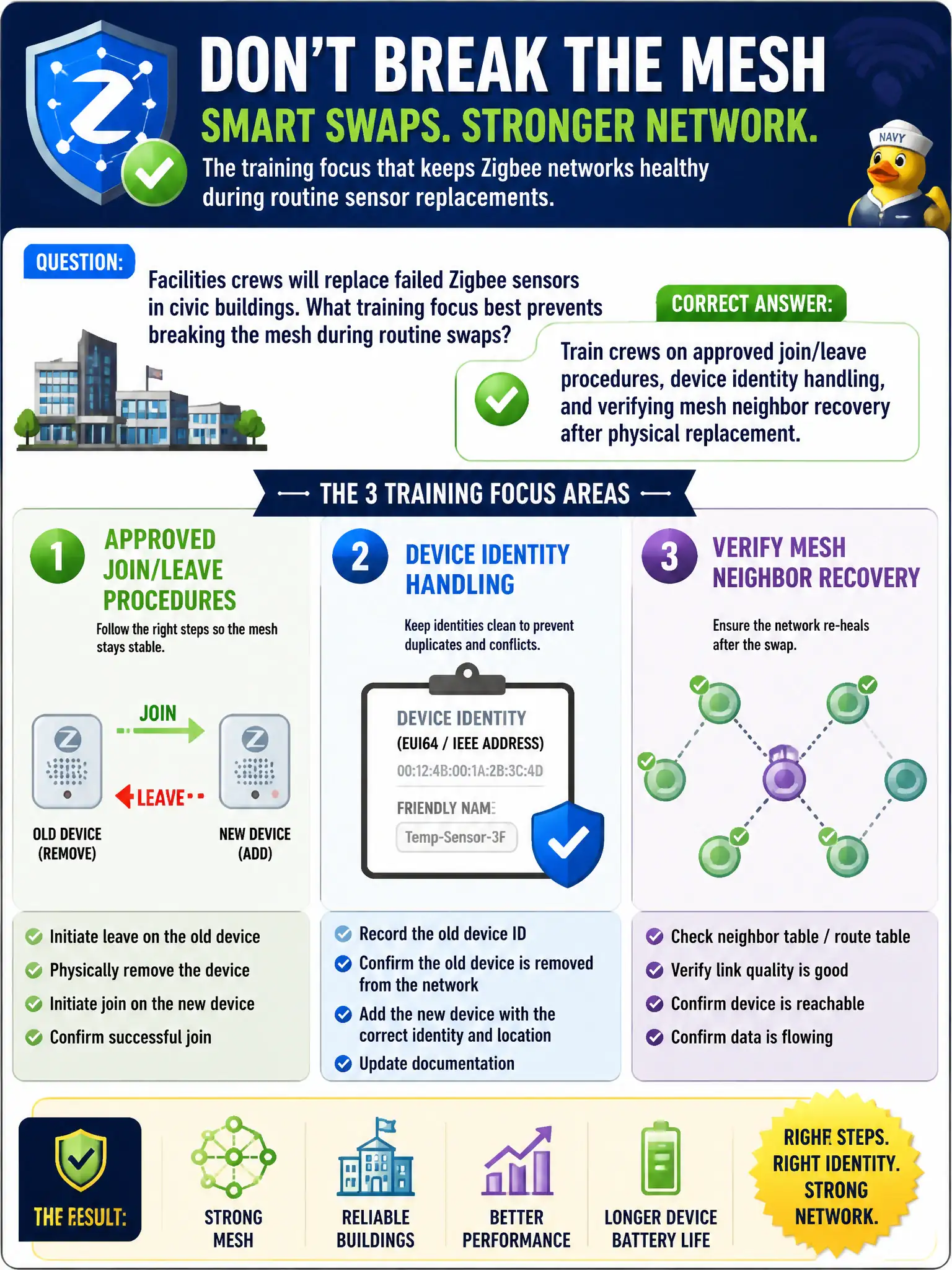
Facilities crews will replace failed Zigbee sensors in civic buildings. What training focus best prevents breaking the mesh during routine swaps?
Select an answer to reveal the explanation.
Short Explanation
Swapping a Zigbee sensor is like changing a light on a string—pull the wrong way and the whole strand goes dark. Teach join/leave steps and check neighbors afterward. Random router resets and secret pairing rituals are how meshes die.
Full Explanation
Facilities crews replacing failed Zigbee sensors in civic buildings need training on approved join/leave procedures, device identity handling, and verifying mesh neighbor recovery after physical replacement so routine swaps do not partition the mesh. Telling crews to factory-reset random working routers whenever any leaf fails destabilizes the network. Instructing staff to remove all powered mains routers first during every single sensor swap is backwards and harmful. Discouraging documentation so each building invents its own pairing ritual guarantees inconsistent municipal operations. Exam caveat: mesh hygiene is a people process as much as an RF process. Operational check: certify crews on the join/leave runbook, audit a sample replacement for neighbor recovery, and keep building-specific Zigbee maps with the civic facilities team. In municipal WLAN and IoT operations, record the chosen control and the rejected alternatives in the change ticket so on-call staff understand which failure modes were avoided for city services. Re-validate after the next maintenance window that the same control still holds under the current platform code, device mix, and civic event calendar used by the wireless team.