
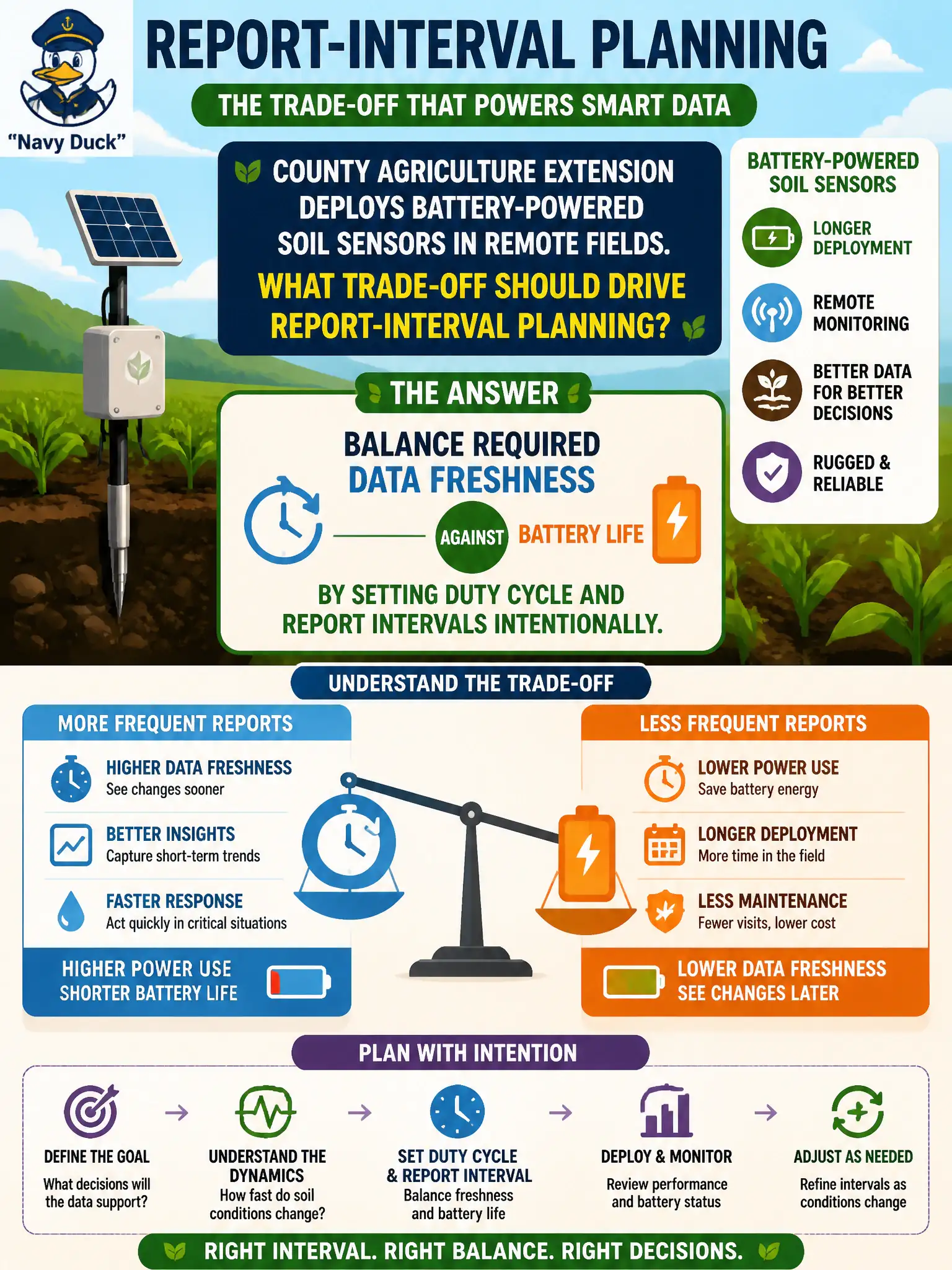
County agriculture extension deploys battery-powered soil sensors in remote fields. What trade-off should drive report-interval planning?
Select an answer to reveal the explanation.
Short Explanation
Every chirp costs battery—like miles on a tank of gas. Match how often the soil must speak with how long the pack must last. Millisecond spam and 'radios use no energy' myths leave fields silent mid-season.
Full Explanation
Battery-powered soil sensors for county agriculture extension must balance required data freshness against battery life by setting duty cycle and report intervals intentionally. Maximizing report rate to once per millisecond regardless of battery chemistry will kill the deployment. Ignoring battery life because LPWAN radios never consume energy is false. Requiring continuous full-power beaconing identical to always-on Wi-Fi laptops defeats the LPWAN purpose. Exam caveat: report interval is an energy budget decision. Operational check: set intervals from agronomy needs and battery math, field-test lifetime, and document the civic sensor duty-cycle standard. In municipal WLAN and IoT operations, record the chosen control and the rejected alternatives in the change ticket so on-call staff understand which failure modes were avoided for city services. Re-validate after the next maintenance window that the same control still holds under the current platform code, device mix, and civic event calendar used by the wireless team. Keep RF, capacity, security, and QoS evidence attached to the municipal runbook entry for auditors and future CWNE-level reviews. Attach spectrum, capacity, security, and QoS evidence to the municipal runbook entry so auditors and future CWNE-level reviews can replay why this control was selected for city services.