
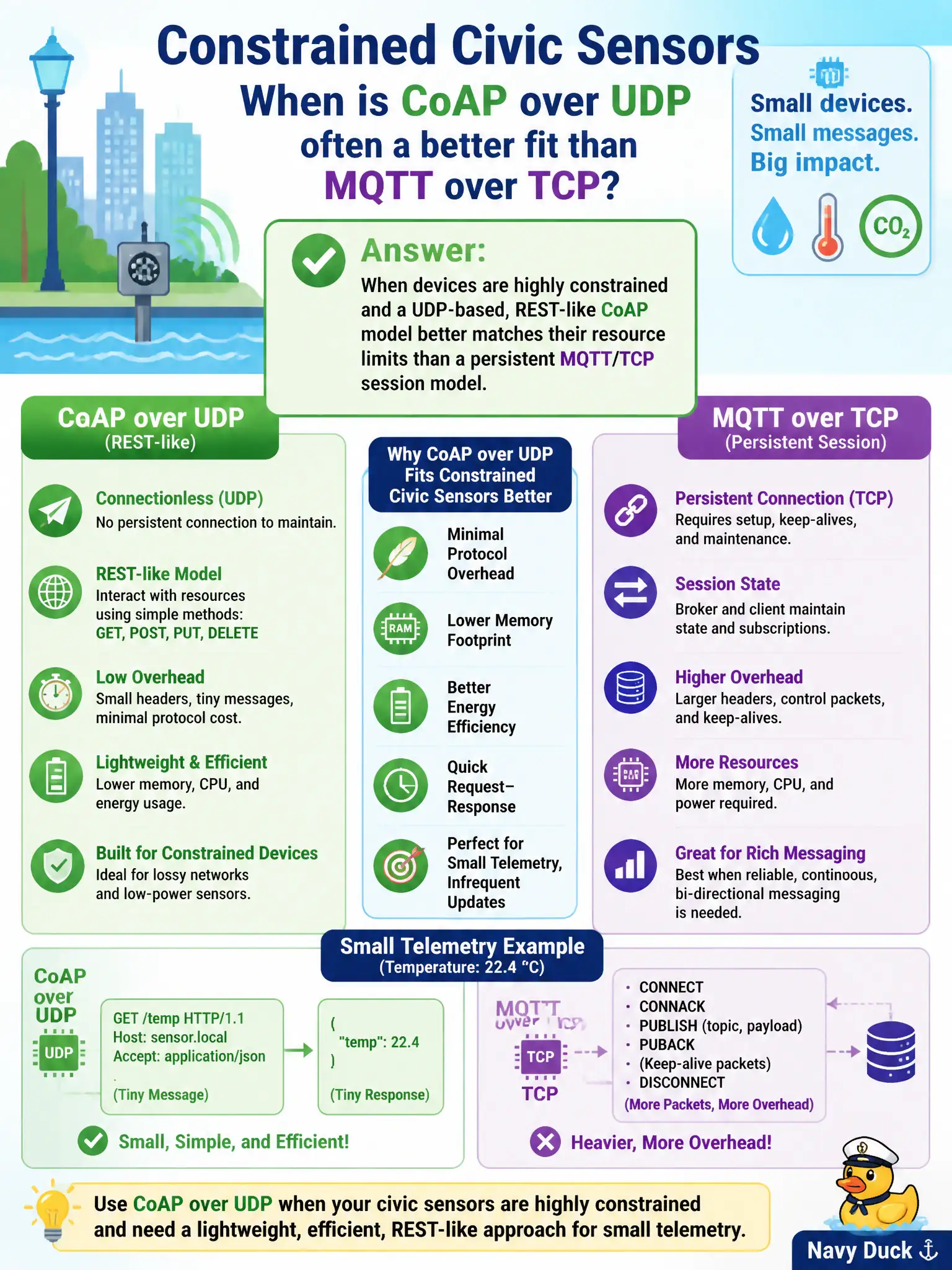
Constrained civic sensors must send small telemetry with minimal protocol overhead. When is CoAP over UDP often a better fit than MQTT over TCP?
Select an answer to reveal the explanation.
Short Explanation
Tiny sensors often prefer CoAP/UDP—light knocks on the door—over keeping an MQTT/TCP conversation open all day. Save MQTT for brokers that expect that session model. SMB and captive portals are not constrained-device telemetry tools.
Full Explanation
Constrained civic sensors sending small telemetry with minimal overhead often fit CoAP over UDP better than MQTT over TCP when devices are highly constrained and a UDP-based, REST-like CoAP model matches resource limits better than a persistent MQTT/TCP session model. CoAP is a poor fit when the only requirement is multi-gigabit WAN file transfer. Sensors terminating full desktop TLS portals with captive HTML login pages are the wrong device class for CoAP telemetry design. Exclusive reliance on SMB file shares for telemetry is not an IoT constrained-protocol pattern. Exam caveat: choose CoAP vs MQTT from device constraints and session model, not fashion. Operational check: prototype CoAP exchanges on target sensors, measure energy and loss handling, and adopt the stack that meets municipal telemetry SLOs. In municipal WLAN and IoT operations, record the chosen control and the rejected alternatives in the change ticket so on-call staff understand which failure modes were avoided for city services. Re-validate after the next maintenance window that the same control still holds under the current platform code, device mix, and civic event calendar used by the wireless team. Keep RF, capacity, security, and QoS evidence attached to the municipal runbook entry for auditors and future CWNE-level reviews.