
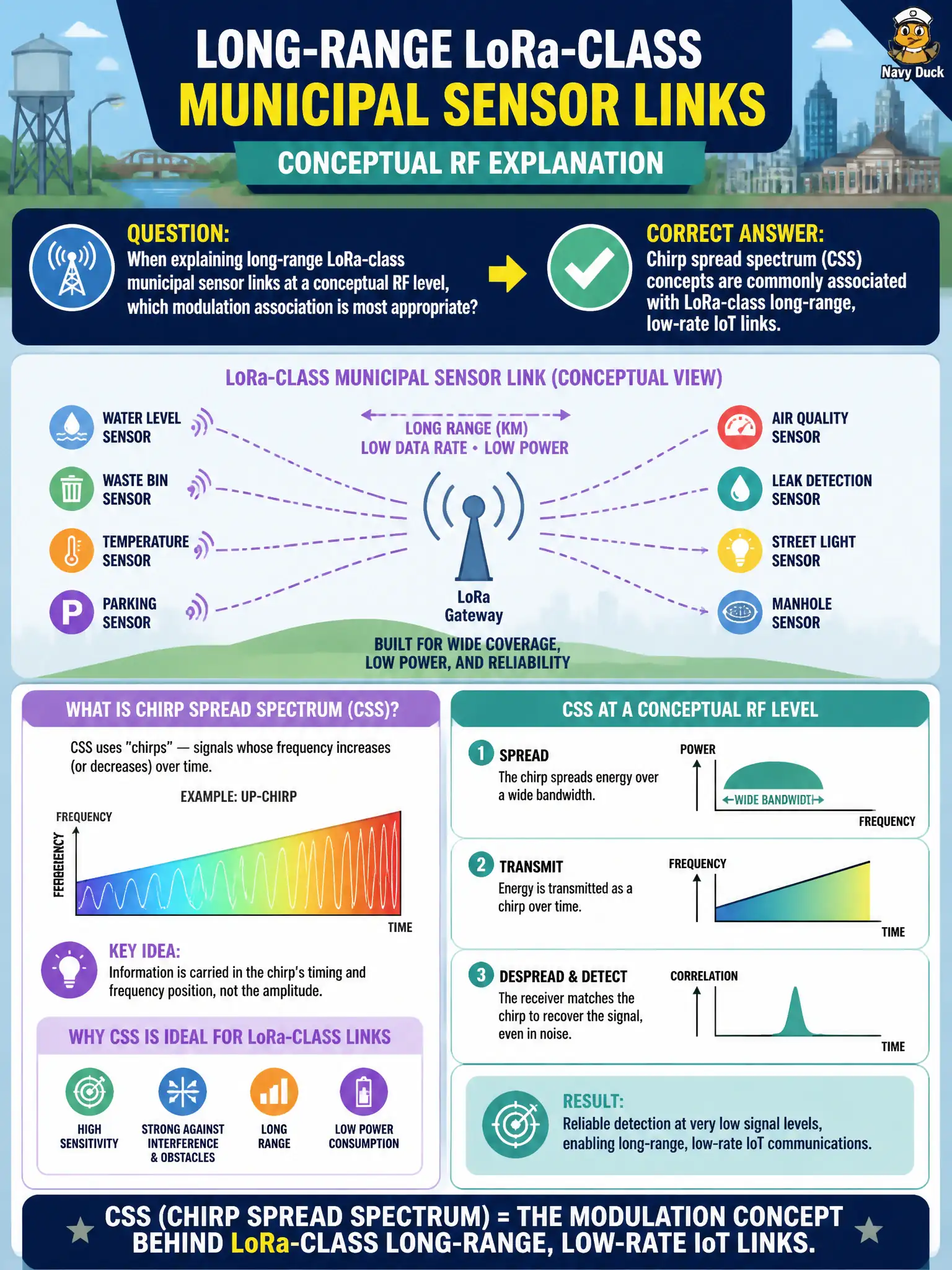
When explaining long-range LoRa-class municipal sensor links at a conceptual RF level, which modulation association is most appropriate?
Select an answer to reveal the explanation.
Short Explanation
LoRa's party trick is chirp spread spectrum—long, swooping tones that dig signals out of noise for tiny payloads. It is not AM radio and not Wi-Fi OFDMA in disguise. When someone says LoRa reach, think CSS, not café Wi-Fi.
Full Explanation
At a conceptual RF level, chirp spread spectrum (CSS) concepts are commonly associated with LoRa-class long-range, low-rate IoT links used for municipal sensors. LoRa-class links do not primarily use classical AM broadcast audio modulation. LoRaWAN does not depend on mandatory 802.11ax OFDMA resource units for every sensor uplink. Chirp mechanisms are not meaningless marketing terms without RF content for LPWAN. Exam caveat: connect LPWAN marketing names to actual modulation concepts at CWNE depth. Operational check: when briefing stakeholders, explain CSS trade-offs of range versus bitrate for civic flood or meter sensors without confusing them with Wi-Fi HE features. In municipal WLAN and IoT operations, record the chosen control and the rejected alternatives in the change ticket so on-call staff understand which failure modes were avoided for city services. Re-validate after the next maintenance window that the same control still holds under the current platform code, device mix, and civic event calendar used by the wireless team. Keep RF, capacity, security, and QoS evidence attached to the municipal runbook entry for auditors and future CWNE-level reviews. Attach spectrum, capacity, security, and QoS evidence to the municipal runbook entry so auditors and future CWNE-level reviews can replay why this control was selected for city services.