
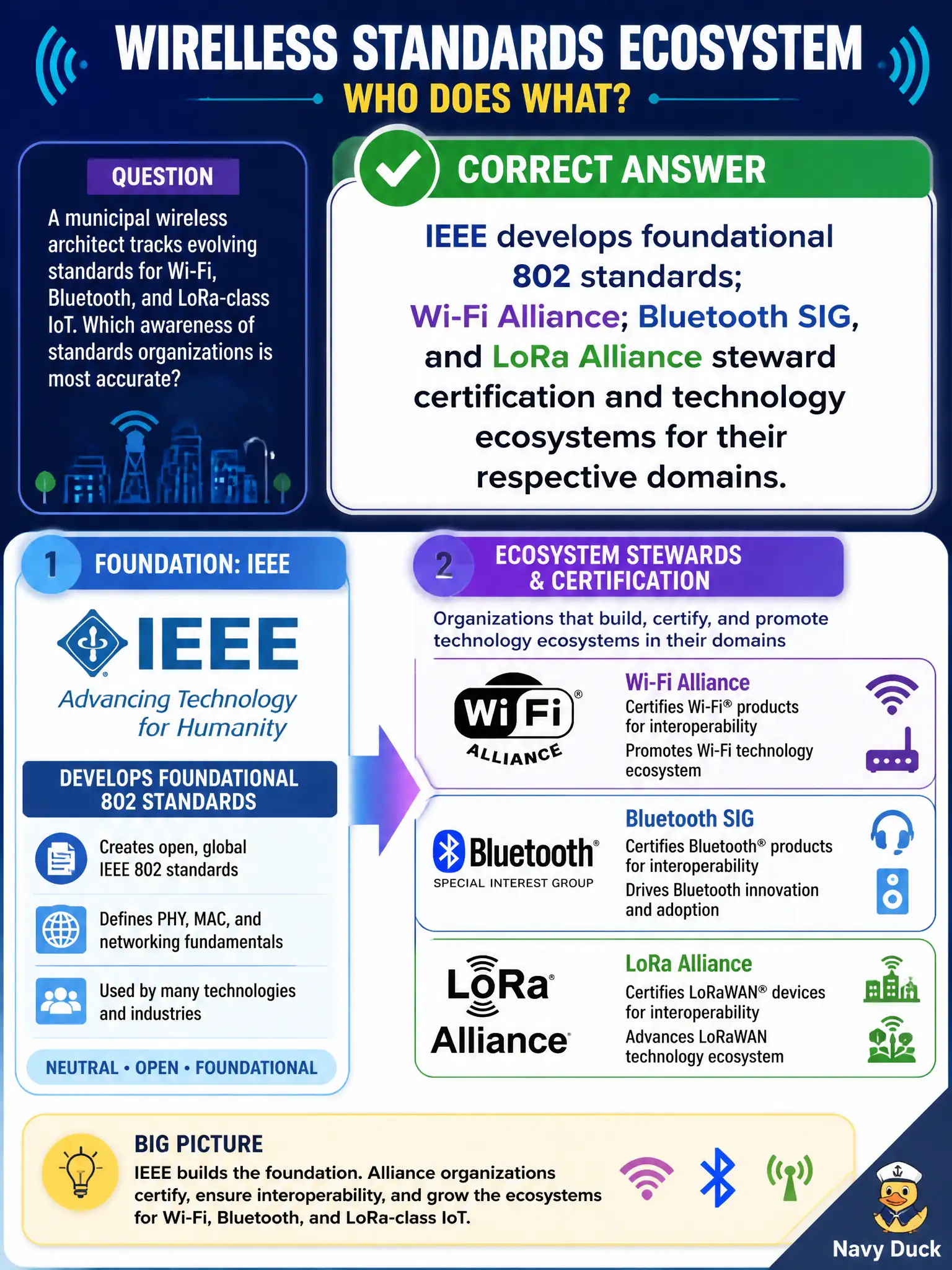
A municipal wireless architect tracks evolving standards for Wi-Fi, Bluetooth, and LoRa-class IoT. Which awareness of standards organizations is most accurate?
Select an answer to reveal the explanation.
Short Explanation
Picture IEEE as the rulebook printers for 802-ish radio languages, while Wi-Fi Alliance, Bluetooth SIG, and LoRa Alliance run the brand clubs and interoperability badges. Do not swap their homework—Bluetooth SIG is not writing your 802.11 PHYs.
Full Explanation
Municipal architects should know IEEE develops foundational 802 standards while Wi-Fi Alliance, Bluetooth SIG, and LoRa Alliance steward certification and technology ecosystems for their domains. The Bluetooth SIG does not publish 802.11 PHY amendments exclusively. The LoRa Alliance does not maintain WPA3 and 802.1X specifications. Wi-Fi Alliance does not replace IEEE entirely or own Zigbee device profiles. Exam caveat: standards literacy prevents mis-assigning governance across Wi-Fi, Bluetooth, and LPWAN. Operational check: cite the correct SDO when writing civic RF/IoT procurement language and certification requirements. In municipal WLAN and IoT operations, record the chosen control and the rejected alternatives in the change ticket so on-call staff understand which failure modes were avoided for city services. Re-validate after the next maintenance window that the same control still holds under the current platform code, device mix, and civic event calendar used by the wireless team. Keep RF, capacity, security, and QoS evidence attached to the municipal runbook entry for auditors and future CWNE-level reviews. Attach spectrum, capacity, security, and QoS evidence to the municipal runbook entry so auditors and future CWNE-level reviews can replay why this control was selected for city services.