
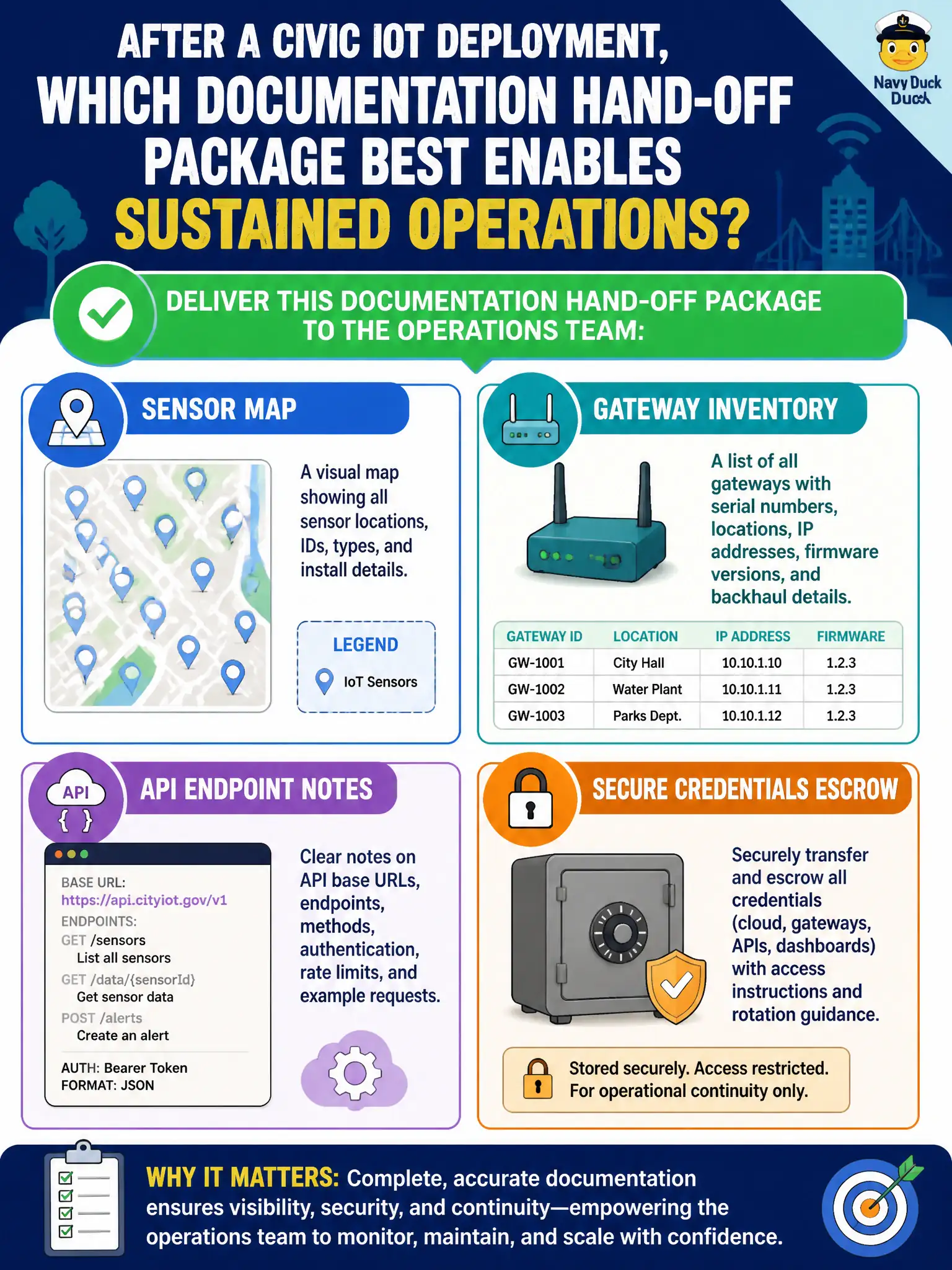
After a civic IoT deployment, which documentation hand-off package best enables sustained operations?
Select an answer to reveal the explanation.
Short Explanation
Ops inherits what you document—maps, gateways, APIs, and where the keys live in escrow. Logos and group texts are not a hand-off. If serial numbers vanish, the next outage becomes a scavenger hunt.
Full Explanation
After a civic IoT deployment, hand operations a sensor map, gateway inventory, API endpoint notes, and secure credentials escrow so sustained operations are possible. A single marketing slide with a vendor logo and no inventories is not a hand-off. Oral tribal knowledge with credentials in a group text fails audit and continuity. Discarding gateway serial numbers to reduce paperwork sabotages asset management. Exam caveat: IoT operability equals documentation plus secure secret handling. Operational check: complete the hand-off checklist, verify ops can locate and re-key a sample gateway, and store escrow per municipal security policy. In municipal WLAN and IoT operations, record the chosen control and the rejected alternatives in the change ticket so on-call staff understand which failure modes were avoided for city services. Re-validate after the next maintenance window that the same control still holds under the current platform code, device mix, and civic event calendar used by the wireless team. Keep RF, capacity, security, and QoS evidence attached to the municipal runbook entry for auditors and future CWNE-level reviews. Attach spectrum, capacity, security, and QoS evidence to the municipal runbook entry so auditors and future CWNE-level reviews can replay why this control was selected for city services.