
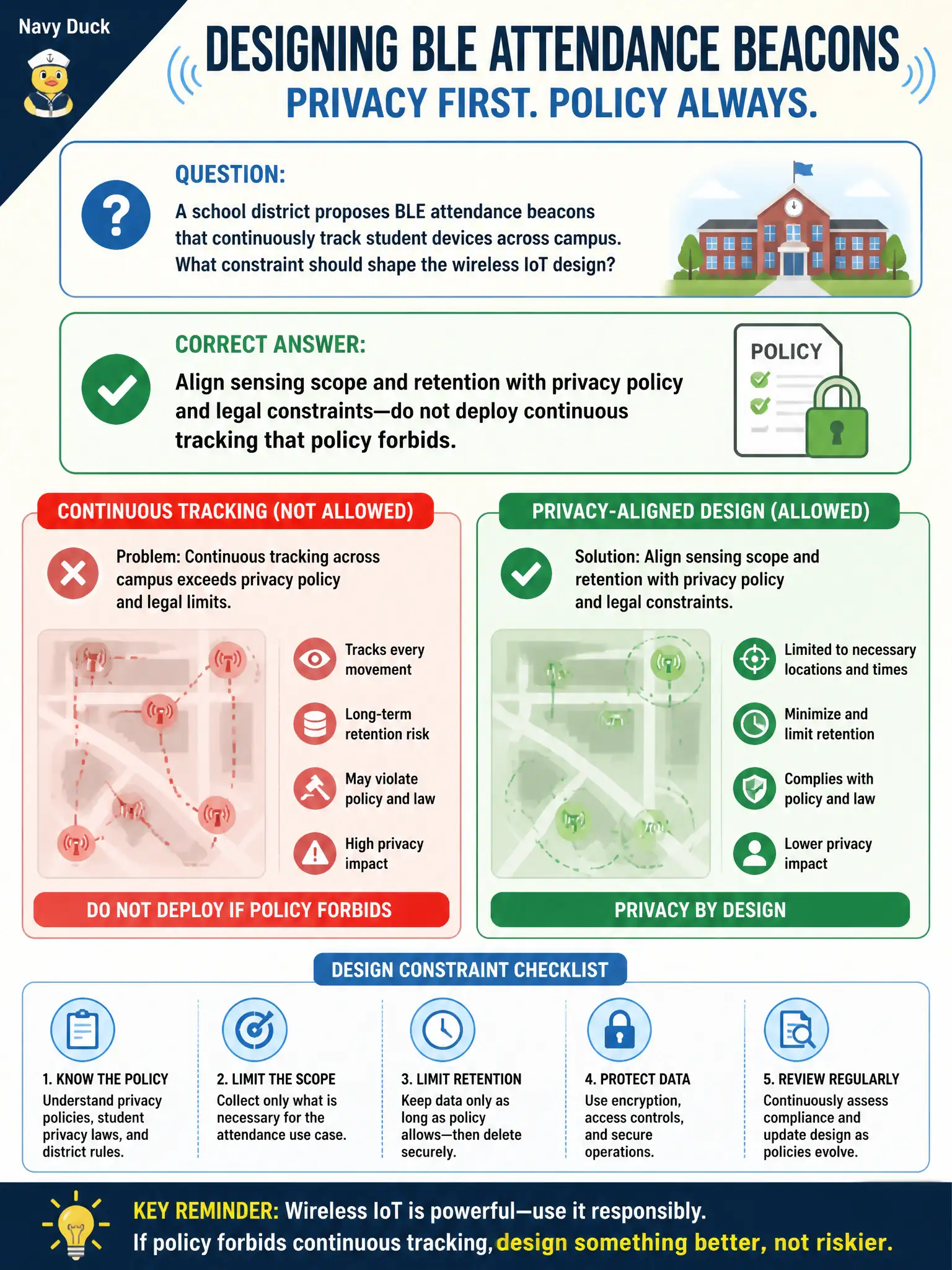
A school district proposes BLE attendance beacons that continuously track student devices across campus. What constraint should shape the wireless IoT design?
Select an answer to reveal the explanation.
Short Explanation
Just because a beacon can whisper everywhere does not mean the district should listen everywhere. Privacy policy and law set the fence line before RF design. Public beacon dumps and 'review it next June' are how projects get shut down.
Full Explanation
School-district BLE attendance beacons that continuously track student devices must align sensing scope and retention with privacy policy and legal constraints—do not deploy continuous tracking that policy forbids. Ignoring privacy because BLE ads are supposedly always anonymous and unregulated in education is unsafe and often wrong. Mirroring every beacon ID on a public unauthenticated website amplifies privacy harm. Mandating privacy reviews only after a full academic-year production rollout is backwards. Exam caveat: wireless IoT design is constrained by privacy law and policy, not only RF. Operational check: obtain privacy/legal sign-off on scope and retention, minimize collection, and only then pilot BLE attendance for the district. In municipal WLAN and IoT operations, record the chosen control and the rejected alternatives in the change ticket so on-call staff understand which failure modes were avoided for city services. Re-validate after the next maintenance window that the same control still holds under the current platform code, device mix, and civic event calendar used by the wireless team. Keep RF, capacity, security, and QoS evidence attached to the municipal runbook entry for auditors and future CWNE-level reviews.