
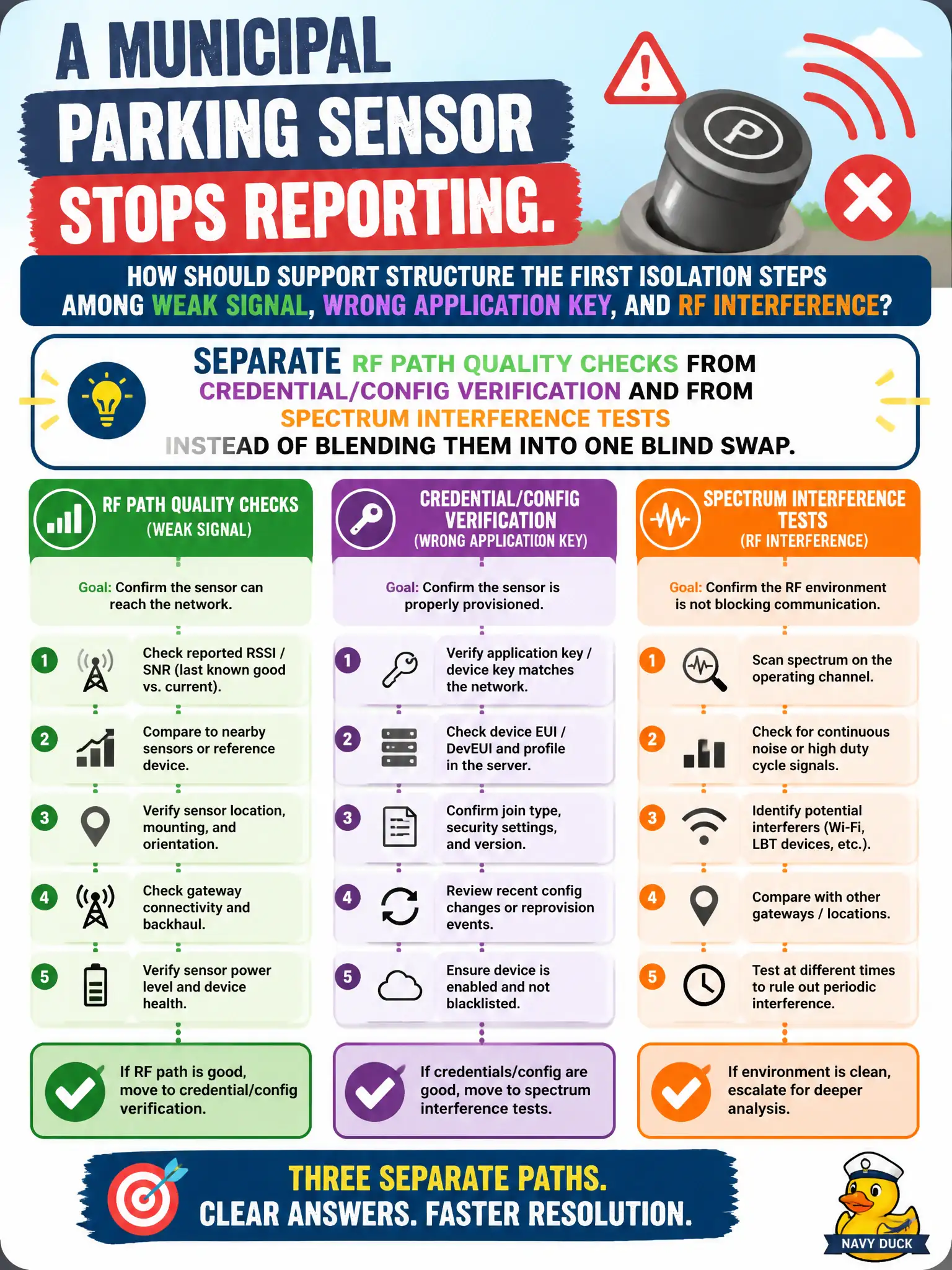
A municipal parking sensor stops reporting. How should support structure the first isolation steps among weak signal, wrong application key, and RF interference?
Select an answer to reveal the explanation.
Short Explanation
Treat it like sorting laundry: signal problems, bad keys, and noisy neighbors are different piles. Check path quality, then credentials, then interference—do not boil the ocean by rebuilding the whole NS first. A CMS theme never fixed a parking sensor radio.
Full Explanation
When a municipal parking sensor stops reporting, separate RF path quality checks from credential/config verification and from spectrum interference tests instead of blending them into one blind swap. Replacing the entire city LoRaWAN network server before checking one sensor is disproportionate. Changing every sensor’s app key citywide as the first action risks mass outage. Updating the public website CMS theme cannot restore sensor RF. Exam caveat: structured isolation beats shotgun changes in IoT support. Operational check: test RSSI/SNR or link metrics, verify the device key/config, scan for interference, then repair the failing layer and record the civic parking IoT ticket outcome. In municipal WLAN and IoT operations, record the chosen control and the rejected alternatives in the change ticket so on-call staff understand which failure modes were avoided for city services. Re-validate after the next maintenance window that the same control still holds under the current platform code, device mix, and civic event calendar used by the wireless team. Keep RF, capacity, security, and QoS evidence attached to the municipal runbook entry for auditors and future CWNE-level reviews. Attach spectrum, capacity, security, and QoS evidence to the municipal runbook entry so auditors and future CWNE-level reviews can replay why this control was selected for city services.