
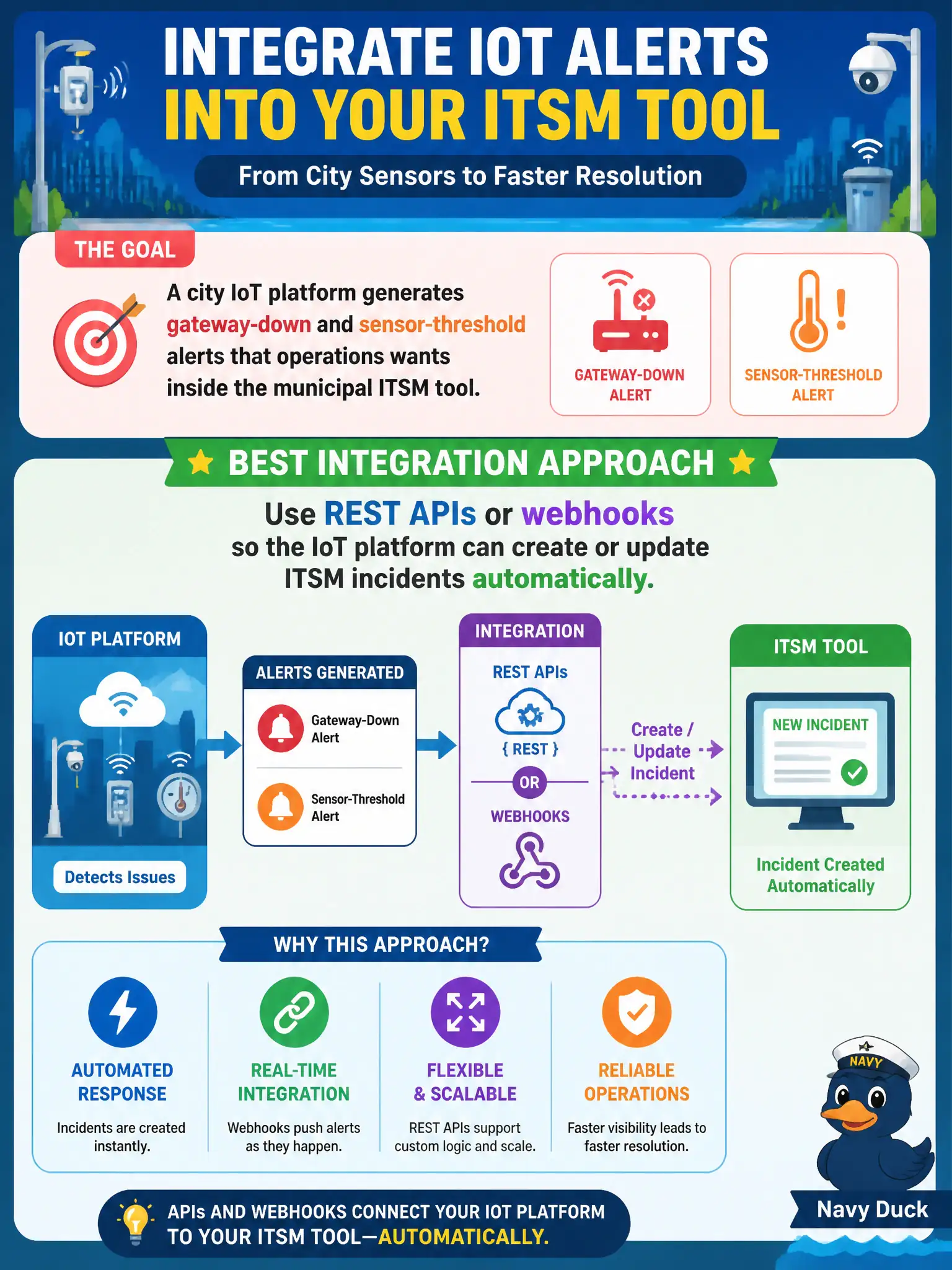
A city IoT platform generates gateway-down and sensor-threshold alerts that operations wants inside the municipal ITSM tool. What integration approach best fits that goal?
Select an answer to reveal the explanation.
Short Explanation
If the IoT brain can shout and the ITSM desk can listen, wire them with APIs or webhooks. Manual retyping and monthly PDFs are how tickets arrive after the flood already started. USB sticks at poles are not a NOC workflow.
Full Explanation
City IoT gateway-down and sensor-threshold alerts belong in the municipal ITSM tool via REST APIs or webhooks that create or update incidents automatically. Requiring NOC staff to retype every alert from a separate vendor portal forever does not scale. Exporting alerts only as monthly printed PDFs is too slow for operations. Storing alerts solely on a USB stick at each gateway with no central ticket path prevents citywide response. Exam caveat: IoT observability must integrate with ITSM, not sit in a silo. Operational check: map alert severities to ITSM priorities, test webhook ticket creation, and train the civic NOC on the resulting runbooks. In municipal WLAN and IoT operations, record the chosen control and the rejected alternatives in the change ticket so on-call staff understand which failure modes were avoided for city services. Re-validate after the next maintenance window that the same control still holds under the current platform code, device mix, and civic event calendar used by the wireless team. Keep RF, capacity, security, and QoS evidence attached to the municipal runbook entry for auditors and future CWNE-level reviews. Attach spectrum, capacity, security, and QoS evidence to the municipal runbook entry so auditors and future CWNE-level reviews can replay why this control was selected for city services.