
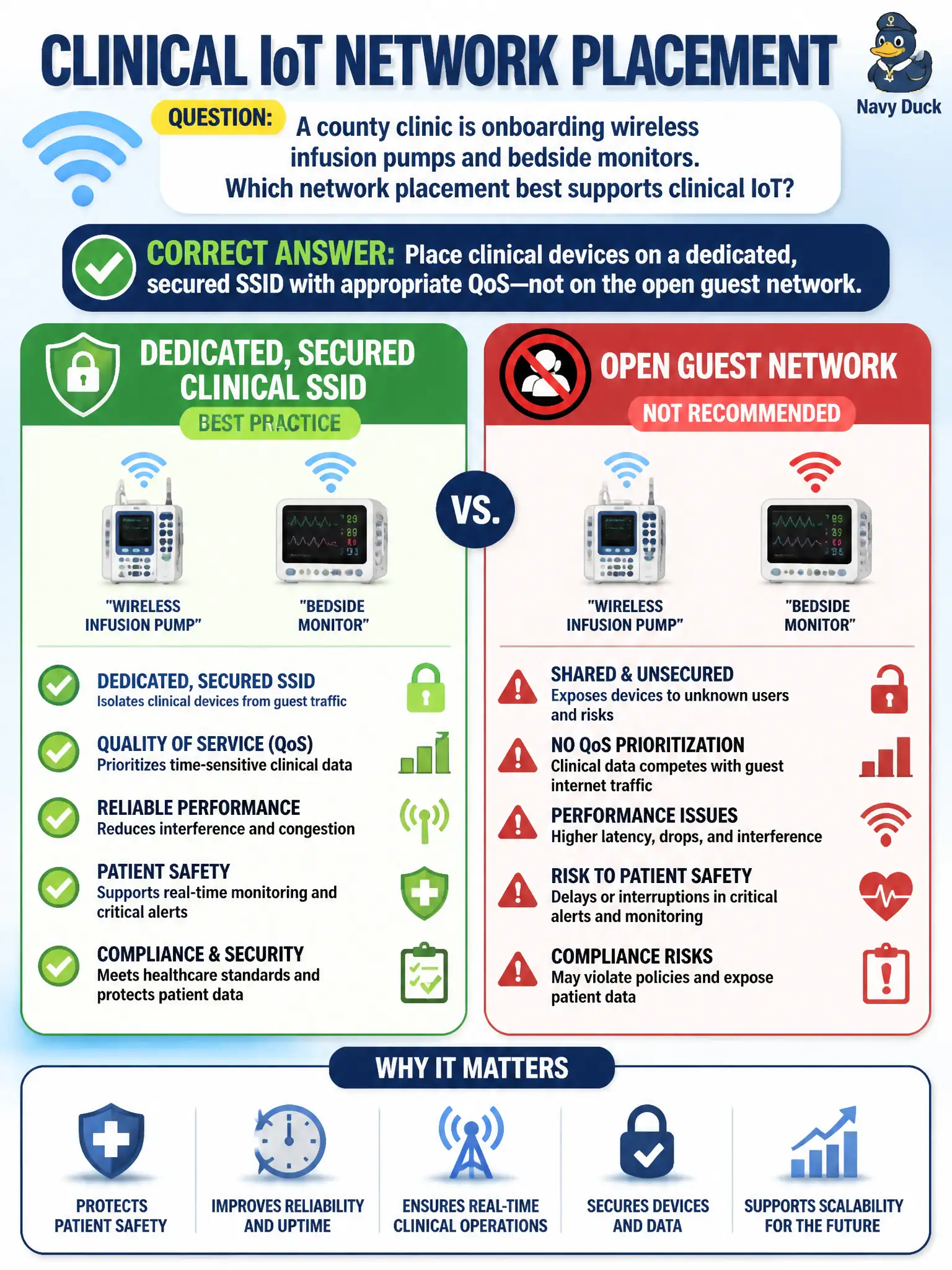
A county clinic is onboarding wireless infusion pumps and bedside monitors. Which network placement best supports clinical IoT?
Select an answer to reveal the explanation.
Short Explanation
Infusion pumps are not visitors—they should not live on guest Wi-Fi. Give clinical IoT a locked-down SSID with the QoS it needs. Captive portals and open air are for coffee shop laptops, not life-supporting gear.
Full Explanation
County clinic infusion pumps and bedside monitors belong on a dedicated, secured SSID with appropriate QoS—not on the open guest network—so clinical IoT is segmented and prioritized. Connecting pumps only to the public guest captive portal exposes care devices to guest risk and portal friction. Bridging clinical IoT into the same unrestricted VLAN as visitor tablets collapses segmentation. Turning off WPA so pumps associate faster during codes abandons encryption for a false urgency trade. Exam caveat: clinical IoT placement is a security and QoS design, not an onboarding shortcut. Operational check: provision the clinical SSID with 802.1X or approved IoT auth, QoS, and ACL isolation, then validate pump and monitor behavior during a clinic drill. In municipal WLAN and IoT operations, record the chosen control and the rejected alternatives in the change ticket so on-call staff understand which failure modes were avoided for city services. Re-validate after the next maintenance window that the same control still holds under the current platform code, device mix, and civic event calendar used by the wireless team. Keep RF, capacity, security, and QoS evidence attached to the municipal runbook entry for auditors and future CWNE-level reviews.