
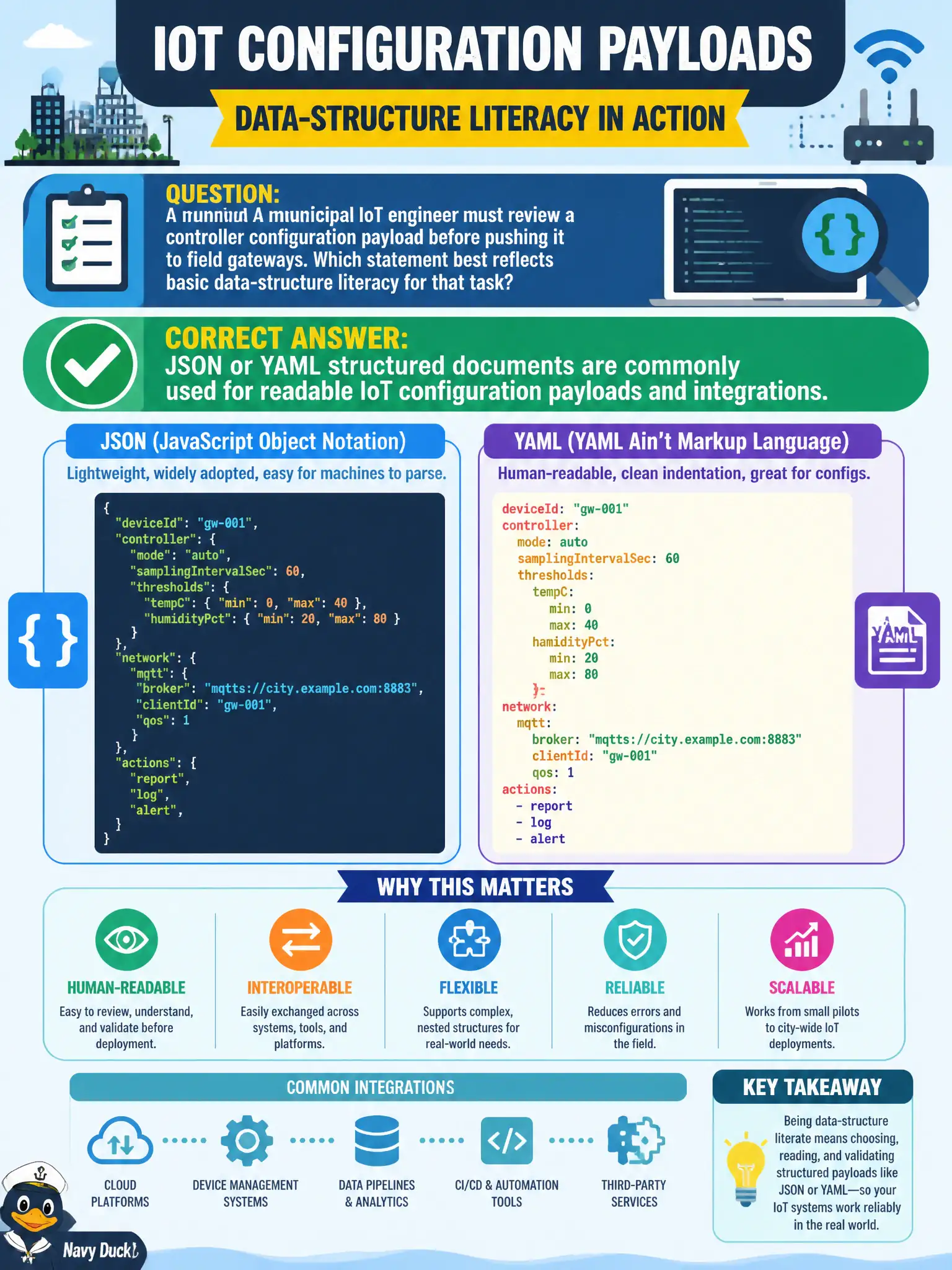
A municipal IoT engineer must review a controller configuration payload before pushing it to field gateways. Which statement best reflects basic data-structure literacy for that task?
Select an answer to reveal the explanation.
Short Explanation
Think of JSON and YAML like neatly labeled shipping manifests for settings—humans and APIs can both read them. Controllers are not shipping audio files or Morse when you push configs. Structured text is the everyday literacy for IoT integrations.
Full Explanation
Municipal IoT engineers reviewing controller configuration payloads before pushing to field gateways should expect JSON or YAML structured documents as common readable formats for configs and integrations. Controller configs are not always raw PCM audio streams. Hexadecimal packet dumps alone are not the preferred human-review format for settings. Morse code is not an enterprise gateway inventory API format. Exam caveat: basic data-structure literacy (JSON/YAML) is part of CWNE-adjacent IoT operations skill. Operational check: lint and diff JSON/YAML payloads in change review, validate against a schema, then push to a canary gateway before citywide rollout. In municipal WLAN and IoT operations, record the chosen control and the rejected alternatives in the change ticket so on-call staff understand which failure modes were avoided for city services. Re-validate after the next maintenance window that the same control still holds under the current platform code, device mix, and civic event calendar used by the wireless team. Keep RF, capacity, security, and QoS evidence attached to the municipal runbook entry for auditors and future CWNE-level reviews. Attach spectrum, capacity, security, and QoS evidence to the municipal runbook entry so auditors and future CWNE-level reviews can replay why this control was selected for city services.